



Hinomoto C142 to C174 faults and common problems: head gasket, starting and hitch
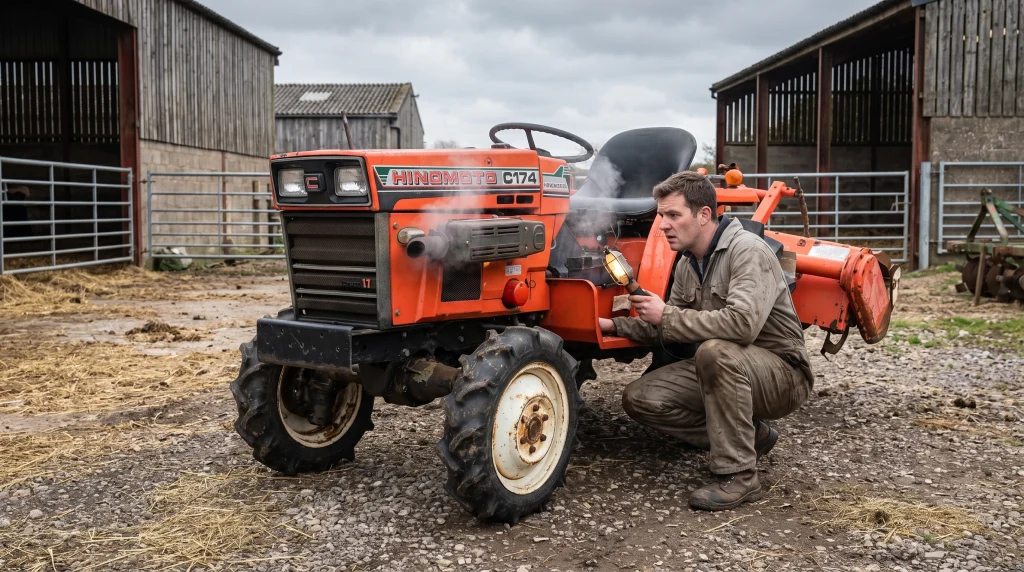
The head gasket and cylinder head are the well-known weak points of the Hinomoto C142, C144, C172, and C174. Below you will find the symptoms, causes, and approach, followed by other faults with symptoms, causes, and solutions.
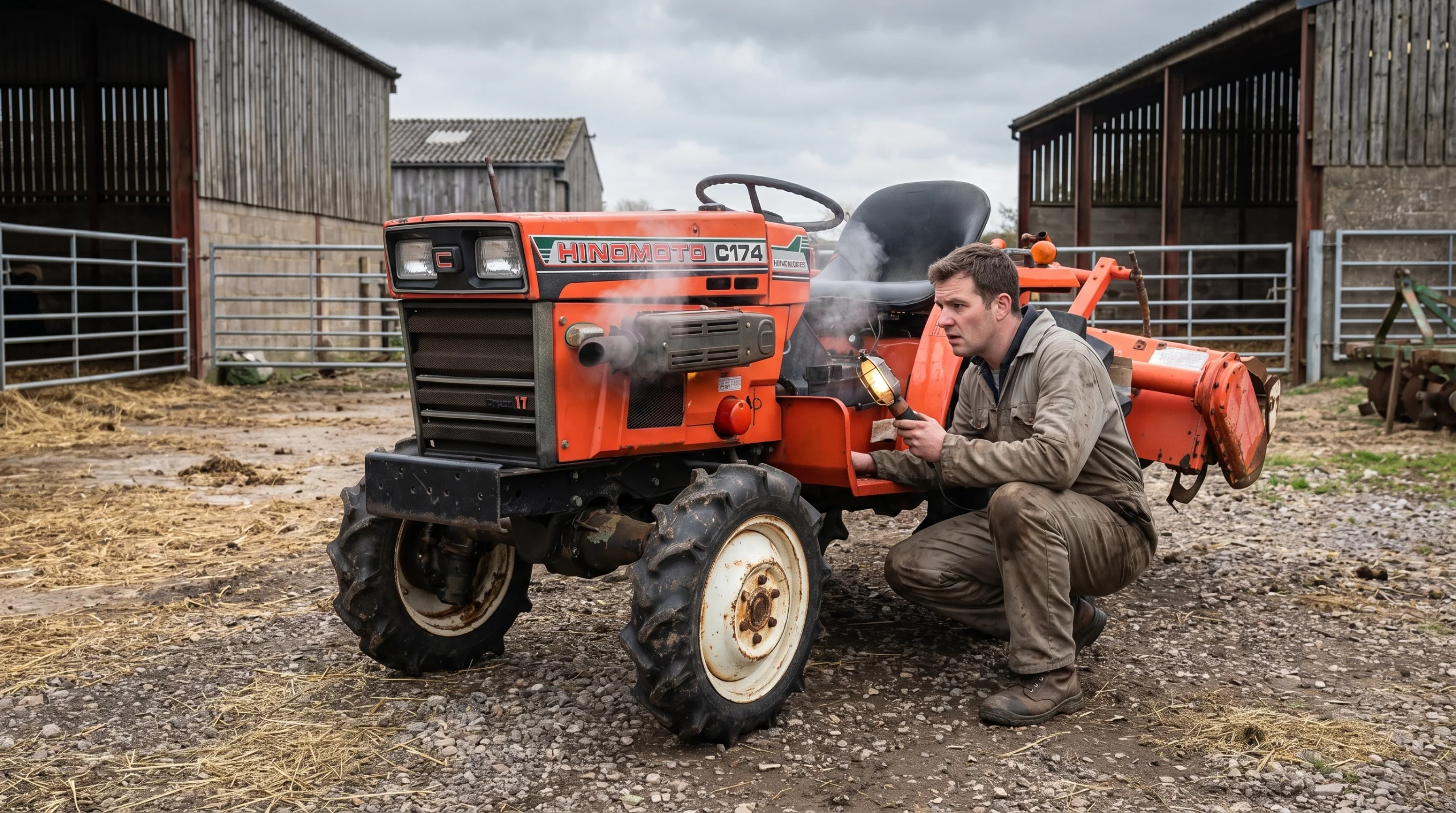
Suitable for the entire series: Hinomoto C142, C144, C172, and C174. All measured values and tightening torques in this blog come from the workshop manual and apply to the C142 and C144 (CS86). The C172 and C174 (CS100) are not listed in that manual. For the CS100, measured values and tightening torques have not been confirmed.
Table of Contents
- Hinomoto C142 to C174 head gasket and cylinder head
- Replacing the Hinomoto C142 and C144 head gasket: approach and tightening torques
- Hinomoto C142 to C174 starting and smoke
- Hinomoto C142 to C174 fuel and injection pump
- Hinomoto C142 to C174 hitch, oil, and miscellaneous
- Hinomoto C142 to C174 faults in a table
Hinomoto C142 to C174 head gasket and cylinder head
At Shop4trac, we often see that the head gasket on these Toyosha engines fails. From owners' practical experience, we know of blown head gaskets and warped and cracked heads, usually following overheating.
Symptoms
- Coolant loss without a visible leak
- Bubbles in the radiator
- Boiling over after approx. 20 minutes of work
- White smoke
- Mayonnaise under the oil cap
- Rising oil level
Causes of overheating
- Clogged radiator core, for example due to grass clippings
- Clogged cooling system or limescale
- Defective radiator cap (C142 and C144: opens at approx. 0.9 bar)
- Loose impeller in the water pump or a leaking water pump (drain hole)
- Loose V-belt (C142 and C144: 8 to 10 mm deflection)
- Stuck thermostat (C142 and C144: starts opening at 69 to 73 °C, fully open at 85 °C)
How do you know if the head is warped? A maximum of 0.05 mm is the guideline for the flatness of the head of the C142 and C144. Measure this before installing a new gasket.
Tip: first resolve the cause of the overheating. For this, there are the Water pump CS86/CS100/CS112 (SKU-292), the Thermostat (SKU-45020) , and the Radiator flush 250 ml (SKU-125007). For the C172 and C174, there is also the Radiator cap copper radiator (SKU-3231).
Replacing the Hinomoto C142 and C144 head gasket: approach and tightening torques
- First, fix the cooling system. Overheating is usually the cause of the damage.
- Check the flatness of the head: the guideline is a maximum of 0.05 mm. Do not surface grind the head. The precombustion chambers are press-fitted, which is why surface grinding the head is not recommended.
- The engine block surface may deviate by a maximum of 0.1 mm. Never remove more than 0.15 mm and check that the pistons do not protrude.
- Use the correct gasket for the engine and place it dry on clean, dry surfaces.
- Tighten the 11 cylinder head bolts (8 x M12 and 3 x M10) in two steps, from the inside out.
- Let the engine warm up and then cool down completely. Then re-torque the cylinder head bolts and check the valve clearance again. This is mandatory according to the manual.
| Bolt | Step 1 | Final torque |
|---|---|---|
| M12 (8 pieces) | 44 to 49 Nm | 88 to 98 Nm |
| M10 (3 pieces) | 20 to 25 Nm | 39 to 49 Nm |
Re-torquing is often forgotten. The valve guides are not individually replaceable: if there is too much play, you need a new head. Always install new valve stem seals. The cold valve clearance is 0.30 mm for the intake and 0.35 mm for the exhaust.
With how many Nm do you tighten the cylinder head bolts? M12: first 44 to 49 Nm, then 88 to 98 Nm. M10: first 20 to 25 Nm, then 39 to 49 Nm. This applies to the C142 and C144. For the C172 and C174, the tightening torques have not been confirmed.
The head gaskets of the CS86 and CS100 are not interchangeable because the bore is different. Choose the Head gasket CS86 C142/C144 (SKU-51) or the Head gasket CS100 C172/C174 (SKU-53). With the complete Gasket set C142-C174 (VAR-0010) , choose the version for your specific engine.
Hinomoto C142 to C174 starting and smoke
Difficult starting, white or blue smoke, misfiring. Cause: the copper sealing ring under the injector is leaking or the injector is carboned up. Test: at idle speed, slightly loosen the high-pressure lines one by one. If the engine running does not change, the fault is in that cylinder. Solution: a new Injector nozzle with sealing rings (SKU-47036-s).
Starter motor does nothing. Cause: the safety start switch on the clutch pedal, the fuse, or a corroded battery ground cable. Solution: press the pedal down completely and check the fuse and ground cable. If the starter motor itself is defective, there is the Starter motor (SKU-129025).
Difficult starting when cold. Cause: one or more defective glow plugs. Measure the resistance: for the C142 and C144, this is approx. 0.23 ohms each. Replace them with the Glow plug C142-C174 (SKU-551303-1).
Hinomoto C142 to C174 fuel and injection pump
Injection pump runs dry. The injection pump has its own crankcase and is not lubricated by the engine. If there is too little oil, the cam wears out and the output drops. After long periods of inactivity, the plungers may seize. Solution: check the oil level. The C142 and C144 take 200 ml of engine oil, and you should change it every 400 hours.
Engine stalls on a slope or when fuel is low. The fuel flows by gravity. Cause: a clogged return line, a dirty filter, or a low tank level.
Water in the diesel after long storage. Solution: drain the water at the filter bowl. Fill the tank after work to prevent condensation.
Black smoke and low power. Cause: a dirty air filter, the injectors, or the injection timing.
Hinomoto C142 to C174 hitch, oil, and miscellaneous
Hitch jerks. Cause: the pump is getting too little oil. Solution: replace the spin-on filter and the oil. There is no separate screen filter. If the tractor is cold, let it warm up first.
Oil pressure light stays on. Cause: the oil pressure switch, the oil level, the suction pipe, or the relief valve. Measure the pressure. For the C142 and C144, this is approx. 1.0 bar at 800 rpm and approx. 4.9 bar at 2700 rpm.
Japanese import. Replace the front axle oil, paying attention to water in the oil and the oil seals. The transmission oil and hydraulic filter have usually never been replaced. More on this in Japanese import compact tractor: first maintenance service.
Hinomoto C142 to C174 faults in a table
| Symptom | Cause | Solution |
|---|---|---|
| Coolant loss, bubbles, white smoke | Head gasket or head, usually after overheating | Repair cooling system, measure head, new gasket |
| Boiling over after approx. 20 minutes | Radiator core, cooling system, radiator cap, water pump, V-belt, or thermostat | Trace and repair cause |
| White or blue smoke, misfiring | Sealing ring under the injector or injector | Loosen lines one by one, replace injector |
| Injection pump runs dry | Too little oil in its own crankcase | Check level and change oil |
| Starter motor does nothing | Safety start switch, fuse, ground cable | Depress pedal completely, check fuse and ground cable |
| Difficult starting when cold | Glow plug | Measure and replace |
| Stalling on a slope or when fuel is low | Return line, filter, low tank level | Clear return line, replace filter, fill tank |
| Hitch jerks | Pump gets too little oil | Replace filter and oil |
| Black smoke, low power | Air filter, injectors, injection timing | Replace air filter, check injectors and injection timing |
| Oil pressure light stays on | Oil pressure switch, oil level, suction pipe, relief valve | Measure oil pressure |
| Water in the diesel | Long period of inactivity | Drain water at the filter bowl |