



Buying a Yanmar 2TNV70, 3TNV70 & 3TNV76: what to check before you buy
The Yanmar 2TNV70, 3TNV70 and 3TNV76 are among the most widely used small diesel engines in the world. If you're considering buying a machine with one of these Yanmar TNV engines — or a standalone engine or rebuild project — here's how to tell the three variants apart, what the real differences are, and what to check before you buy. This blog is the starting point of our complete knowledge base series on the Yanmar TNV IDI engines.
Suitable for the entire series: Yanmar 2TNV70, 3TNV70 and 3TNV76 (indirect injection TNV engines, water-cooled). The Komatsu designations 2D70E, 3D70E and 3D76E are the same engines under a different label.
Yanmar TNV: where do you find these engines?
Yanmar built the TNV IDI series as an OEM engine for dozens of equipment manufacturers. You'll find the 2TNV70, 3TNV70 and 3TNV76 in, among others, John Deere ride-on mowers and sub-compact tractors (X495, X595, X740–X748, 1026R, 2305, 2320 and the Gator series), mini excavators from Takeuchi, Hitachi, Komatsu and Wacker Neuson, wheel loaders from Kramer and Weidemann, Goldoni tractors, plate compactors and rollers from Ammann, and countless generator and pump sets. So if you buy one of these machines, you're effectively also buying this Yanmar engine — and that's good news, because parts are excellently available.
Yanmar 2TNV70, 3TNV70 and 3TNV76: the differences
The three variants look very similar — same construction, same swirl-chamber combustion (IDI), same maintenance logic — but differ significantly in cylinder count, bore and power output. The figures below come directly from the official Yanmar workshop manual.
| Specification | Yanmar 2TNV70 | Yanmar 3TNV70 | Yanmar 3TNV76 |
|---|---|---|---|
| Number of cylinders | 2 | 3 | 3 |
| Bore × stroke | 70 × 74 mm | 70 × 74 mm | 76 × 82 mm |
| Displacement | 0.570 L | 0.854 L | 1.115 L |
| Max. power (net) | 8.1–14.6 hp at 2000–3600 rpm | 9.1–21.7 hp at 1500–3600 rpm | 12.2–26.5 hp at 1500–3600 rpm |
| Continuous power | 11.1–13.3 hp | 8.3–19.7 hp | 11.1–24.1 hp |
| Engine weight (dry) | 66 kg | 83 kg | 110 kg |
| Combustion | Swirl chamber (IDI), naturally aspirated | ||
| Cooling | Liquid-cooled with radiator | ||
| Firing order | 1-2 | 1-3-2 | 1-3-2 |
| Oil pressure (rated speed) | 0.29–0.44 MPa | ||
| Starter motor | 12V / 1.0 kW | 12V / 1.0 kW | 12V / 1.1 kW |
| Alternator | 12V / 18A | 12V / 18A | 12V / 40A |
The key takeaway for you as a buyer: the 2TNV70 and 3TNV70 share the same bore and stroke (70 × 74 mm), so pistons, piston rings and cylinder liners are identical between the two — but the head gasket and gasket set are not, of course, since the 2TNV70 has two cylinders. The 3TNV76 is a fundamentally different engine with a 76 mm bore and 82 mm stroke: no parts of the crankcase or cylinder head are interchangeable with the 70 variants. So never order "by eye" — always check the engine plate.
Reading the Yanmar TNV engine plate: which variant do I have?
The engine number tells you exactly what you have. Take, for example, 3TNV76T-0 0000: the first digit is the number of cylinders (2 or 3), "TNV" is the engine series, and the number after that is the bore in millimeters (70 or 76). After the model number there's often a letter code indicating the speed rating:
| Code | Speed range | Typical use |
|---|---|---|
| VH | 3200–3600 rpm, variable | Ride-on mowers, construction and industrial machines |
| VM | 2000–3000 rpm, variable | Agricultural, construction and industrial machines |
| CH | 3000–3600 rpm, constant | 2-pole generator sets, irrigation pumps |
| CL | 1500 or 1800 rpm, constant | 4-pole generator sets, irrigation pumps |
When purchasing, and when ordering parts, always note the complete model and serial number from the engine plate. Especially with machines that span multiple production years (such as the John Deere X495/X595, which was first fitted with a 3TNE74 and later with the 3TNV76), this prevents ordering the wrong parts.
Yanmar 2TNV70, 3TNV70 & 3TNV76: strengths and weaknesses
These engines are known for being tough and fuel-efficient. The indirect injection runs smoothly and quietly compared to direct-injection engines of this size, and the block with wet cylinder liners rebuilds well. There are, however, a few points worth noting from real-world experience:
Cold starting depends on the glow plugs. An IDI engine really needs working glow plugs. If the engine starts poorly in cold weather, worn glow plugs or a faulty glow plug relay are the most common cause — a cheap and easy fix, but something to factor in during a test start.
The cooling system deserves attention. Leaking water pumps (check for traces at the weep hole under the pump shaft) and sluggish thermostats occur as the engine ages. Overheating is deadly for the head gasket and cylinder head, so check the coolant level, radiator, and whether the engine stays at temperature without overshooting. Read more about this in Yanmar TNV cooling: preventing overheating.
The stop solenoid and wiring. If the engine stalls, or conversely refuses to stop, the fuel shut-off (stop solenoid) or its wiring is a known culprit — not a reason to walk away from the purchase, but worth checking.
Fuel quality. The mechanical injection pump and injectors are sensitive to contaminated diesel. A machine that has stood idle for a long time with old fuel may have sticking injectors or a clogged fuel system.
Inspecting a Yanmar TNV engine before purchase: the checklist
| Check | What to look for |
|---|---|
| Cold start | Should start promptly after glow-plug preheating. Prolonged cranking or heavy white/blue smoke = glow plugs, compression or injectors. |
| Compression | Factory value 2TNV70/3TNV70: 3.24 ± 0.1 MPa; 3TNV76: 3.43 ± 0.1 MPa at 250 rpm. Wear limit: 2.55 and 2.75 MPa respectively. |
| Oil pressure / oil warning light | Light must go out immediately after starting. Rated 0.29–0.44 MPa at operating speed. |
| Oil and coolant | Milky oil or oil in the coolant indicates head gasket or cylinder head problems. |
| Warm exhaust smoke | Persistent blue = oil consumption (rings/guides), black under load = injectors/air filter. |
| Cooling system | Is the water pump dry? Is the radiator clean and leak-free? Is the thermostat present (not removed!)? |
| Engine plate | Note the complete engine number and verify it matches the machine documents. |
Yanmar TNV parts: excellently available
A major plus of this engine series: virtually everything is available as a quality part, often considerably cheaper than original. A selection from our range for these engines:
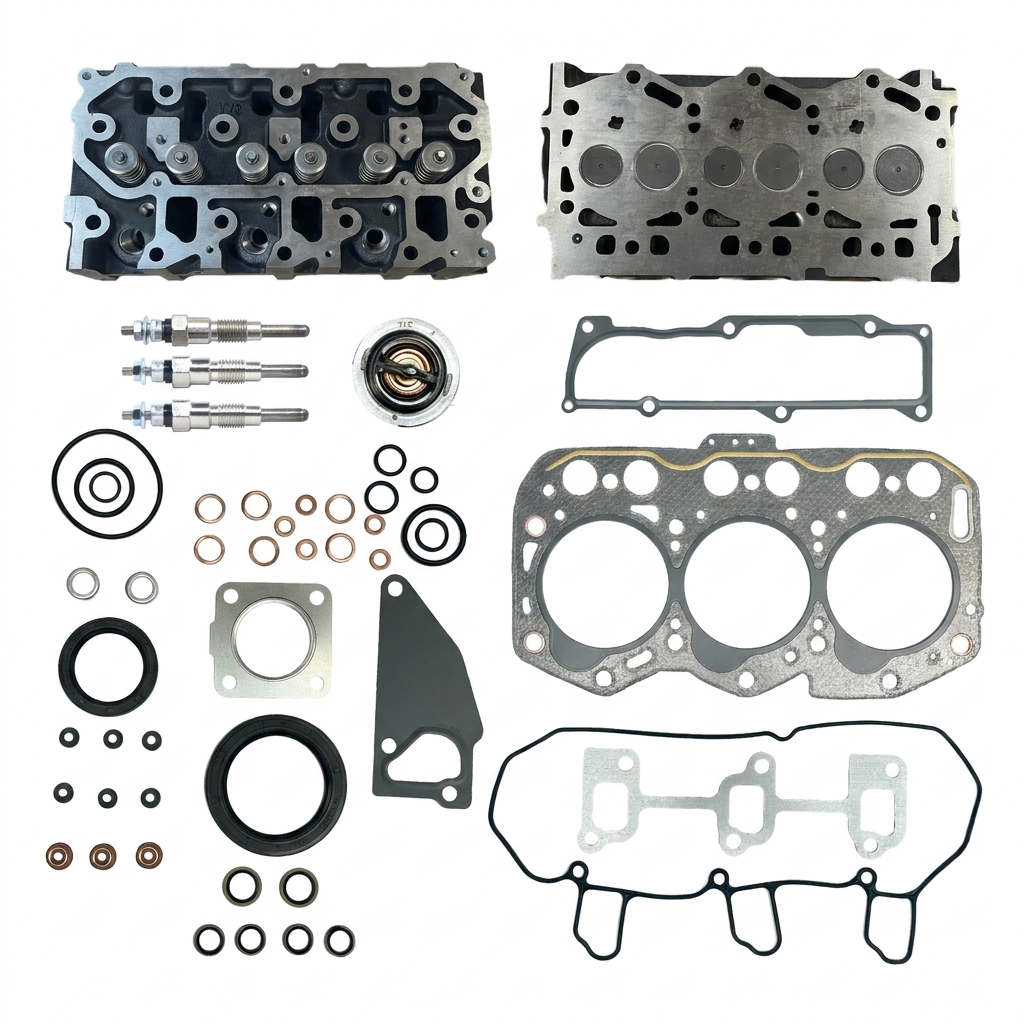
- Complete overhaul kits: overhaul kit Yanmar 3TNV76 (VAR-850047) and engine overhaul kit Yanmar 3TNV70 (SKU-850035)
- Head gaskets and gasket sets per variant: head gasket 2TNV70 (SKU-65115), head gasket 3TNV70 (SKU-65105) and head gasket 3TNV76 (SKU-65081)
- Complete cylinder heads: cylinder head 3TNV70 complete (SKU-990032) and cylinder head 3TNV76 complete with gasket set (SKU-990033)
- Cooling: water pump 2TNV70/3TNV70 (SKU-40070), water pump 3TNV76 incl. thermostat (SKU-351-T) and thermostat 3TNV70/3TNV76 (SKU-45016)
- Electrics and starting: starter motor (SKU-129044), alternator (SKU-1200013) and glow plug OEM 129155-77800 (SKU-551216)
- Maintenance: fuel filter OEM 119810-55650 (SKU-150007) and oil filter + engine oil 15W40 set (SKU-15W402/2)
Handy for a rebuild project: we also supply the original service manual for the Yanmar 2TNV70, 3TNV70 and 3TNV76 (VAR-0094) — the same workshop manual on which this blog series is based, complete with all measurement values and procedures.
Yanmar TNV knowledge base: read more
Questions about fit or unsure which variant you have? Send us the complete engine number from the engine plate — we're happy to find out for you.