



Yanmar RS-240 to RS-330: all technical specifications at a glance
Looking for the technical specifications of the Yanmar RS-240, RS-270, RS-300 or RS-330? Below you'll find all the data from the original Yanmar manual for the Forte Rice Special series: engine, dimensions, weights, travel speeds, PTO speeds, tires, and the officially measured test values per model.
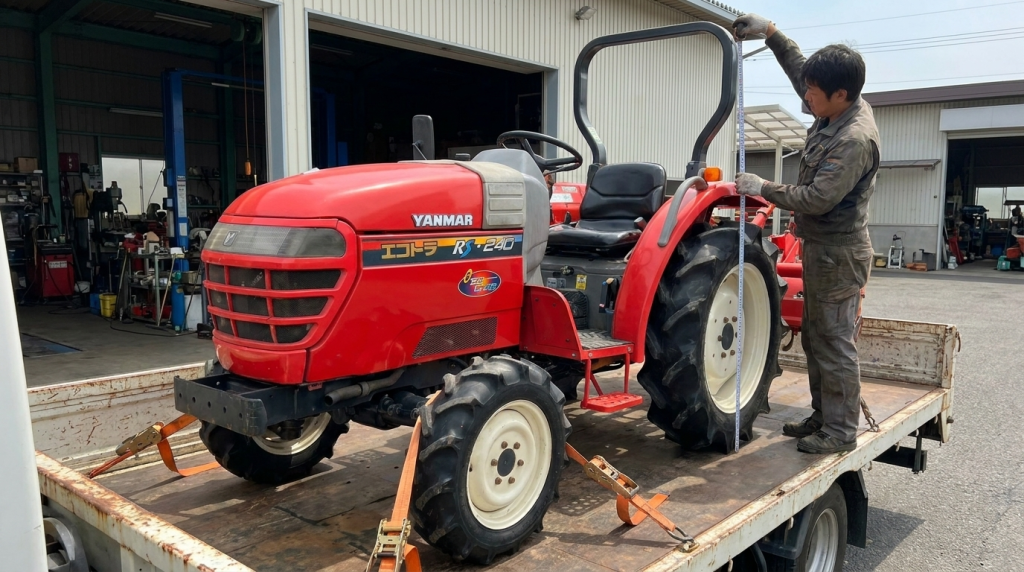
Suitable for the entire series: Yanmar Forte Rice Special RS-240, RS-270, RS-300 and RS-330 (also known as RS24, RS27, RS30 and RS33), including the R, S, J, U, V and Q variants.
Yanmar RS series: engine specifications
| Component | RS-240 | RS-270 | RS-300 | RS-330 |
|---|---|---|---|---|
| Engine type | 3TNE82-RZSN | 3TNE84-RZSB | 3TNE84-RZSA | 3TNE84-RZSN |
| Power | 24 hp (17.7 kW) @ 2600 rpm | 27 hp (19.9 kW) @ 2600 rpm | 30 hp (22.1 kW) @ 2800 rpm | 33 hp @ 2800 rpm |
| Cylinders | 3 | 3 | 3 | 3 |
| Bore × stroke | 82 × 90 mm | 84 × 90 mm | 84 × 90 mm | 84 × 90 mm |
| Displacement | 1425 cc | 1496 cc | 1496 cc | 1496 cc |
| Injection pump | Bosch-type, semi-throttle injectors | |||
| Cooling | Water cooling with radiator (5.6 l including expansion tank) | |||
| Fuel | Diesel; tank 30 l (cabin version 32 l) | |||
All engines are idle-running, indirect-injection three-cylinders with automatic glow control (glow time 1 to 3 seconds, depending on coolant temperature). The electrical system is 12 volt with a 55 Ah battery, a 40 A alternator and a 1.2 kW starter motor.
The engine in detail: Yanmar 3TNE82 and 3TNE84
The three-cylinder engines in the RS series deserve a separate section, as they're the main reason these tractors are so easy to maintain. The 3TNE family is one of Yanmar's most widely built industrial engines: Komatsu built exactly the same engine under its own name (3D84E/3D84N), and you'll also find it in John Deere compact tractors, Takeuchi and Kobelco mini-excavators, and Komatsu wheel loaders. The result for you as an owner: virtually every engine component is still readily available — from gaskets to cylinder liners.
For an overhaul or major service, the following are available, among others: the complete gasket set 3TNE82 (SKU-999001) for the RS-240 and the gasket set 3TNE84 (SKU-999002) for the RS-270 through RS-330, the individual head gasket 3TNE84 (VAR-65080) — available in metal (MLS) and graphite, note: the two are not simply interchangeable — plus piston rings 84 mm (SKU-95018), valves, connecting rod and main bearings, and cylinder liners.
Handy reference values for the injectors (for reference, verify by engine number): opening pressure approximately 19.6 MPa (196 bar) and a torque of 40–45 Nm; the injector nozzles (SKU-47002-s) fit both the 3TNE82 and the 3TNE84. The thermostat opens at 71 °C. Before ordering block-related parts, always check the engine number on the block's nameplate: the bore (82 vs 84 mm) determines what fits.
Yanmar RS series: dimensions and weights
| Component | RS-240 | RS-270 | RS-300 | RS-330 |
|---|---|---|---|---|
| Length (to lower links) | 2970 mm | 2970 mm | 2970 mm | 2970 mm |
| Width | 1310 mm | 1380 mm | 1435 mm | 1435 mm |
| Height | 1875 mm | 1900 mm | 1930 mm | 1960 mm |
| Wheelbase | 1580 mm | 1580 mm | 1580 mm | 1580 mm |
| Ground clearance | 310 mm | 325 mm | 350 mm | 370 mm |
| Weight (with 3-point linkage) | 1140 kg | 1165 kg | 1230 kg | 1250 kg |
| Front tires | 6-14 | 7-14 | 7-16 | 8-16 |
| Rear tires (hi-lug) | 9.5-24 | 11.2-24 | 12.4-24 | 12.4-26 |
The cabin version (Q) is slightly longer, wider and heavier per model; expect around 200 to 220 kg extra weight. The standard tire pressure is 1.5 kg/cm² front and 1.0 kg/cm² rear.
Yanmar RS series: transmission and travel speeds
The standard version has 12 forward and 12 reverse gears (main gear 4 × range gear 3) with a mechanical shuttle (reverser) and creep speeds from 0.5 km/h. The maximum travel speed is around 13 to 15 km/h, depending on the model. The J version (High Speed) has 16 forward and reverse gears and reaches about 22 to 25 km/h. The drivetrain is otherwise the same across all models: dry single-plate clutch, differential lock at the rear, and engageable four-wheel drive.
Yanmar RS series: power take-off (PTO)
| PTO | RS-240 / RS-270 | RS-300 / RS-330 |
|---|---|---|
| Forward speeds (3 settings) | 550 / 796 / 1270 rpm | 592 / 857 / 1367 rpm |
| Reverse speed (1 setting) | 665 rpm | 716 rpm |
| Shaft | 35 mm (JIS), clockwise (viewed from the shaft) | |
Yanmar RS series: hydraulics and lift
The three-point linkage is category JIS I with position control and electrically operated quick-lift (lever and toggle switch). The hydraulic pump delivers over 21 to 24 l/min at a system pressure of approximately 15.3 MPa; the relief valve is factory-set to 16.9 to 17.0 MPa. The practically measured lift capacity at the lower link balls is approximately 1235 to 1245 kgf (12.1–12.2 kN) — more than enough for a 160 to 180 cm rotary tiller or a flail mower. The standard Yanmar rotor supplied was per model: RSB161M (160 cm) on the RS-240, RSB171M (170 cm) on the RS-270 and RS-300, and RSB181M (180 cm) on the RS-330.
Measured test values per model
The RS series was officially certified at the time (Japanese national tractor test, 1998). The main measured values:
| Measured value | RS-270 | RS-300 | RS-330 |
|---|---|---|---|
| PTO power (max.) | 18.3 kW (24.9 hp) @ 550 rpm | 20.2 kW (27.5 hp) @ 592 rpm | 22.3 kW (30.3 hp) @ 592 rpm |
| Max. torque (converted crankshaft) | 89.3 Nm @ 1600 rpm | 88.0 Nm @ 2000 rpm | 94.4 Nm @ 1500 rpm |
| Max. drawbar pull (on concrete) | 8.92 kN (910 kgf) | 8.06 kN (822 kgf) | 9.33 kN (951 kgf) |
| Lower link lift force | 12.21 kN (1245 kgf) | 12.11 kN (1235 kgf) | 12.11 kN (1235 kgf) |
| Turning radius (with brake) | 2.06 m | 2.11 m | 2.15 m |
| Noise level (at ear) | 87 dB(A) | 87 dB(A) | 88 dB(A) |
| Static tipping angle | 39° | 40° | 39° |
No test figures for the RS-240 are included in the manual ("—"). Notable is the torque reserve: the RS-330 already has its maximum torque available at 1500 rpm, meaning it barely loses speed under load — a characteristic owners describe in practice as "unstoppable."