



Yanmar RS-240 to RS-330 Maintenance Schedule: Intervals and Adjustment Values
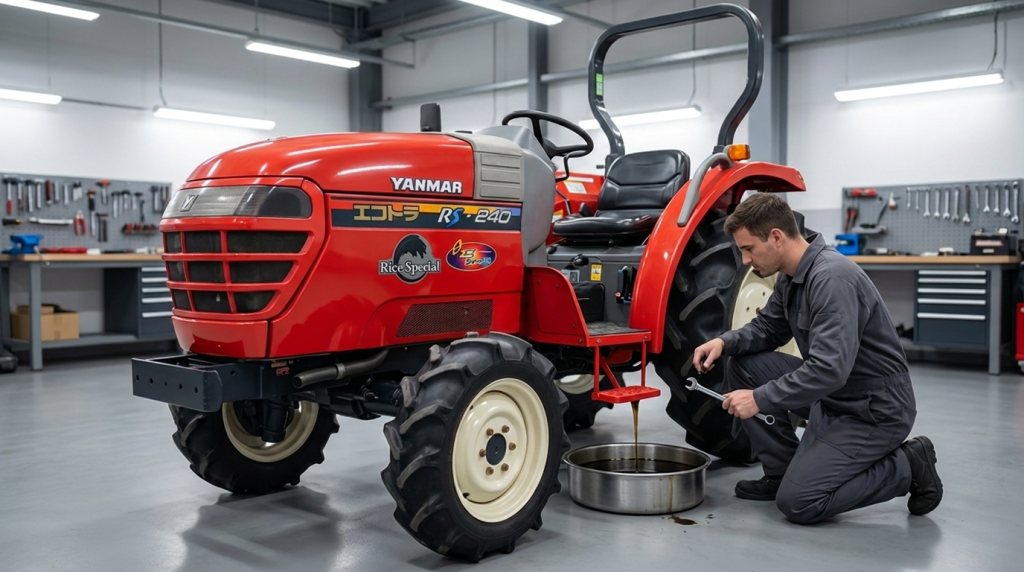
Good maintenance is the reason a Yanmar RS-240, RS-270, RS-300 or RS-330 still works daily after 25 years. In this article you'll find the complete maintenance schedule from the original manual — per hour reading — plus all adjustment values for the clutch, brakes, steering, toe-in and V-belt, so you can check and adjust everything yourself.
Suitable for the entire series: Yanmar Forte Rice Special RS-240, RS-270, RS-300 and RS-330 (also known as RS24, RS27, RS30 and RS33), including the R, S, J, U, V and Q versions.
Yanmar RS series: daily check (before each use)
The manual prescribes a short daily round: engine oil level, coolant level in the expansion tank, battery fluid between the marking lines, tire pressure and visible leaks or loose parts. If you work in straw, grass or dust, also clean the radiator screen (the removable mesh in front of the radiator) before and after work — a clogged screen is the number one cause of overheating in this series. Finally, check that the electrical wiring isn't rubbing anywhere and that there are no bits of straw on the battery or exhaust.
Yanmar RS series: maintenance schedule per hour reading
| Maintenance point | Interval (according to manual) |
|---|---|
| Change engine oil | First time after 50 hours, then every 100 hours |
| Replace engine oil filter | First time after 50 hours, then every 300 hours (or every 2–3 oil changes) |
| Check transmission oil (also hydraulic/steering oil) | Every 50 hours; change first time after 50 hours, then every 300 hours |
| Replace line filter (transmission oil filter) | First time after 50 hours, then every 300 hours |
| Check / change front axle oil | Check every 50 hours; change every 300 hours |
| Clean oil strainer (screen) in the transmission | With every oil change (50/300/600 hours) |
| Fuel filter/strainer cleaning — element replacement | Clean every 100 hours; replace element every 300 hours |
| Clean / replace air filter element | Normal: clean every 100 hours, replace every 1000 hours; dusty work: clean every 50 hours, replace every 400 hours; replace at least once a year |
| Clean radiator screen and cooling fins | Every 50 hours (with straw/dust: every working day) |
| Check / replace coolant | Check daily; replace once a year, including flushing the radiator |
| Battery fluid / specific gravity + top-up | Fluid daily; density and charge every 100 hours |
| Lubricate (brake pedal shaft, clutch shaft, front axle center pin) | Every 50 hours, and always after working in wet land or mud |
| Check V-belt (cooling fan) | Every 50–100 hours; check new belt again after 50 hours |
| Check fuel lines and clamps | Every 50 hours; replace every 2 years |
| Radiator hoses and power steering hoses | Check daily; replace every 2 years |
| Check electrical wiring | Every 50 hours or once a year |
| Check steering ball joints and important bolts | Every 100 hours |
| Have valve clearance and injectors checked | Every 600 hours (workshop) |
Why that first 50-hour interval? With a fresh overhaul or a newly fitted belt or filter, most of the dirt and stretch is released in the first hours of operation. That's why Yanmar has you replace or readjust almost everything for the first time after 50 hours, and only then switch to the longer interval. If you run few hours per year, stick to the yearly limit: coolant and air filter element annually, hoses and fuel lines every two years — even if the hour meter is low.
Yanmar RS series: adjustment values
These values come directly from the manual and you can check them yourself with simple tools:
| Adjustment point | Value | Adjust via |
|---|---|---|
| Clutch pedal play | 20 – 30 mm | Turnbuckle under the footboard; check locknut |
| Brake pedal play (left = right!) | 20 – 30 mm | Turnbuckle per pedal, behind the brake pedals |
| Steering wheel play | 20 – 50 mm | If deviating: workshop (fully hydraulic steering) |
| Front wheel toe-in | 0 – 5 mm (A−B ± 5 mm) | Tie rod ends; tighten locknuts |
| V-belt deflection | 10 – 15 mm under thumb pressure | Tilt alternator (loosen mounting bolt) |
| Tire pressure | 1.5 kg/cm² front / 1.0 kg/cm² rear | — |
| Front wheel bolts | RS-240/270: 6.7–8.5 kgm · RS-300/330: 16–19.6 kgm | Torque wrench |
| Rear wheel bolts | 16 – 19.6 kgm (all models) | Torque wrench |
| Rim/ring bolts rear wheel (RS-270/300/330) | 34 – 37 kgm; marking lines must be aligned | Torque wrench + set new marking |
Two points deserve extra attention. First, the brake play: if it's unequal left and right, the tractor brakes unevenly — downright dangerous on the road. After adjusting, also check that the parking brake still holds when you fully press the pedal. Second, the V-belt: if you can swing the alternator all the way out and the belt still slips, it's worn and needs replacing — check it again after 50 hours.
Exhaust color as a health check
Handy rule of thumb from the manual: when starting, the RS may briefly emit a little black smoke, after which the exhaust should be colorless. Persistent black smoke indicates a mixture that's too rich or a clogged air filter; white smoke means engine oil is being burned along with it (or just water vapor in cold weather). If the engine smokes black or white even without load, have it checked.