



Mitsubishi K3A–K3F fuel, injection and starting
{"@context":"https://schema.org","@type":"FAQPage","mainEntity":[{"@type":"Question","name":"What is the injector opening pressure of the Mitsubishi K3?","acceptedAnswer":{"@type":"Answer","text":"160 kg/cm2 (approximately 2276 psi) for the throttle-type injector of the swirl chamber versions."}},{"@type":"Question","name":"Why does my Mitsubishi K3 start with difficulty?","acceptedAnswer":{"@type":"Answer","text":"Usually due to insufficient preheating or faulty glow plugs, air or dirt in the fuel, or low compression. Diagnose in that order: first glow plugs, then fuel, then compression."}}]}
A Mitsubishi K3 that starts poorly or runs erratically is almost always related to fuel or injection. Air in the system, a clogged filter or a worn injector are the usual suspects. In this blog you'll learn how the K3's fuel and injection system works, what values the manual specifies, and how to get it running smoothly and keep it that way.
Suitable for the entire series: K3A, K3B, K3C, K3D, K3E, K3F, K3H and K3M.
How the Mitsubishi K3 fuel system works
The K3 uses a Bosch M-type injection pump with a centrifugal flyweight governor. Fuel flows through a paper fuel filter to the pump, which supplies an injector for each cylinder. The swirl chamber versions (K3A through K3E) have a throttle-type injector; the direct injection versions (K3C through K3F) have a hole-type injector with a combustion bowl in the piston. This difference determines which injector fits — never swap them.
| Item | Value |
|---|---|
| Injection pump | Bosch M-type |
| Governor | Centrifugal flyweight |
| Swirl chamber injector (IDI) | Throttle-type ND-DN4SD24 |
| Direct injection injector (DI) | Hole-type (multi-hole) |
| Injector opening pressure | 160 kg/cm² (± 2276 psi) |
| Injection order | 1-3-2 |
| Injection timing (depending on version) | 19° or 23° before TDC |
| Injector holder tightening torque (housing/lock nut) | 6–8 kg-m (59–78 Nm) |
| Delivery valve holder tightening torque | 4–5 kg-m (39–49 Nm) |
Getting the Mitsubishi K3 to start well
The K3 is an indirect (or direct) injection diesel with glow plugs. A healthy, well-maintained engine starts easily when cold and burns clean within a few seconds. For reliable starting:
- Preheat. Turn the ignition to the glow position and let the glow plugs warm up before starting. The colder it is, the longer you should preheat; in freezing weather you'll need noticeably more preheating time than on a warm day. If starting is difficult, check whether the glow plugs and glow plug relay are working.
- Clean fuel. Use fresh, clean diesel and maintain the fuel filter on schedule (clean every 100 hours, replace element every 400 hours). Water or dirt in the fuel is disastrous for the injection pump and injectors.
- Bleed after filter work. If you've had the filter or lines off, bleed the system before starting — air in the line is the most common cause of "won't start after maintenance".
- Healthy compression. If it still won't start easily despite good preheating and fuel, check the compression (standard 32 kg/cm² at 280 rpm, service limit around 22 kg/cm²). Low compression points to valves, piston rings or the cylinder head.
Mitsubishi K3 injectors and injection
Injectors wear over time: the spray pattern deteriorates, causing soot, vibration and higher fuel consumption. The manual specifies checking the injectors every 400 hours and maintaining the opening pressure at 160 kg/cm². Have injectors tested and adjusted, or replace the nozzle. When ordering, pay close attention to DI or IDI and the spray angle — the wrong nozzle causes soot formation and a rough-running engine.
Fuel and injection sorted:
- Complete injector (genuine Mitsubishi) K3B/K3D/K3E (SKU-47023-s) — ready to install with holder.
- Direct injection nozzle K3D/K3E/K3F (SKU-47003-s, DLLA155P15) — includes seal kit. Check your old nozzle number for the spray angle.
- K3 filter set with fuel filter (SKU-100149).
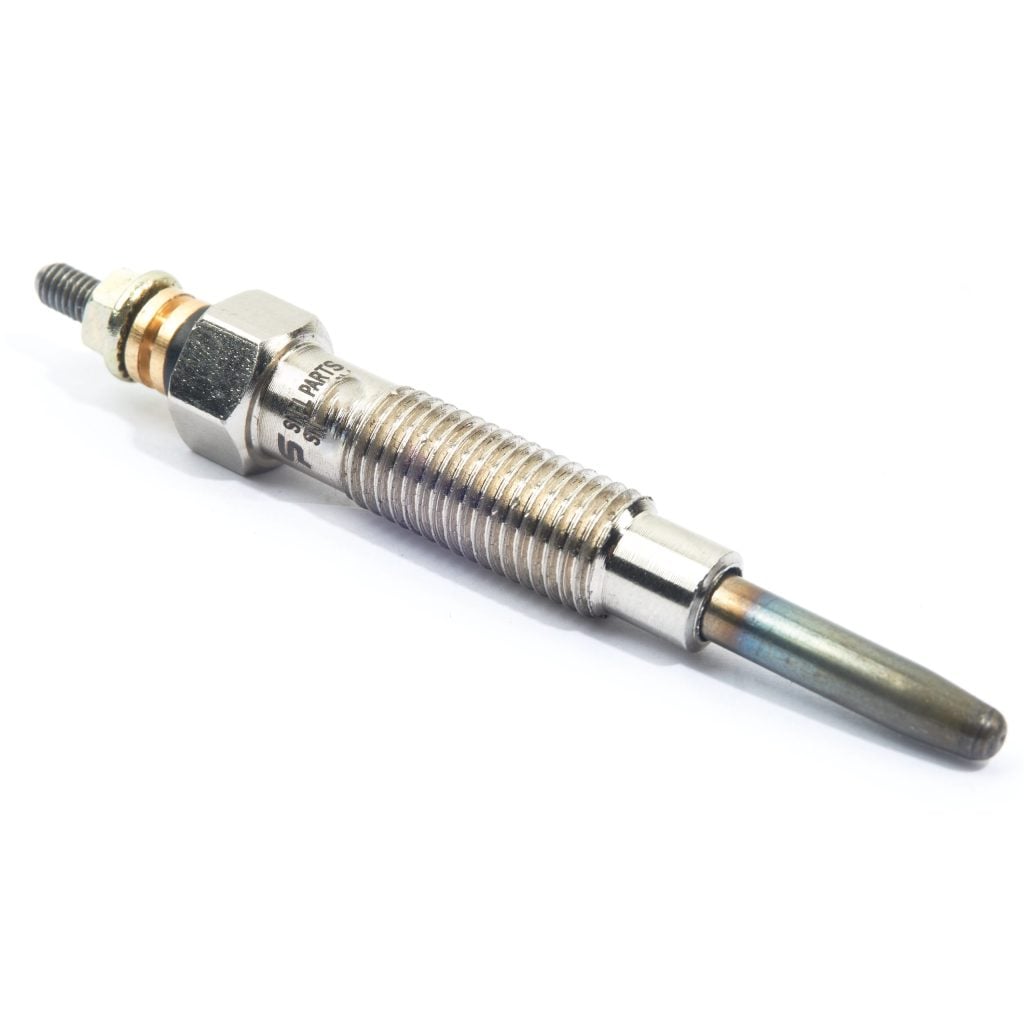
- Glow plug K3 series (SKU-55808) — for easy cold starting.
- Fuel feed pump K3B/K3E (SKU-56011) — mechanical feed pump.