



Buying a Mitsubishi L2A, L2C, L2E, L3A, L3C and L3E: purchasing advice
Thinking about a compact machine or mini tractor with a Mitsubishi L3E or L2E underneath, or do you already have one and wonder if it's the right one? Then you're in the right place. The Mitsubishi L-series is one of the most widely used small diesel engines in mini tractors, horticultural machinery, generators, sweepers and loaders, and even marine applications. Precisely because it powers so many brands, buyers often don't know exactly what they have under the hood. In this first blog, we explain how to identify the model, what the real differences are between the two-cylinder L2E and the three-cylinder L3E, and what to watch out for before you spend your money.
Suitable for the entire series: Mitsubishi L2A, L2C, L2E, L3A, L3C and L3E (including the later L3E2 and MVL3E versions). You'll find the L-series in, among others, Iseki TU / Landhope, Shibaura, Solé Diesel, Vetus, Casalini, Pel-Job, Farmtrac, Terex and Kobelco.
Mitsubishi L2E and L3E: what exactly is it?
The L-series is a family of light, water-cooled four-stroke diesel engines with overhead valves and a swirl chamber (indirect injection). Water-cooled is important to remember: these engines have a real water pump, thermostat, radiator and fan, not air cooling. That makes them quiet and relatively smooth-running, but it also means you need to thoroughly check the cooling system when buying one.
The engine owes its long life to a simple, solid design: cast-iron block and head, a Bosch-type injection pump, closed-type glow plugs for starting, and a compression ratio of 23:1. Nothing exotic, and that's exactly why the L-series lasts so long and why parts are still readily available.
How to read the type designation
The name tells you exactly what you have. Take the L3E:
| Character | Meaning |
|---|---|
| L | Series name (L = lightweight engine) |
| 2 or 3 | Number of cylinders (2 = two-cylinder, 3 = three-cylinder) |
| A / C / E | Cylinder bore: A = 65 mm, C = 70 mm, E = 76 mm |
The machine usually also has an application and version code after it (for example, 11 for agriculture, 31 for industry, 61 for export). The engine number and displacement are stamped on the block, on the injection pump side. Wipe it clean and write it down: you'll need that number later to order the correct parts.
Why this matters: the bore size (that last letter) determines which pistons and head gasket fit. An L3E (76 mm) and an L3C (70 mm) look similar, but their pistons and gaskets are not interchangeable. So always order based on the full type designation, not just "L3".
Mitsubishi L2E versus L3E: the real differences
Both engines come from the same family and share the same bore (76 mm) and stroke (70 mm). The difference lies in the number of cylinders, which affects displacement, weight, power and maintenance.
| Specification | L2E | L3E |
|---|---|---|
| Number of cylinders | 2 | 3 |
| Bore × stroke | 76 × 70 mm | 76 × 70 mm |
| Displacement | 0.635 l | 0.952 l |
| Compression ratio | 23:1 | 23:1 |
| Firing order | 1 – 2 | 1 – 3 – 2 |
| Dry weight | approx. 61 kg | approx. 75 kg |
| Engine oil (full/empty, excl. filter 0.5 l) | 2.4 / 1.4 l | 3.0–4.8 / 1.5–3.0 l |
| Coolant (engine itself) | 1.2 l | 1.8 l |
| Battery (depending on application) | 12 V, 45 Ah or more | 12 V, 60 Ah or more |
| Power (indicative) | approx. 11–16 hp | approx. 15–18 hp in tractors, up to ~33 hp in marine applications |
The power output isn't listed in the workshop manual and depends heavily on the application and RPM; these figures are indicative. You can find the exact power rating on the type plate or in the owner's manual of your machine. In practice, you choose the L2E for a light, compact machine where reliability and low fuel consumption are the priority. The L3E runs more smoothly, has more low-end torque, and is the logical choice as soon as you're powering heavier implements or need continuous power. Note: more cylinders also means slightly more oil, a larger battery, and three injectors instead of two to maintain.
What to watch out for when buying
A well-maintained L-series engine will last a very long time. But because these engines are often found in older grey-import machines, it pays to check a few things before buying.
Cooling system (since it's water-cooled)
Check the coolant: brown sludge or oil in the coolant indicates a leaking head gasket or a cracked head. Check that the water pump isn't leaking, that the thermostat works, and that the radiator isn't partially clogged. Overheating is the number one killer of these engines.
Compression and smoke
A healthy L-series engine starts promptly after glow-plug preheating and barely smokes once warmed up. Persistent blue smoke indicates oil consumption, white smoke points to coolant or an injection problem, and black smoke suggests a tuning or air filter issue. If it runs unevenly, a weak cylinder (injector or valve) could be the cause in an L3E.
Starting and preheating
Poor cold starting is often due to worn glow plugs, a weak battery, or air in the fuel system — usually cheap to fix. Don't be put off by a difficult cold start if everything else is fine.
Engine number and origin
Note the engine number stamped on the injection pump side of the block. With grey imports, the type plate sometimes doesn't match the actual block; with the engine number and bore size, you'll know for sure which parts fit.
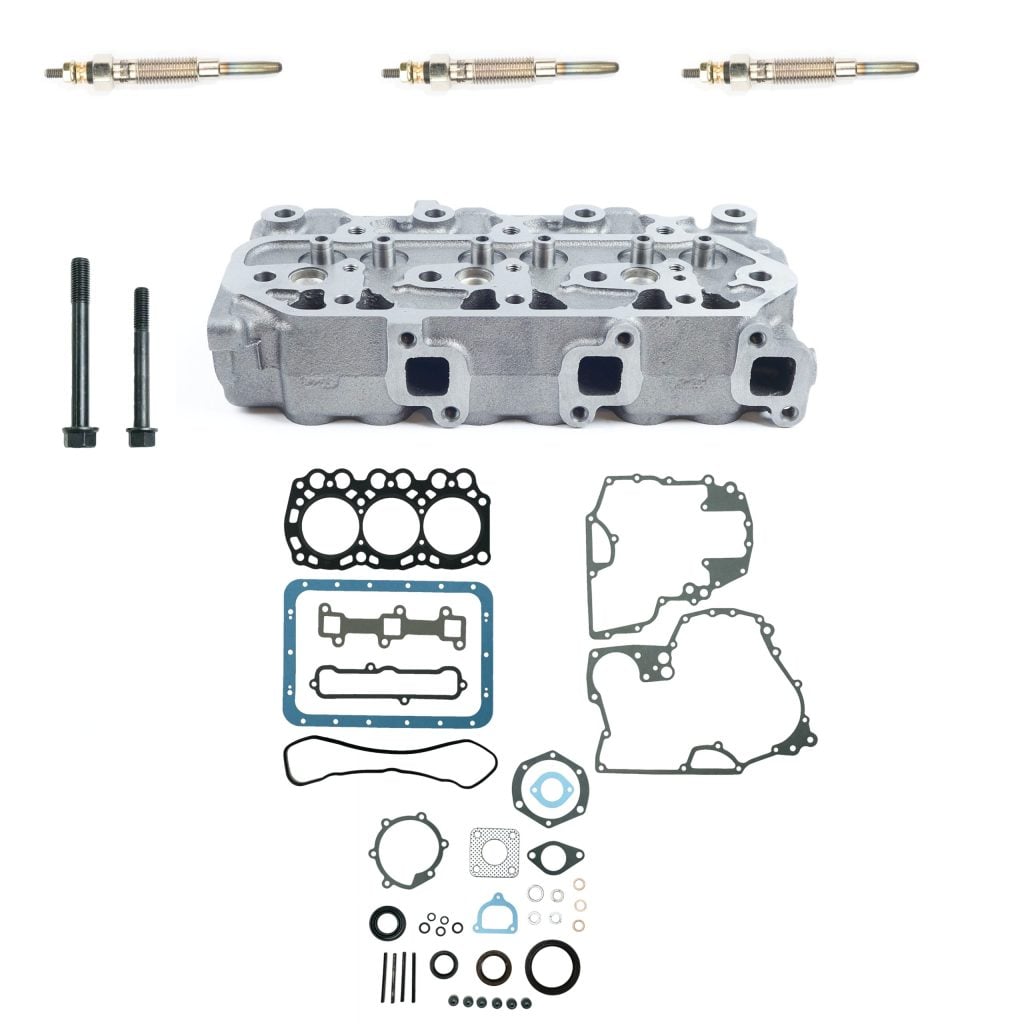
Get it running again with: L2E head gasket or the complete L3E gasket set, the L3E engine overhaul kit, injectors, fuel lift pump, water pump and engine oil filter. Always order based on your full type designation and bore size, since the L3E (76 mm) and L3C (70 mm) don't share pistons or a head gasket.
Frequently asked questions
Is the Mitsubishi L2E or L3E air-cooled or water-cooled?
Water-cooled. The L-series has a water pump, thermostat, radiator and fan. So be sure to check the complete cooling system when buying.
What is the difference between an L3E and an L3C?
The number of cylinders is the same (three), but the bore differs: the L3E is 76 mm, the L3C is 70 mm. As a result, pistons and head gaskets are not interchangeable. The last letter in the type code indicates the bore.
Where can I find the engine number?
The engine number and displacement are stamped on the block, on the injection pump side. Write down this number before ordering parts.
{"@context":"https://schema.org","@type":"FAQPage","mainEntity":[{"@type":"Question","name":"Is de Mitsubishi L2E of L3E lucht- of watergekoeld?","acceptedAnswer":{"@type":"Answer","text":"Watergekoeld. De L-serie heeft een waterpomp, thermostaat, radiateur en ventilator. Controleer bij aankoop dus het complete koelsysteem."}},{"@type":"Question","name":"Wat is het verschil tussen een L3E en een L3C?","acceptedAnswer":{"@type":"Answer","text":"Het aantal cilinders is gelijk (drie), maar de boring verschilt: L3E is 76 mm, L3C is 70 mm. Daardoor zijn zuigers en koppakking niet uitwisselbaar."}},{"@type":"Question","name":"Waar vind ik het motornummer?","acceptedAnswer":{"@type":"Answer","text":"Het motornummer en de cilinderinhoud staan ingeslagen op het blok, aan de kant van de inspuitpomp. Noteer dit nummer voordat je onderdelen bestelt."}}]}