



Storing and Winterizing the Yanmar Ke Series: The Complete Step-by-Step Plan
A Yanmar Ke-1, Ke-1D, Ke-2D or Ke-3D sits idle for many owners for months between seasons. With the correct storage procedure — taken directly from the factory manual — you'll start your Yanmar Ke series tractor in spring without any hassle, and prevent rust, a dead battery, and clogged fuel lines.
Suitable for the entire series: Yanmar Ke-1, Ke-1D, Ke-2D and Ke-3D.
After every workday: small maintenance tasks that win the winter
Wash the tractor clean the same day, dry it thoroughly, and then grease the lubrication points and hinge joints. When washing, keep water away from the electrical components and the air filter. Doing this consistently means there's hardly any work left when it's time for storage.
Winterizing the Yanmar Ke Series: step by step
- Remove the key and turn the ignition to "stop"; store the key separately.
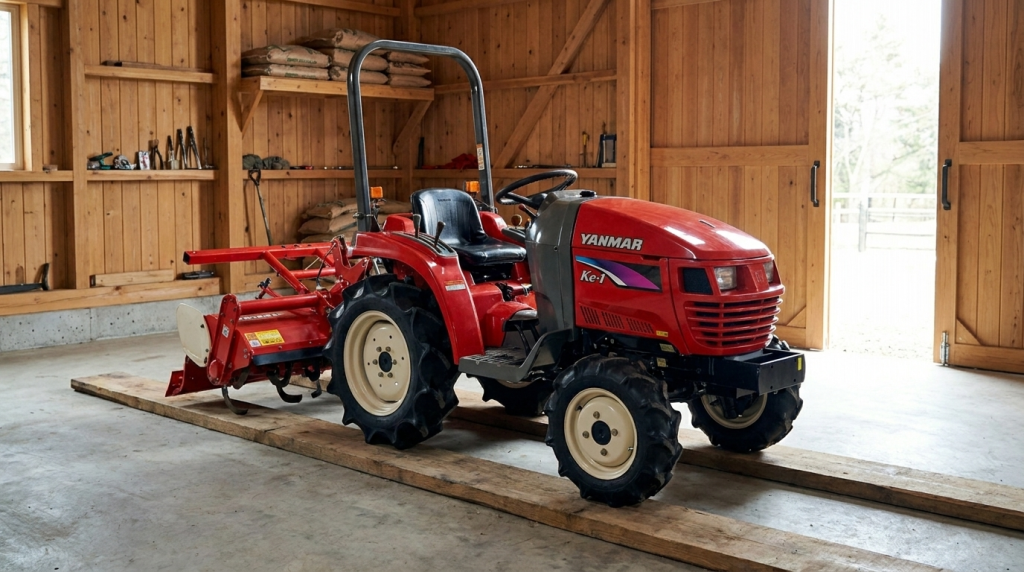
- Store in a dry, ventilated location. Remove the wheel weights and detach the tiller from the tractor, or let it rest lowered on a board so the blades aren't touching the ground.
- Protecting bare metal: coat rust-prone parts (lift arms, cylinder and shaft components) with rust-inhibiting oil or grease.
- Fill the tank completely to prevent condensation, and close the fuel valve ("C"). A half-empty tank is the main source of water in the fuel — and thus of starting problems come spring.
- Fully charge the battery and disconnect it. Preferably remove the battery from the machine and store it somewhere cool, dry and dark; if it stays in the machine, at least disconnect the negative terminal. A battery discharges on its own — recharge it every month.
- Cooling system: drain the coolant, or — more practical in our climate — refresh it before winter with a fresh LLC mixture containing sufficient antifreeze. Never go into frost with just water.
- Cover the openings: seal off the exhaust, air intake and oil filler opening (for example with a plastic bag and elastic band) to prevent moisture and pests from entering the engine.
- Inflate the tires to the correct pressure, so they don't deform during standstill.
Starting up again after storage
- Remove all covers from the exhaust, intake and filler opening — don't forget this, otherwise the engine won't be able to draw in air.
- Connect the fully charged battery (positive first, then negative) and open the fuel valve.
- Check all fluid levels: engine oil, transmission oil, front axle oil (4WD) and coolant.
- Check the tire pressure and the V-belt (10–15 mm deflection).
- Preheat, start, and let the machine warm up gently before the first load — in cold weather, follow the warm-up table from our operating article.
- If a major service is scheduled (the 100- or 300-hour mark), spring is the ideal time: see the complete maintenance schedule.
🔧 Parts tip from Shop4trac
- Glow plug Yanmar 3TN63 / 3TN66 / 3TNE68 (SKU-551216) — if it struggles to start after winter, the glow plugs are suspect number one.
- We'll look up the right filters for the spring service by engine code for you — just send a photo of the type plate.