



Iseki TU1400-TU1601: buying advice & difference between the 00 and 01 series
Iseki TU1400-TU1601: which mini tractor should you buy?
The Iseki TU series has been a trusted name in the Dutch and Belgian gardening and hobby farming world for decades. Small, sturdy, and easy to maintain. In this article, we compare the two generations side by side: the TU1400, TU1500 and TU1600 (hereafter the "00 series") and their successors the TU1401, TU1501 and TU1601 (the "01 series"). We provide buying advice for each model, including indicative second-hand prices, and explain exactly what has changed between the generations.
Suitable for the entire series: Iseki TU1400, TU1400F, TU1500, TU1500F, TU1600, TU1600F (00 series) and Iseki TU1401, TU1401F, TU1501, TU1501F, TU1601, TU1601F (01 series). The F version is always the 4WD version.
Main conclusion upfront
Anyone torn between a 00 series and an 01 series can breathe a sigh of relief: the engine has been carried over unchanged per cylinder class between both generations. The TU1400 and TU1401 share the same Mitsubishi K3A (776cc), the TU1500 and TU1501 share the K3B (849cc), and the TU1600 and TU1601 share the K3C (900cc). Parts such as the cylinder head gasket, water pump, V-belt, and exhaust manifold are therefore largely interchangeable 1-to-1 between the generations within the same cylinder class. What has changed is mainly in the drivetrain and adjustability — more on that below.
Iseki TU1400 (00 series): buying advice
| Version | 2WD (TU1400) or 4WD (TU1400F) |
|---|---|
| Engine | Mitsubishi K3A, 776cc, 3 cylinder, 14 hp / 2600 rpm |
| Weight | 490 kg (2WD) / 520 kg (4WD) |
| Indicative second-hand price | approx. €2,500 – €4,500, depending on hours, condition, and attachments |
The entry-level model of the series. Compact and light, with the smallest engine block (65 mm bore). A great choice for light soil cultivation, a small rotary harrow, or lawn maintenance on a small plot. When buying, check the condition of the clutch (dry single-plate diaphragm clutch) and for leaks around the cylinder head gasket — on a 776cc block, this is by far the most expensive part to replace if it fails.
Iseki TU1500 (00 series): buying advice
| Version | 2WD (TU1500) or 4WD (TU1500F) |
|---|---|
| Engine | Mitsubishi K3B, 849cc, 3 cylinder, 14.9 hp / 2600 rpm |
| Weight | 515 kg (2WD) / 555 kg (4WD) |
| Indicative second-hand price | approx. €3,000 – €6,200, depending on hours, condition, and attachments |
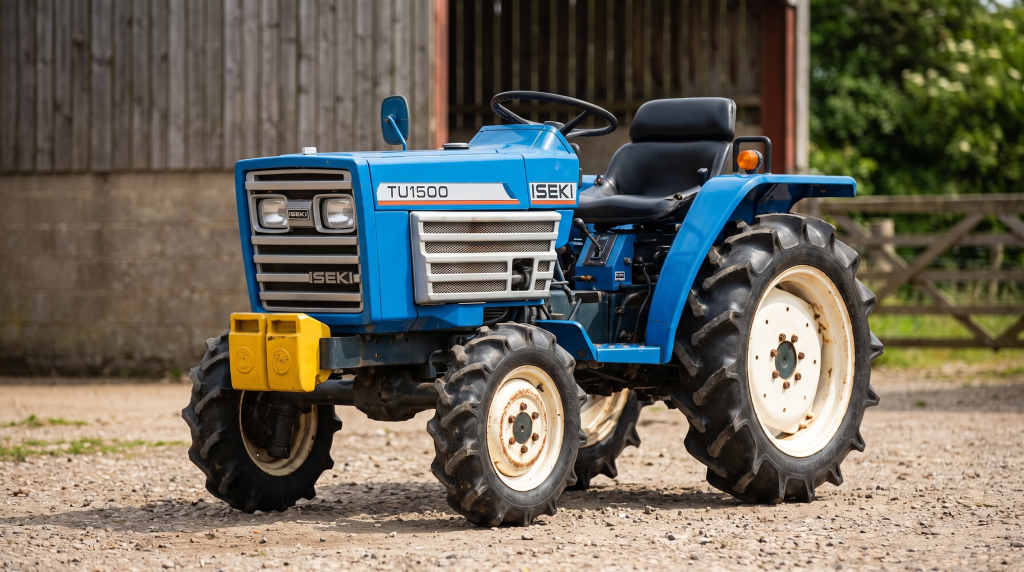
The mid-range model of the series and in practice the most frequently traded: we recently found listings in the United Kingdom (approx. 543 running hours) priced around €7,000 and an example in France around €3,950. So expect a wide price range — hours and the condition of the hydraulics/lift weigh most heavily on the asking price.
Iseki TU1600 (00 series): buying advice
| Version | 2WD (TU1600) or 4WD (TU1600F) |
|---|---|
| Engine | Mitsubishi K3C, 900cc, 3 cylinder, 16.5 hp / 2600 rpm |
| Weight | 530 kg (2WD) / 560 kg (4WD) |
| Indicative second-hand price | approx. €3,200 – €6,500, depending on hours, condition, and attachments |
The most powerful model of the 00 series, with the largest bore (70 mm) of the three. Ideal if you need just a bit more pulling power for a front loader or a heavier rotary harrow, without moving into an entirely different weight class.
Iseki TU1401, TU1501 and TU1601 (01 series): what has changed?
The successor series therefore shares the engines of the 00 series but has received a noticeable update in several areas. The table below compares the three pairs side by side.
| Component | TU1400 ↔ TU1401 | TU1500 ↔ TU1501 | TU1600 ↔ TU1601 |
|---|---|---|---|
| Engine | Unchanged per pair: K3A / K3B / K3C (same displacement, bore, and power) | ||
| Transmission | 00 series: "selective sliding" only. 01 series: a combination of "constant mesh" and sliding gear — this shifts noticeably smoother and with less gear wear. | ||
| Driving speed (top gear) | 12.3 km/h (2WD) / 13.6 km/h (4WD) → 11.40 km/h |
13.6 km/h → 12.60 km/h |
13.6 km/h → 12.60 km/h |
| Front track width | fixed: 700 mm (2WD) / 770 mm (4WD) → adjustable, 2 settings: 700 or 800 mm |
fixed: 700 / 770 mm → adjustable, 2 settings: 700 or 800 mm |
fixed: 700 / 770 mm → adjustable, 2 settings: 700 or 800 mm |
| Rear track width | not specified as adjustable → adjustable, 2 settings: 790 or 920 mm |
continuously variable 800–912 mm → adjustable, 2 settings: 800 or 910 mm |
continuously variable 800–912 mm → adjustable, 2 settings: 800 or 910 mm |
| Weight | 490/520 kg → 510/540 kg (+ K version: 530/555 kg) | 515/555 kg → 525/560 kg | 530/560 kg → 530/565 kg |
| Minimum turning circle | not stated in the 00 series manual | 01 series: 1.83 m (TU1401) / 1.89 m (TU1501, TU1601), with brake | |
| Versions | The TU1401 also has a slightly longer "K" version (2105 mm instead of 2080 mm, +20-25 kg) | no additional version | no additional version |
| Options (factory) | 01 series explicitly specifies as options: creep gear, auto rotary clutch, weights, tow hitch, and 3-point lift (JIS category 0) | ||
In short: the 01 series is the same engine in a slightly refined chassis. The main reason to prefer an 01 series is the adjustable track width (handy if you need to drive between narrow rows) and the smoother-shifting transmission. Anyone focused purely on engine power or maintenance costs will barely notice a difference — which is good news for parts availability.
Buying tip for viewing in person: always ask for the chassis number and check whether the engine code on the nameplate (K3A, K3B, or K3C) matches what the seller states. With grey-imported units, a TU1500 is sometimes offered as a TU1600 (or vice versa) — knowing the engine code ensures you know exactly which parts you need. Not sure? Send us a photo of the nameplate and we'll take a look with you.