



Mitsubishi L2A, L2C, L2E, L3A, L3C and L3E cooling: thermostat and water pump
The Mitsubishi L3E and L2E are water-cooled, which is an important difference from many other small diesel engines. They have a genuine water pump, thermostat, radiator and fan. Keep that system in good order and the engine will stay nicely at temperature; neglect it, and overheating is the quickest route to a cracked head or blown head gasket.
Suitable for the entire series: Mitsubishi L2A, L2C, L2E, L3A, L3C and L3E. The cooling system design is the same; only the coolant capacity differs between the two- and three-cylinder versions.
How the cooling system works
A V-belt drives the centrifugal water pump and the alternator. The water pump pushes the coolant through the block and head; a thermostat regulates when the fluid is cooled via the radiator, and the fan draws air through the radiator. The coolant capacity of the engine itself is 1.2 litres for the L2E and 1.8 litres for the L3E; with the radiator and hoses included, the total in practice is more.
| Component | Specification / value |
|---|---|
| Cooling method | Forced water circulation |
| Water pump | Centrifugal type, V-belt driven |
| Coolant (engine only) | L2E 1.2 l · L3E 1.8 l |
| Thermostat (opening) | approx. 76.5 °C (depending on type fitted) |
Preventing and detecting overheating
If the engine runs too hot, check these points, from cheapest to most expensive:
- Coolant level and quality. Too low a level or old, contaminated fluid cools poorly. Brown sludge or oil in the coolant indicates a head or gasket problem.
- Radiator. Blocked with dust/chaff on the outside or silted up on the inside causes immediate overheating. Clean the fins and flush through if necessary.
- Thermostat. If it stays closed, the fluid doesn't reach the radiator. Test or replace it if in doubt.
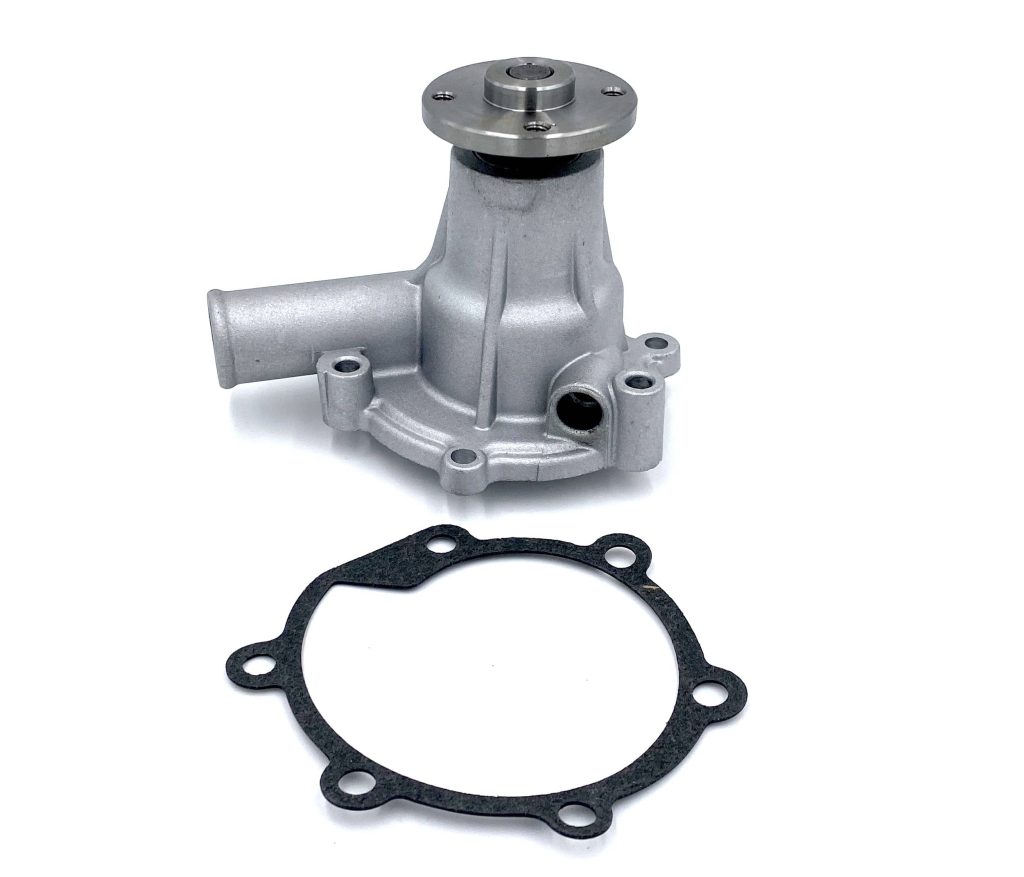
- Water pump. Leakage at the weep hole or a growling bearing means replacement is needed.
- V-belt. A slipping or too-loose V-belt makes the water pump turn too slowly. Adjust the tension so the belt deflects about a centimetre under firm thumb pressure.
In marine applications with raw water cooling, overheating is often caused by a worn raw water impeller or a silted-up heat exchanger; check the inlet and impeller there first.
Cooling parts in stock: water pump including gasket, thermostat and a temperature switch/sensor to catch problems early. Order using your engine number, as there are several versions.
Frequently asked questions
Is the Mitsubishi L3E air- or water-cooled?
Water-cooled. The L series has a water pump, thermostat, radiator and fan, driven via a V-belt.
How much coolant goes into an L2E or L3E?
The engine itself holds 1.2 litres (L2E) or 1.8 litres (L3E). With the radiator and hoses included, the total capacity is greater; top up to the correct level.
At what temperature does the thermostat open?
Around 76.5 °C, depending on the type fitted. A thermostat that stays closed is a common cause of overheating.
{"@context":"https://schema.org","@type":"FAQPage","mainEntity":[{"@type":"Question","name":"Is the Mitsubishi L3E air- or water-cooled?","acceptedAnswer":{"@type":"Answer","text":"Water-cooled. The L series has a water pump, thermostat, radiator and fan, driven via a V-belt."}},{"@type":"Question","name":"How much coolant goes into an L2E or L3E?","acceptedAnswer":{"@type":"Answer","text":"The engine itself holds 1.2 litres (L2E) or 1.8 litres (L3E). With the radiator and hoses included, the total capacity is greater; top up to the correct level."}},{"@type":"Question","name":"At what temperature does the thermostat open?","acceptedAnswer":{"@type":"Answer","text":"Around 76.5 degrees Celsius, depending on the type fitted. A thermostat that stays closed is a common cause of overheating."}}]}