




Bought a Japanese import compact tractor? This is the service to do straight away
Just bought a Japanese import compact tractor? Then give it one complete major service straight away: all oils, all filters, coolant and V-belt, plus a check of the glow plugs, oil seals, brakes and linkage. A grey import almost always arrives without a manual and without a service history. It has often stood unused for years, sometimes it has worked in a paddy field, and the manufacturer does not support it. By replacing everything in one go, you start from zero.
Below you will find the capacities from the factory schedules for each model, the order of the service and the known weak points. Still choosing? Then first read the guide on which compact tractor to buy.
Why a grey import needs a major service straight away
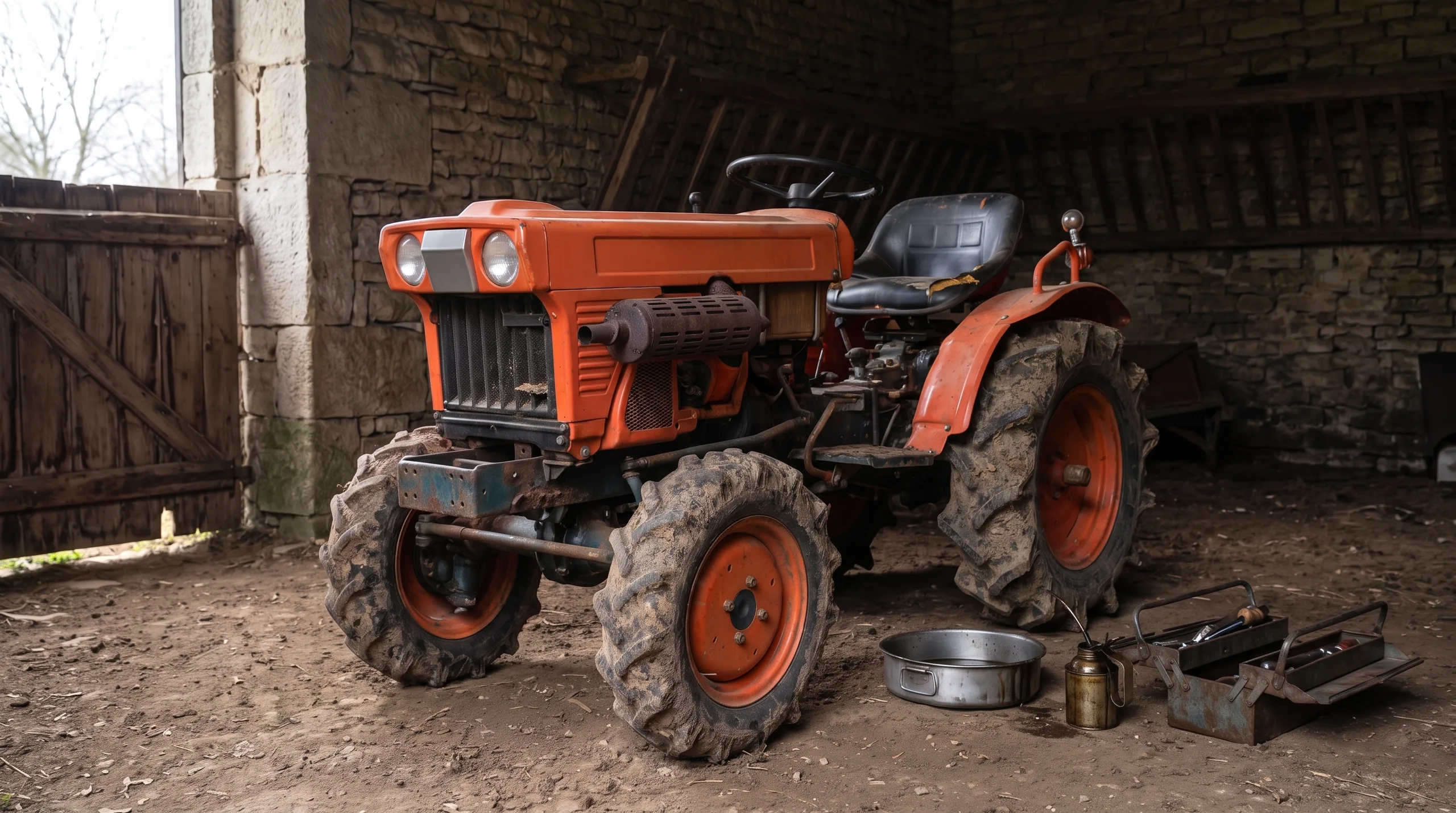
A grey import, such as a Kubota B7001, Iseki TX, Yanmar YM, Mitsubishi MT or Hinomoto E, was built for the Japanese market and brought to Europe without EU type approval. In Japan these tractors mainly worked in paddy fields: wet ground, mud and water up to the axles. Hence the tyres with tall lugs and the paddy-field tiller that comes with them. Kubota itself states that such tractors come without a ROPS frame, seat belt, PTO guard, safety decals or English manual, and that the manufacturer does not support them. Lights are usually missing too. If you want to take it on the road, read compact tractor on the public road.
Do not assume the maintenance has been kept up in recent years. A tractor like this often stands at a dealer in Japan for a long time, travels to Europe in a container and then stands at a dealer again here. In our experience, little is usually done to it along that chain. That is not true of everyone: there are also very reliable dealers in the Netherlands, Germany and France who check an import properly. But without a service history, it is safer to assume that everything is still original. The transmission oil has practically never been changed in Japan, and so neither has the hydraulic filter.
Iseki specifies that after work in wet paddy soil, the front final drive should be checked for muddy water via the check plug. A tractor that has worked in rice paddies can therefore have water in the front axle, especially if a front axle oil seal is leaking. That is why we always change the front axle oil on an import, whatever the oil looks like. In the B7100 manual, Kubota specifies that the clutch pedal should be locked in the depressed position during storage, because the clutch plate can otherwise rust solid. That is exactly the issue with imports that have been stored for a long time.
The principle: change all fluids and replace all filters in one go, even if they look reasonable. Note the hour meter reading on the day of the service and only count from then on. Grey Yanmars with wound-back hour meters do occur (indicative).
Step 1: engine oil and filters by model
Start with the engine: drain the oil, replace the oil, fuel and air filters and fit a new sealing washer on the drain plug. Intervals are in operating hours: “35 / 75” means the first change after 35 hours and then every 75 hours.
| Model | Engine | Engine oil | First change / interval (hours) | Oil filter (hours) | Fuel filter (hours) | Air filter (hours) |
|---|---|---|---|---|---|---|
| Kubota B6000 | ZL600 | approx. 2 l | 35 / 75 | mesh filter, wash out | clean 100, cartridge every 3 years | oil bath, change oil 50 |
| Kubota B7001* | D750 | 3.9 l | 35 / 75 | 150 | clean 100 | clean 100, replace annually |
| Kubota B1200-B1600** | D750, D850, D950 | 3.4 l | 35 / 75 | 150 | replace 400 | clean 100, replace after 6 cleanings |
| Kubota B1750 | D950 or D850 | 3.1 l | 50 / 100 | 50 / 200 | clean 100, replace 400 | clean 100, replace annually |
| Iseki TX1300 / TX1500 | Mitsubishi KE70 / KE75 | 2.6 l | 50 / 100 | 100 | clean 100, replace 300 | clean 100, replace 400 |
| Iseki TX1510 / TX2160 | Mitsubishi K3B | approx. 3 l (indicative) | see the manual | – | – | – |
| Iseki TU1700 | Isuzu E3AF1 | approx. 3 l (indicative) | see the manual | – | – | – |
| Yanmar YM2000 | 2TR20 | 4.0-5.0 l (indicative) | 50 (indicative) | 100 (indicative) | – | – |
| Yanmar YM1610 | 3T75U | approx. 3.4 l (indicative) | see the manual | – | – | – |
| Yanmar F14D-F16D | 3T70B, 3T72H-N, 3T75U | – | see the manual | – | – | – |
| Mitsubishi MT180 | K3C | approx. 3 l (indicative) | see the manual | – | – | – |
* Figures for the B7100, technically almost identical to the B7001. ** According to the translated manual. A dash means no reliable figure is available. Where a value is marked (indicative), fill to the mark on the dipstick.
The B6000 is different: it has a washable mesh oil filter with a magnet and an oil bath air filter in which you change the oil. When checking the level on the YM2000, only rest the screw-in dipstick on its thread (indicative).
Oil type: the factory specified SAE 30 or 10W-30. In practice, most owners use a 15W-40 diesel engine oil (indicative). For the Kubota B7001, B1200-B1750, Iseki TX/TU1400-1600 and Yanmar YM1500-YM2000 there is an oil filter set with 5 litres of 15W40 (SKU-15W402/5), and for the two-cylinder TX1300 and TX1500 the Iseki TX1000-TX1500 filter set (SKU-10041). For the TX1410 and TX1510 two lengths of air filter are in circulation, 166 and 185 mm (indicative): measure the old filter.
Step 2: fuel tank, fuel tap, sediment bowl and bleeding
After a long period of standing, the tank may contain water, sediment and rust; the B1600 troubleshooting table for an engine that will not start begins exactly there. Iseki specifies cleaning the inside of the tank every year. After that, always fill up through a strainer; according to the B7100 manual, sand will otherwise damage the injection pump. Replace the rubber fuel hoses together with the clips: Kubota specifies this every 2 years.
On a sediment bowl, clean the glass and replace the rubber seal if it leaks. A leaking seal lets in air: the engine stalls or will not start (indicative). For the Iseki TX and TU1400-1600 there is a complete sediment bowl (SKU-15011).
A new fuel filter always needs bleeding. The manuals describe it like this:
- Open the fuel tap and undo the bleed screw on the filter 2 to 3 turns until diesel comes out without air bubbles. Tighten it.
- Do the same at the second plug on the filter (Iseki TX) and then at the bleed plug on the injection pump.
- Turn the engine over on the starter for a few seconds (B7100: about 10 seconds; Iseki TX: throttle lever fully open) so that the fuel pipes and injectors are bled.
Step 3: transmission and hydraulic oil, suction strainer and front axle
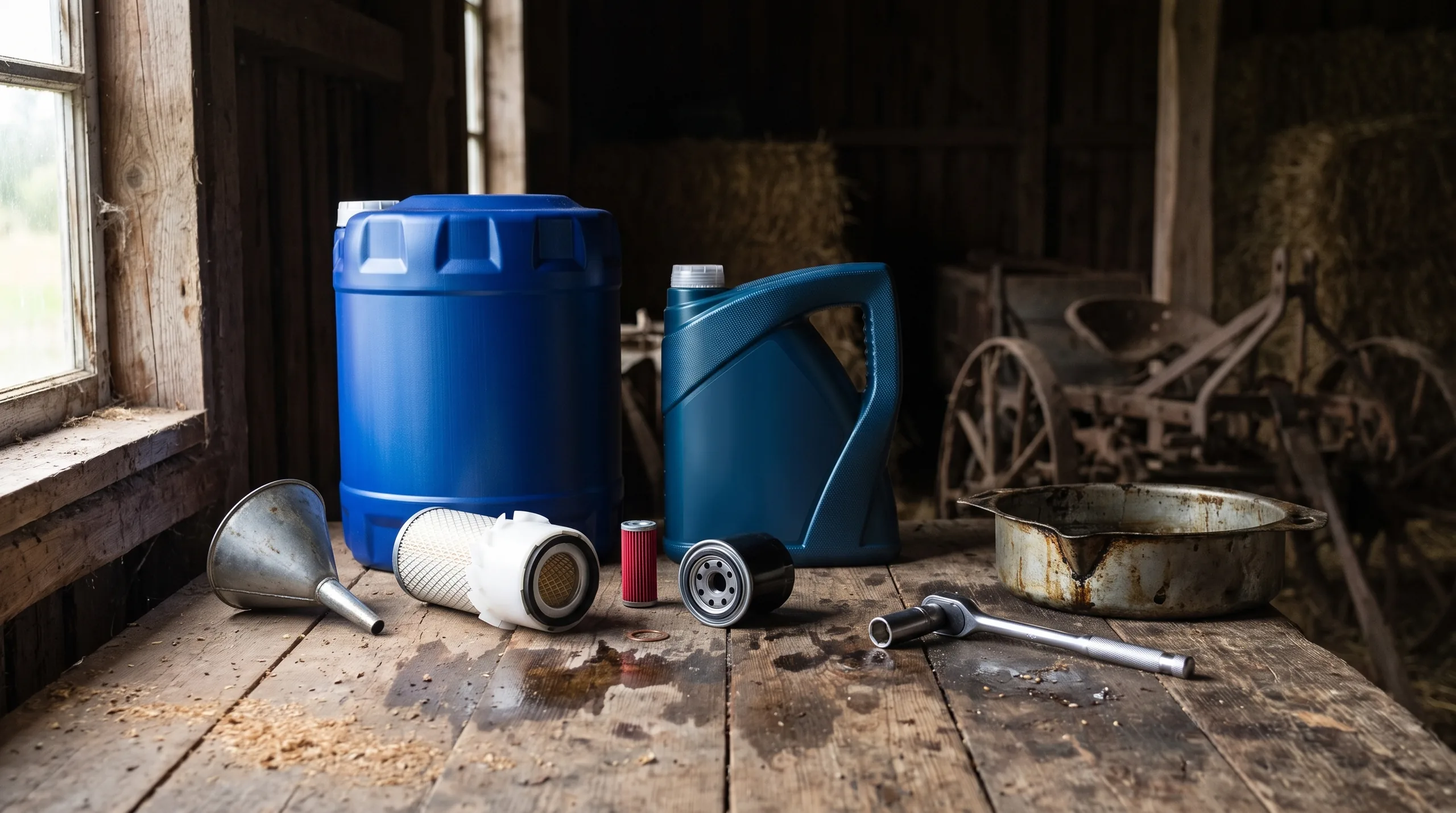
Transmission and hydraulics share the same oil. On a 4WD, the front axle differential and final drives come on top of that.
| Model | Transmission/hydraulics | Factory oil type | Front axle: differential + final drive | Interval (hours) |
|---|---|---|---|---|
| Kubota B6000 | 9 l | SAE 80 gear oil | 0.5 l + 0.2 l per side, SAE 80 | 50 / 300 |
| Kubota B7001 (B7100 figures) | 11.5 l | Kubota UDT | 0.7 l + 0.15 l per side, SAE 80 | 50 / 300; front axle 300 |
| Kubota B1200-B1600 | 17 l | see the manual | approx. 1.5 l + 0.5 l per side, SAE 90 | 50 / 300 |
| Kubota B1750 | 12 l | Kubota UDT | 1.5 l + 0.5 l per side, SAE 80 or 90 | 100 / 300 |
| Iseki TX1300 / TX1500 | 13 l / 16 l | SAE 80 gear oil | 0.7 l + 0.25 l per side, SAE 80 or 90 | 50 / 300 |
| Yanmar YM2000 | approx. 15 l (indicative) | universal tractor oil (indicative) | – | approx. 300 (indicative) |
| Yanmar YM1610 | approx. 12 l (indicative) | – | approx. 3 l (indicative) | – |
Never mix: the B7100 manual says so in as many words. So on an import, drain everything and refill with a single type. Today a GL-4 UTTO or STOU oil is the usual choice for transmission and hydraulics, with 80W-90 GL-4 in the front axle (indicative). On a Yanmar too, 80W-90 belongs in the front axle only (indicative).
Milky white oil means water. A split or hardened rubber boot around the gear lever is the best-known cause: if the tractor stands outside or you hose it down, water runs in at exactly that point. Paddy-field work also gets water into the transmission and front axle. Over time, moisture in the oil attacks bearings and gears, and a timely oil change and a new gear lever boot easily prevent that. If you find milky oil, change it straight away and clean the suction strainer. Kubota specifies cleaning the strainer at every oil change, Iseki every 300 hours. For the Kubota B series there is a hydraulic filter (SKU-2500013), and for the Iseki TX and TU a suction filter (SKU-250010).
If the hydraulic lift only works after a long warm-up (a known issue on the Yanmar YM1610D), water in the oil and a clogged suction strainer are often the cause. If an Iseki TU1700 on the other hand stops lifting once the oil is warm, look at the hydraulic pump shaft seal (air, foaming oil) or a weak relief valve spring. Jerky lifting: check the quick couplers and the relief valve for dirt (all indicative).
Step 4: cooling system and V-belt
Change the coolant; Iseki and Kubota specify this every year. According to Kubota, use only clean water or permanent antifreeze. Replace the radiator hoses every 2 years; on the B7001 they harden and crack (indicative). For the B6001 to B7100 there is a radiator hose set with coolant (SKU-33046). Clean the radiator inside and out and check the pressure cap.
A slack V-belt causes overheating and a battery that does not charge. Kubota gives approx. 10 mm of deflection under approx. 10 kg of thumb pressure (B6000, B7100, B1750) and approx. 7 mm on the B1600. The Iseki TX manual gives 10 mm on one page and 5 mm on another: keep to 5 to 10 mm. The old B7001 has no temperature gauge but a warning whistle that is no longer available; fitting a separate temperature gauge is a good idea (indicative).
Step 5: glow plugs, Thermostart, battery and alternator
All the models here run on 12 V. Kubota and Iseki use one glow plug per cylinder, with a glow resistor in series that lowers the voltage. The glow plugs themselves are therefore built for about 10 to 10.5 V (Kubota) and 9.5 V (Iseki) (indicative). That resistor is also the indicator: it only glows after 10 to 20 seconds and is hard to see in daylight.
Iseki specifies checking the glow plugs every 400 hours and inspecting the wiring for breaks. Check the type when ordering: the TX1300 comes in an M12 and an M10x1.25 version, and the TU1700 even has three types (indicative). For the Kubota D750, D850 and D950 there is the Kubota B1200-B1702 and B5000-B7100 glow plug (SKU-551303-1).
Older Yanmar YMs have a Thermostart in the inlet manifold: a heater coil onto which diesel drips from a small reservoir. Heat for no more than 10 to 15 seconds, or the element can be damaged. You bleed a new Yanmar YM1100-YM3110 Thermostart (SKU-55006) by switching it on for 10 seconds and off for 30 seconds, 10 to 20 times (indicative).
The Kubota B6000, B7100, B1600 and B1750 have a decompression lever for a cold start or a weak battery. Charge the battery, and while the tractor is standing, top up the charge every 1 to 2 months. Measure the charging voltage: 12.5 to 13 V at rest, 0.5 to 2 V higher with the engine running (indicative). If you do not reach that, suspect the alternator or regulator. Watch out for home-made wiring: on one B7100 a wrongly connected preheat circuit drained the battery (indicative).
Step 6: oil seals, brakes, clutch and steering play
Kubota specifies checking clutch, brake and steering play every 100 hours. The factory values:
| Model | Clutch pedal | Brake pedal | Steering wheel |
|---|---|---|---|
| Kubota B7100 | 2-4 mm | 10-30 mm | 10-30 mm |
| Kubota B1600 | 20-30 mm | 30-40 mm | 20-50 mm |
| Kubota B1750 | 20-30 mm | 20-30 mm | 5-30 mm |
| Iseki TX | 15-20 mm | 30-40 mm | approx. 30 mm |
All the Kubota B models we looked at and the Iseki TX have dry drum brakes and a dry clutch. Oil in a brake drum or on the clutch therefore means a leak. On the Iseki TX you check this every year via the plug under the clutch housing. Known leak points (indicative):
- Kubota B7100 4WD: the oil seal between the hub housing and the bevel gear housing of the front axle; see the Kubota front axle oil seal (SKU-96026).
- Kubota B7001: the banjo bolt with copper washers on the hydraulic pump.
- Iseki TU: stub axle seals, such as the Iseki TU1400-TU2101 stub axle oil seal (SKU-96009).
- Yanmar: wheel seals and the brake shaft seal, which lets oil run into the brake drum.
On neglected Yanmars the brake camshaft is often seized; penetrating oil and heat usually free it (indicative). Finally, grease the stub axles, track rod ends, pedal shafts and centre pivot, every 50 hours according to the factory.
Step 7: linkage, PTO and tyres
Japanese tractors often have a JIS-0 or JIS-1 linkage instead of European Category 1. According to the factory, the Iseki TX has a JIS-0 three-point linkage, with the tiller on a two-point mounting. In practice the pins are Cat 1 size but the arms are narrower, “Cat 1 limited”, so some Cat 1 implements foul the tyres (indicative). The Yanmar KE-4 has a two-point linkage (indicative). For the Iseki TX1000-TX155 and TU1400-TU1601, a Cat 1 3-point linkage set (SKU-14004) is the solution.
PTO speeds according to the factory: Kubota B7100 514/876/1,498 rpm, B1600 550/770/1,150 rpm, B1750 540/924 rpm, Iseki TX 472/752/1,177 rpm. The B6000 manual gives 560/840/1,350 rpm on one page and 524/836/1,308 rpm on another. The B7100 and B1600 turn clockwise viewed from behind, the B6000 anticlockwise (indicative): in that case you need a reversing gearbox. Grey Yanmars often have no overrunning clutch in the PTO (indicative); fit one when running a mower. For soil cultivation, a PTO slip clutch (SKU-43006) protects the PTO and transmission.
Paddy-field tyres have tall lugs. Factory rear sizes: B6000 7-16, B7100 8-16, B1600 8.3-22, Iseki TX1500 8-18; for the B7001, 5.00-12 front and 8-16 rear are quoted (indicative). Replacement paddy tyres are hard to find; many owners switch to R1 or turf tyres (indicative).
Tidying up: stickers, paint, lighting and tyres
Many imports are fine technically, but look tired after 30 to 40 years: faded stickers, dull paint, rust on the chassis and a headlight without a lens. With a day’s work you can make a tractor like that look fresh again. A new sticker set makes the biggest difference; we have them for most Kubota B models (such as the Kubota B1400 (SKU-32037) and B1702 (SKU-32042)) and for the Iseki TX and TU (such as the Iseki TX1410 (SKU-32024)). A coat of paint on the bonnet and matt black paint on the chassis and wheel rims do the rest.
Also make sure the lights work again: a complete Kubota B1200-B1600 headlight (SKU-50005), an Iseki TX1000-TX2160 headlight (SKU-50004) or just a Kubota B5000-B7100 bulb holder (SKU-50016). You will find more in the lighting category. If the paddy tyres are worn or cracked, a set of new tyres is the last step: the tractor runs more smoothly on the road and immediately looks better.
First major service checklist and costs
- Note the hour meter reading, data plate and engine number.
- Check the tank for water, dirt and rust.
- Replace the fuel hoses and clips, clean the sediment bowl.
- Replace the fuel filter and bleed the system.
- Replace the engine oil, oil filter and drain plug washer.
- Replace the air filter (B6000: change the oil in the oil bath).
- Drain and inspect the transmission oil, clean the suction strainer.
- Refill with a single type of transmission oil.
- Change the oil in the front axle and final drives, look out for water.
- Replace the coolant and radiator hoses, check the pressure cap.
- Tension or replace the V-belt.
- Charge the battery, measure the charging voltage.
- Check the glow plugs or Thermostart and the wiring.
- Adjust clutch, brake and steering play.
- Check the oil seals and grease everything.
- Test the linkage, PTO direction and overrunning clutch.
- Then tidy up: stickers, lighting, paint and tyres.
Material costs, incl. VAT (indicative): filter set approx. €23 to €43, 5 litres of engine oil approx. €35 to €45, transmission oil approx. €55 to €60 per 10 litres (usually 2 cans needed), glow plug approx. €12.50 to €19.50 each, Thermostart approx. €18.50 to €24.50. A complete service kit with V-belt, filters, oil, hoses and coolant costs approx. €125 to €200. Add 20 litres of transmission oil and you come to roughly €240 to €320.
Frequently asked questions
How much engine oil does a Kubota B7001 take?
3.9 litres, according to the factory manual for the B7100, which is technically almost identical to the B7001. Figures for the B7001 itself give the same number (indicative). Change the oil first after 35 hours and then every 75 hours, and replace the oil filter every 150 hours. Fill to the mark on the dipstick.
Which oil goes in the transmission of a Japanese compact tractor?
That depends on the model. The factory specified SAE 80 gear oil for the Kubota B6000 and Iseki TX, and Kubota UDT for the B7100 and B1750. Today a GL-4 UTTO or STOU oil is the usual choice, with 80W-90 in the front axle (indicative). Never mix different types.
Why does my Japanese import start badly from cold?
On a Kubota or Iseki, 10 to 20 seconds of preheating is needed before the indicator glows. If it still starts badly, check the glow plugs, the glow resistor and the wiring, and on a Yanmar YM the Thermostart. Air drawn in through a leaking sediment bowl is also a known cause. On the two-cylinder Iseki TX1300 and TX1500, low compression can also play a part (indicative).
How often should the oil be changed on a Kubota B series?
Every 75 hours on the B6000, B7100 and B1600, after a first change at 35 hours; treat the B7001 the same as the B7100. On the B1750 it is every 100 hours, with the first change after 50 hours. Replace the oil filter every 150 hours on the B7100 and B1600 and every 200 hours on the B1750.
Will a European implement fit the linkage of an Iseki TX?
Not always straight away. The factory states a JIS-0 three-point linkage for the Iseki TX. In practice the pins are often Cat 1 size with narrower arms, “Cat 1 limited” (indicative), so some Cat 1 implements foul the tyres. A Cat 1 linkage set for the Iseki TX solves this.
What does a first major service cost in materials?
Allow roughly €240 to €320 incl. VAT (indicative) for a complete service kit plus about 20 litres of transmission oil. A filter set on its own costs approx. €23 to €43 and 5 litres of engine oil approx. €35 to €45 (indicative). Glow plugs, oil seals and brake parts come on top of that.
Product tip: parts for the first service
- Kubota B6001-B7001 and B6100-B7100 filter set (SKU-10091): oil, fuel and air filter for the Kubota B7001, B7100 and B1200-B1702.
- Iseki TX1210-TX2160 filter set (SKU-10040): for the three-cylinder TX1510 and TX2160 and the TU1400-TU1600.
- Yanmar YM1500-YM3000 filter set (SKU-10066): for the Yanmar YM1500 and YM2000.
- STOU GL-4 transmission oil, 10 litres (SKU-15W402): for transmission and hydraulics, usually 2 cans.
- 80W90 GL-4 front axle oil, 4 litres (SKU-80W90): for the differential and final drives of the 4WD front axle.
- Kubota B5000-B7001 and B5100-B7100 manual (VAR-0083): the manual that is usually missing with an import.
Questions about parts for your model? Contact us with the make, type and engine number, and we will look up the right part.