



Front loader on a compact tractor: when it makes sense, when it doesn’t and which loader fits?
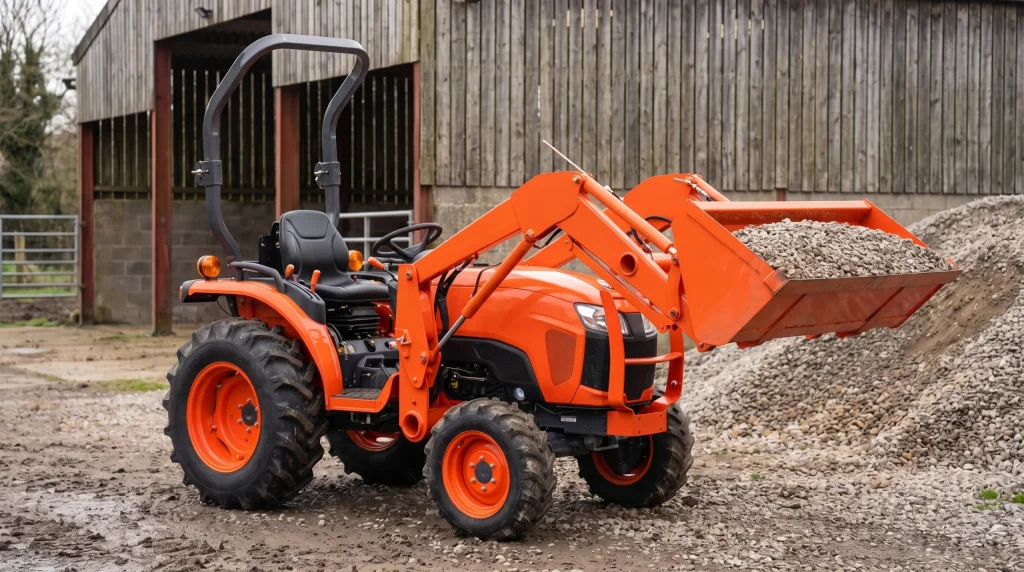
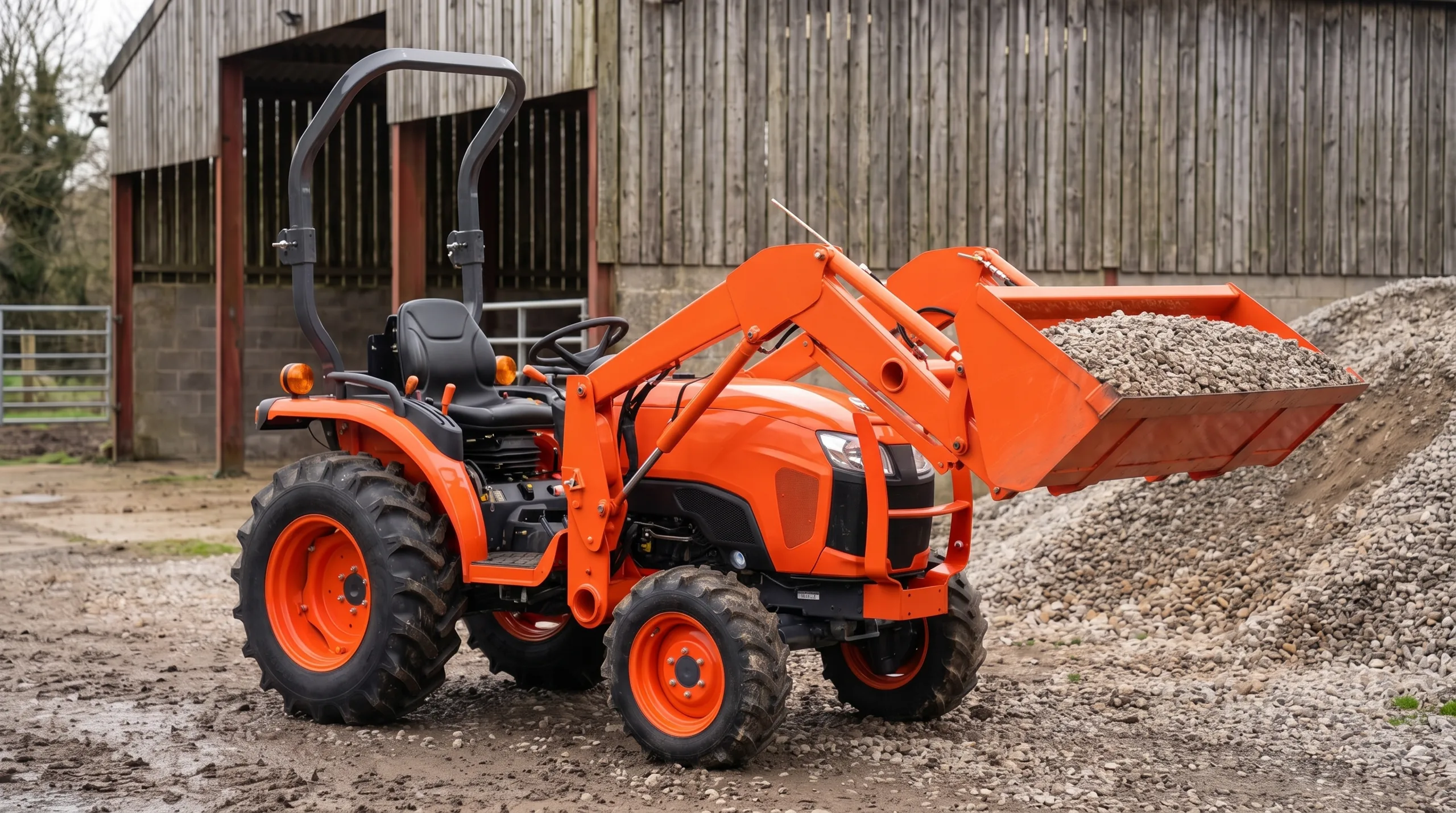
A front loader on a compact tractor makes sense if the tractor has four-wheel drive, delivers enough oil for the loader and you carry enough ballast at the rear. Then, according to Kubota’s factory figures, a compact loader lifts roughly 185 to 410 kg at 500 mm in front of the pivot point: enough for manure, soil, gravel and light pallets. On a tractor with rear-wheel drive only, on a light Japanese import with a 10 to 12 litre per minute pump, or for one job a year, a front loader is not a good idea. In this blog you will learn how to read the lift capacity, what the pump and the front axle need to handle, which quick-attach system to choose and roughly what a loader costs.
Still unsure which tractor you need? Start with our guide on which compact tractor to buy. Want to fit a loader yourself? Then also read our article on front loader kits with step-by-step installation.
When a front loader on a compact tractor makes sense, and when it doesn’t
A loader puts a lot of strain on the front axle, the hydraulics and the stability. Go through these two lists before you buy.
Makes sense:
- You move manure, sand, soil, gravel or wood chips every week.
- You handle bales, big bags or pallets around the yard, for example on a horse farm.
- The tractor has four-wheel drive and a pump that at least meets the loader’s oil requirement.
- You can carry ballast at the rear: a three-point weight, a heavy implement or filled tyres.
Doesn’t make sense:
- A tractor with rear-wheel drive only. The steering knuckles and the front axle are not designed for the load, and reversing with a full bucket gives you no grip.
- A light grey import with a 10 to 12 l/min pump. The loader will be slow (see below).
- You only need the loader a few days a year. Hiring a mini articulated loader is then cheaper and quicker.
- You regularly need to lift more than half a tonne or stack high. That is a job for a wheel loader.
Hydrostatic or manual gearbox for loader work?
Loader work consists of short runs forwards and backwards. A hydrostatic transmission is ideal for that, because you change direction without using the clutch. If you mainly do draught work and only load now and then, a manual gearbox is fine.
Compact tractor front loader lift capacity: pivot point, 500 mm and pallet fork
The biggest number in a brochure is usually the lift capacity at the bucket pivot point. In practice a load never hangs there: a pallet or bale has its centre of gravity further forward. So look at the figure at 500 mm in front of the pivot point. The Kubota figures below come from the manufacturer’s specification sheets; the other loaders are indicative.
| Loader | Tractor | Pivot point max | 500 mm in front of pivot | Lift height | Loader weight | Oil requirement |
|---|---|---|---|---|---|---|
| Kubota LA203 | BX1860 | 280 kg | 185 kg | 1,810 mm | 157 kg | 14 l/min, 123 bar |
| Kubota LA243 | BX2360/2660 | 340 kg | 235 kg | 1,810 mm | 170 kg | 14 l/min |
| Kubota LA344 | BX1880/2380 | 335 kg | 231 kg | 1,795 mm | 217 kg | 14 l/min |
| Kubota LA435 | B2301/2401/2601 | 430 kg | 300 kg | 1,995 mm | 208 kg | 18 l/min, 141 bar |
| Kubota LA525 | L2501/L3301/L3901 | 491-513 kg | 372-388 kg | 2,394 mm | 365 kg | 23.9 l/min |
| Kubota LA555 | L3560 | 540 kg | 408 kg | 2,448 mm | 455 kg | 31 l/min |
| John Deere 120R (indicative) | 1023E/1025R/2025R | 364 kg | 251 kg | 1,830 mm | 284 kg | 26.5 l/min |
| John Deere 220R (indicative) | 2032R/2036R/2038R | 509 kg | 365 kg | 2,160 mm | 331 kg | 20.2 l/min |
| New Holland 200LC (indicative) | Workmaster 25 | 727 kg | 552 kg | 2,386 mm | 535 kg incl. bucket | 30.1 l/min |
| MX/Iseki C2 (indicative) | 20-50 hp | 570 kg | 410-450 kg at ground level | 2.25 m | 180-230 kg | 20 l/min, 140 bar |
Rule of thumb (indicative): with pallet forks, where the load sits 60 to 75 cm in front of the pivot point, you are left with about 60% of the pivot point figure. With a bucket it is about 80%, with a grab or logs well under half. So a Kubota LA435 rated at 430 kg at the pivot point lifts roughly 260 kg with pallet forks.
This is where it goes wrong with bales. A small bale of hay weighs 15 to 25 kg, but a round bale of hay easily weighs 300 to 600 kg and a bale of haylage or silage 400 to 700 kg or more (indicative). If you want to move round bales, you need a loader of the LA525 class or bigger, or a tractor like the Iseki TLE3410, which lifts about 700 kg with a front loader and third function (indicative). Read more in our blog on the compact tractor for horse farms.
Oil requirement and pump output: does the front loader suit your tractor?
If the tractor’s pump delivers less oil than the loader needs, everything goes slowly. The smallest Kubota loaders need 14 l/min, the LA435 18 l/min. Compare that with your tractor’s pump output.
| Tractor | Type | Pump output | Loader work (indicative) |
|---|---|---|---|
| Iseki TX2160 | Grey import | 10.2 l/min (indicative) | Below 14 l/min: very slow |
| Kubota B7100 | Grey import | 11.4 l/min (indicative) | Below 14 l/min: very slow |
| Kubota B2410 | Grey import | 16.7 l/min (indicative) | Light loader |
| Kubota B1750 (4WD) | Grey import | 20.8 l/min (indicative) | Suits the LA435 class |
| Kubota B1241 | EU | 17.0 l/min | Light loader |
| Kubota B2201/B2231/B2261 | EU | 18.9 l/min | LA435 class |
| Iseki TM3217/TM3267 | EU | 20.6 l/min | MX/Iseki C2 class |
| Kubota BX231/BX261 | EU | 25 l/min | More than enough for BX loaders |
Front loader on a Kubota B7001 or another grey import
A front loader for the Kubota B7001? It can be done, but don’t expect much. The B7001 has a 3-cylinder D750 of 13.8 hp and weighs about 476 kg (indicative). We have no reliable pump figure for the B7001; the B7100 from the same period manages 11.4 l/min and lifts 181 kg with the rear linkage (indicative). Even the lightest Kubota loader in the table weighs 157 kg, a third of the tractor, and needs 14 l/min. The loader rises slowly and the front axle has a hard time. And only on a four-wheel-drive unit.
A Kubota B1750 with four-wheel drive and 20.8 l/min is a much better base. If you still want a light import to do loader work, you can have a separate pump fitted to the engine (forum tip, indicative). Grey imports with a loader fitted appear second-hand for about €8,450, compared with €4,350 to €8,500 excl. VAT for 15 to 23 hp without a loader (indicative).
Ballast and front axle: the 25% rule
With a full bucket at the front, the rear wheels get light: you lose grip and braking power. The standard is that at least 25% of the total weight stays on the rear axle. Test it like this: load the bucket to the maximum, extend the arm well forward and check that the rear axle stays firmly on the ground. For loader work a 50/50 split is often used (indicative).
The Kubota LA525 manual gives two ways to add ballast at the rear: a three-point weight and wheel weights. You can also fill the rear tyres. An 11.2-24 tyre filled to 75% holds about 105 kg of water, and up to 160 kg with calcium chloride. In practice, at least about 160 kg of ballast is quoted for a Kubota BX and about 227 kg for a B series (indicative, check the manual for your model).
Drive with the bucket low. Even with good ballast, the bearings, oil seals, rims, tyres and steering parts of the front axle wear faster than on a tractor that only mows.
Mounting bracket, quick attach and third function
Bracket and subframe
The subframe spreads the loader’s forces across the chassis. With a kit or custom loader, watch four things. The subframe must never rest directly on the sump. There must be clearance to the tie rods, even at full lock. Use reinforcement plates where the manufacturer specifies them. And re-tighten all bolts after the first operating hours.
Euro hitch, skid steer or Kubota quick attach
- Euro hitch: the widest choice of implements and a better view of the bucket.
- Skid steer: easier to hitch, but less visibility. Stoll’s compact loaders come with a skid steer frame as standard.
- Kubota: its own quick attach with two levers.
On a second-hand tractor, check which system is fitted before you buy buckets or forks.
Third function and double-acting valve
A standard loader has two functions: lift and tilt. For a bale clamp, silage grab or grapple you need a third function, an extra double-acting valve that you operate by cable or electrically. A separate valve block costs from about €200 excl. VAT (indicative), excluding hoses and fitting.
Mechanical or hydraulic self-levelling
Self-levelling keeps the bucket or fork level as the arms rise. Mechanical self-levelling is simple and safe with pallets and bales, but the extra linkage blocks your view. Hydraulic self-levelling gives a clear view of the implement.
What does a front loader for a compact tractor cost?
The price depends on the route: kit, custom-built or factory loader. All amounts are indicative, 2025-2026 price level unless stated otherwise.
| Route | Price (indicative) | Note |
|---|---|---|
| Budget front loader kit | €1,600-2,200 excl. VAT | Fitting it yourself takes a hobbyist 5 to 6 hours |
| Premium front loader kit | €2,500-3,500 excl. VAT | Better finish, often more options |
| Hydraulic parts | €270-560 | Valve block, hoses, couplings, oil |
| Fitting by a mechanic | €250-600 | If you don’t do the work yourself |
| Custom loader incl. fitting | approx. €3,000 incl. VAT | Made to measure for your tractor |
| Quicke C09S compact | approx. €2,870 (2022 price) | Cat. A bracket approx. €2,435 extra |
Add hydraulic parts and a budget kit quickly goes over €2,000. The full cost breakdown and the fitting are covered in our article on front loader kits.
Alternatives: rear pallet fork, rear loader or hiring a wheel loader
For pallets, big bags and bales on a level yard, a pallet fork on the three-point linkage is often enough. At the rear, too, lift capacity drops with distance: there is easily 40 to 45% between lifting at the ball ends and lifting 61 cm behind them. A Kubota BX2380 lifts 550 kg at the ball ends and about 310 kg at 61 cm.
- Rear pallet fork: cheap, no load on the front axle, but you have to reverse.
- Rear loader or tipping bucket: hangs on the three-point linkage and runs on its own hydraulics. Especially handy on an articulated tractor, see implements and front loader on an articulated tractor.
- Hiring a mini articulated loader: about €70 to €150 per day (indicative).
- Wheel loader: a Weidemann Hoftrac 1160 has a tipping load of 1,070 to 1,450 kg (with a bucket it may lift about half of that), compared with about 700 kg on the front loader of a 40 hp compact tractor (indicative). For a lot of loading and high stacking, a wheel loader is better.
Maintenance with loader work: greasing, front axle, oil seals and steering parts
The Kubota LA525 manual specifies greasing all grease nipples every 10 operating hours, and checking bolts and hoses daily.
- Bolts: re-tighten the bracket and subframe bolts after the first hours and check them regularly after that.
- Hoses and couplings: watch for weeping, chafing and leaking quick couplers.
- Front axle: a leaking oil seal on the differential or steering knuckle is the first sign of overloading. Replace it in time.
- Steering parts: tie rod ends and tie rods take more punishment with a full bucket.
- Hydraulics: change the transmission and hydraulic oil and the hydraulic filter as specified in the manual.
You can find the parts for that maintenance with us, from oil seals to hydraulic pumps. Intervals differ per model, so check the manual.
Frequently asked questions
How much can a front loader on a compact tractor lift?
According to the factory figures, a compact Kubota loader lifts 280 to 540 kg at the pivot point and 185 to 408 kg at 500 mm in front of it. That last figure is the one that counts in practice. With pallet forks you are left with about 60% of the pivot point figure, with a bucket about 80% (indicative). So a loader rated at 430 kg at the pivot point lifts roughly 260 kg with forks.
Can I fit a front loader to a Kubota B7001?
It can be done, but it is not a good base. The B7001 weighs about 476 kg and has 13.8 hp (indicative). The comparable B7100 delivers 11.4 l/min of oil, while the lightest Kubota loader needs 14 l/min and already weighs 157 kg. The loader will be slow and the front axle heavily loaded. A B1750 with four-wheel drive and 20.8 l/min is a better choice.
How much ballast do I need for loader work?
At least 25% of the total weight must stay on the rear axle, even with a full bucket extended well forward. Use a three-point weight, wheel weights or filled tyres. An 11.2-24 tyre filled to 75% holds about 105 kg of water, and up to 160 kg with calcium chloride. For a Kubota B series, about 227 kg of ballast is quoted (indicative).
What is the difference between a Euro hitch and skid steer?
They are two quick-attach systems at the front of the loader arms. The Euro hitch has the widest choice of buckets and forks and gives a better view of the implement. Skid steer is easier to hitch, but you see less. Kubota uses a quick attach with two levers on its own loaders. Choose the system before you buy implements, because they are not interchangeable.
What does a front loader for a compact tractor cost?
A budget front loader kit costs about €1,600 to €2,200 excl. VAT, a premium kit €2,500 to €3,500 excl. VAT. On top of that come hydraulic parts at €270 to €560 and possibly fitting by a mechanic at €250 to €600. A custom loader including fitting costs about €3,000 incl. VAT. All amounts are indicative, 2025-2026 price level.
Do I need a third function on my front loader?
Only if you use implements with their own cylinder, such as a bale clamp, silage grab or grapple. For a bucket or pallet fork, lift and tilt are enough. A third function is an extra double-acting valve, operated by cable or electrically. A separate valve block costs from about €200 excl. VAT (indicative), excluding hoses and fitting.
Product tip: parts that wear first with loader work
- Front axle differential oil seal Kubota B5000-B7001 (SKU-96010), front axle oil seal Kubota B1200-B1702 (SKU-96074) and front axle differential oil seal Iseki TX1000-TX2160F (SKU-96059): the front axle is the first to leak with a lot of loader work.
- Tie rod end Kubota A/B/B1 series (VAR-0031) and tie rod end Iseki TA/TL/TU/TE (VAR-0057): against play in the steering with a full bucket.
- Hydraulic pump Kubota B1200-B7100 (SKU-115001-7) and hydraulic pump Iseki TU/TL/TE/TX (SKU-115001-12): when the loader becomes noticeably slower.
- Lift cylinder O-ring/seal Kubota B5000-B7001 | B1200-B1502 (SKU-96110): for a linkage that slowly drops.
- Transmission oil STOU hydraulic/gearbox GL-4 (SKU-15W402): for tractors whose manual specifies a universal tractor oil.
- Hydraulic filters: replace the filter together with the oil.
Questions about parts for your model? Get in touch and include the make, type and, if possible, the serial number of your tractor.