



Implements and front loader on an articulated tractor: what fits, what does not and how to do it safely
Implements on an articulated tractor: what fits on the back, what can go on the front, and can you fit a front loader? Those are the three questions we hear most often from people considering a BCS Invictus, Ferrari Cromo, Pasquali Siena, Antonio Carraro or Valpadana. The short answer: on the back almost anything category 1 up to about a tonne will fit, on the front only on reversible models or models fitted with a front linkage, and a front loader is possible, but with clear limits. In this blog we set out the linkage, PTO and hydraulics per model and explain which implements go well with articulated steering.
Read the difference between an articulated tractor, a reversible tractor and an ordinary compact tractor first if you are still unsure which type you need; this blog assumes the choice for an isodiametric tractor has already been made.

Articulated tractor three-point linkage: category, lift capacity and pump per model
The small articulated tractors have a category 1 three-point linkage (or 1N, the narrow version with the same pins but shorter lift arms). The lift capacities below are factory figures, measured at the ball ends; 60 centimetres behind the ball ends, where the centre of gravity of a flail mower or rotavator sits, you are left with roughly two thirds of that.
| Model | Linkage cat. | Lift capacity at the ball ends | Hydraulic pump | PTO | Front linkage / front PTO |
|---|---|---|---|---|---|
| Goldoni Base 20 (22 hp) | 1N | 500 kg | 18.5 l/min | 540/540E, ground speed | No |
| Ferrari Cromo 35 RS Junior (25 hp) | 1 | 500 kg (950 kg with optional double lift cylinder) | Single circuit | 540 | No |
| Ferrari Cromo 35 AR / BCS Invictus 35 / Pasquali Siena 35 (25 hp) | 1 | 950 kg | approx. 19 l/min, up to 6 couplers | 540 | No |
| BCS Invictus K300 / K400 (26 / 35.6 hp) | 1 | 1,050 kg | 16.5 l/min steering + 16.5 l/min linkage, 125 bar; AR up to 6, RS up to 4 couplers | 540 + ground speed; optional independent electro-hydraulic | No |
| Pasquali Siena K6.40 RS (35.6 hp) | 1 | 1,050 kg | 22 l/min, 125 bar, up to 6 couplers | 540 | No |
| Antonio Carraro Tigre 3200 (26 hp) | 1 | 950 kg | — | 540, ground speed | No |
| Antonio Carraro TTR 4400 HST (38 hp) | 1 | 850 kg single-acting, 1,100-1,300 kg double-acting | 33 l/min, 130-140 bar | 540 or 1,000, independent | Front PTO 1,000 rpm as an option; reversible |
| Valpadana 4645 ARM (35 hp) | 1 | 1,000 kg | — | 540 | No |
| BCS Valiant 60 AR Micro (49 hp) | 1 | 1,200 kg | 33.5 l/min (option) | 540 | No; reversible |
| Ferrari Mizar 70 AR (63 hp) | 1 (2 optional) | 1,900 kg | approx. 37 / 48 l/min | 540/540E | No; reversible |
| Ferrari Vega 85 / BCS Vithar 85 (75 hp) | 1 and 2 | 2,300 kg | up to 51 l/min, up to 13 couplers | 540/540E, optional 540/1,000 | 800 kg front linkage as an option; reversible |
| Antonio Carraro SRX / TRX 7800-9900 (70-85 hp) | 2 | 2,100-2,400 kg | — | 540/540E | Front linkage on request; reversible |
Two terms from that table deserve an explanation. 540E (economy) delivers 540 rpm at the PTO at a lower engine speed; with light implements such as a disc mower, measurements show this saves 16 to 27 per cent fuel on average and a lot of noise. A synchronised or ground-speed PTO turns with the driving speed, so in proportion to the wheels. It is intended for powered trailers and for implements that have to do a fixed amount of work per metre travelled (a seed drill, for example). For a flail mower or rotavator you always use the normal 540 setting.
Which implements suit an articulated tractor?
The low weight, the compact build and the wheels that follow the same track make an articulated tractor strong in work where you constantly go round obstacles, and weak in work that demands pulling power and weight. Rule of thumb for the 25 to 35 hp class: from 25 hp engine power you have about 20 to 22 hp left at the PTO, and per metre of working width you reckon on 10 to 15 hp for a flail mower and 15 to 20 hp for a rotavator.
| Implement | Articulated tractor 25-35 hp | Note |
|---|---|---|
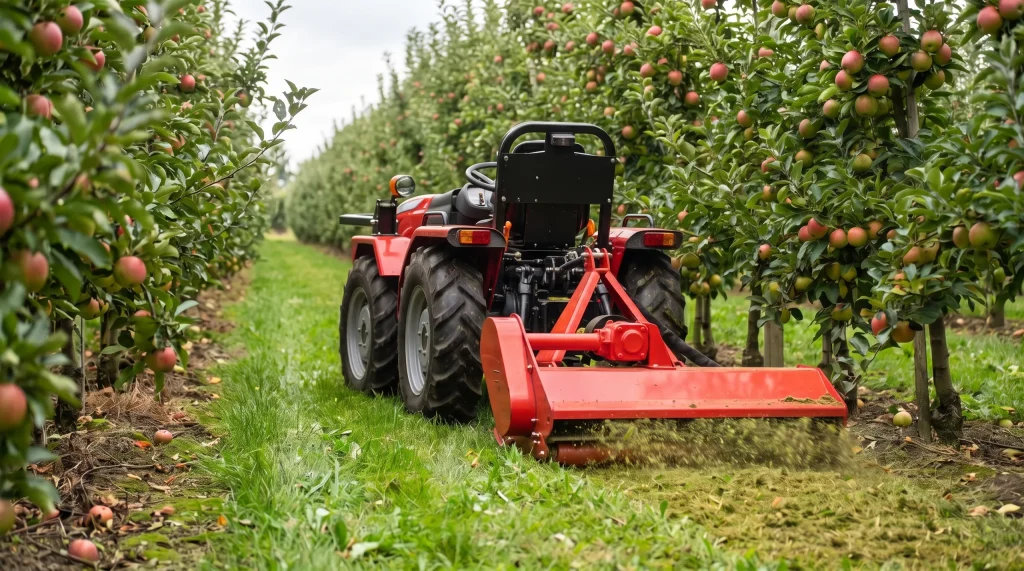
| Flail mower / mulcher | Excellent, 1.20-1.60 m | The implement par excellence for orchards and vineyards; watch the radiator and the air filter (dust) |
| Disc mower (rotary), lawn mower | Excellent | 540E saves fuel; fit turf tyres on lawns |
| Rotavator, power harrow | Good up to approx. 1.25 m | Choose a rotavator weight that suits the lift capacity at a distance |
| Mist sprayer / orchard sprayer | Excellent | Mounted tanks up to about 300 litres, larger ones trailed; watch the 50/50 weight distribution with a full tank |
| Tipping trailer, powered trailer | Good | With a powered trailer use the ground-speed PTO; brakes on the trailer on slopes |
| Sweeper brush, snow plough, snow blower | Good, preferably at the front | At the rear only practical on a reversible tractor; otherwise you drive in reverse |
| Wood chipper, shredder | Good | PTO power determines the maximum branch thickness |
| Plough, subsoiler, deep cultivation | Limited | Too light, and the centre pivot does not like pulling forces on slopes; a single-furrow plough at most |
| Rear pallet fork, rear loader | Good | A smart alternative to a front loader on an articulated tractor |
| Front loader | Possible, with limits | See below |
Implements at the front: reversible tractor, front linkage and front PTO
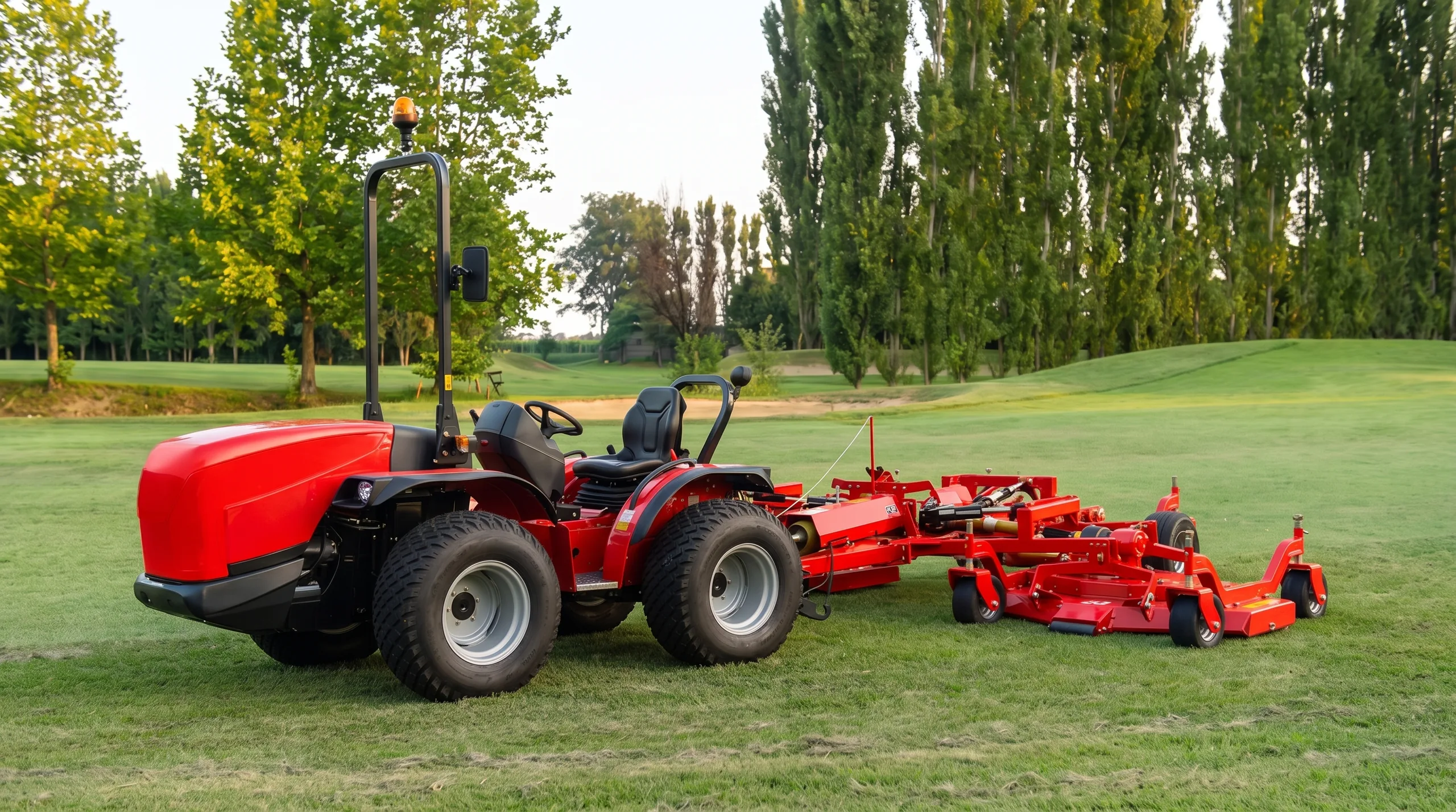
On an articulated tractor without a reversible seat, everything is behind you. If you want to see a sweeper brush, a snow blower or a flail mower along a bank all day, choose a reversible tractor: there the rear linkage simply becomes the front linkage when you turn the seat round. That does not exist in the 25 to 35 hp class of the BCS group; for that you go to Antonio Carraro (TTR, TRX, SRX), Valpadana IS or the 50 hp plus models from BCS, Ferrari and Pasquali.
A true front linkage with front PTO, where you carry an implement at the rear and at the front at the same time, is rarer in this world than on ordinary tractors. The Ferrari Vega and BCS Vithar have an optional 800 kilo front linkage with four hydraulic couplers and category 1 quick couplers; the Carraro TTR 4400 an optional front PTO at 1,000 rpm. The Mizar 70 and the Valiant 60 have no front linkage. On the Vega a front linkage cannot be combined with front weights, so factor in the ballast question (see below).
Front loader on an articulated tractor: is it possible?
Yes, but not like on a Kubota B or an Iseki TG. The problem lies in the design: the engine sits on the front half, and that half turns relative to the rear half. So a front loader goes on the part that steers, ahead of the centre pivot, with the load projecting in front of the front axle. As soon as you articulate with a full bucket, that load shifts sideways relative to the rear half and the driver’s centre of gravity. It is well known in the loader world that less articulation angle gives more stability under load, and that is exactly why front loader work on an articulated tractor has to be done calmly and in a straight line. The low build also limits the lift height, and the 16 to 22 litres per minute hydraulic pump on the small models makes the loader slow.
Even so, front loaders are made for these tractors, mainly by Italian loader manufacturers, in light series with a quick-change system, mechanical parallel linkage and an optional rear ballast box. They are available for the BCS Valiant, Invictus and Vithar, the Ferrari Cromo, Cobram, Thor and Vega, the Antonio Carraro TGF, HR and TC and for Goldoni. These manufacturers do not always publish lift capacities and lift heights; in the 25 to 35 hp class, expect a loader that in practice lifts a few hundred kilos to roughly 1.8 to 2.2 metres (indicative; for comparison, a loader on a compact Kubota BX lifts around 300 kilos to 1.8 metres). On the RS versions with steering wheels a front loader works more smoothly than on the AR, because the load does not turn with the steering.
Practical rules for front loader work on an articulated tractor
- Load and unload in a straight line; only steer once the bucket is low. Never articulate on a slope with a high, full bucket.
- Rear ballast is a must: a ballast box or a heavy implement on the three-point linkage, plus wheel weights if needed. Without ballast the rear axle goes light and you lose braking and steering.
- Take the loader off when not in use; with heavy loader work, the centre pivot, the front axle and the front half of the chassis take more punishment than the manufacturer designed for with mowing, and in the long run you will notice that in the bushes and axle seals.
- Tyre pressures front and rear according to the chart, and with a lot of loader work a tractor tread instead of turf tyres.
The alternative: rear loader or rear pallet fork
For articulated and reversible tractors there are rear loaders that you hang on the three-point linkage and operate with the tractor’s own hydraulics. A common version lifts around 400 kilos to about 2.3 metres and weighs around 200 kilos (indicative), with a bucket, a pallet fork or a bale spike. On a reversible tractor you simply work forwards with the loader in front of you, without the load hanging ahead of the centre pivot. For pallets, bulk bags and bales around the yard, a simple pallet fork on the linkage is often enough.
Hydraulic couplers and double-acting valves
For a flail mower with side shift, a tipping trailer or a loader you need double-acting valves. The Invictus AR has enough as standard for six couplers (three double-acting), the RS for four, the Siena K6.40 up to six, the Vega up to thirteen with a joystick. On a used machine, check what is actually fitted; adding valves is possible, but not cheap. The pump output determines how fast everything moves: 16 to 22 litres per minute on the small models is fine for a linkage and a mower, but tight for a loader with a fast cycle.
Ballast, tyres and track width
An isodiametric tractor spreads its weight roughly 60/40 front to rear; an implement on the linkage brings that to 50/50, which is exactly the intention. Wheel weights and liquid ballast in the tyres increase traction without occupying the linkage, but contribute less to weight transfer than a ballast block on the linkage. Wheel weights are available as a factory option on the Invictus.
The choice of tyres on these machines is wide: the Invictus is available on 6.50-16 (standard), 210/95R16 and 260/70R16 with tractor tread and on 28×9.00-15 turf tyres, which makes the track width vary from 806 to 1,392 mm. Turf tyres with rounded shoulders hardly damage grass but give less grip; an agricultural or tractor tread pulls better on the land and leaves marks on lawns. The Carraro TTR 4400 has seven tyre sizes, with 1.4 to 1.6 bar front and 0.8 to 1.4 bar rear, and a ground pressure of less than 0.4 bar on turf tyres. You widen the track by reversing the rims (offset rim) or with spacers; a wide track gives stability on slopes, a narrow track fits between the rows. Stick to the combinations in the manual, because the four-wheel drive of an isodiametric tractor does not tolerate a difference in rolling circumference between front and rear.
Frequently asked questions
Can you fit a front loader on an articulated tractor?
Yes, with limits. Italian loader manufacturers supply light front loaders with parallel linkage for the BCS Valiant, Invictus and Vithar, Ferrari Cromo, Cobram, Thor and Vega, Antonio Carraro TGF, HR and TC and Goldoni. Expect a few hundred kilos to roughly 1.8 to 2.2 metres (indicative), load and unload in a straight line, and always use rear ballast.
How much can an articulated tractor lift?
At the ball ends of the three-point linkage: Goldoni Base 20 and Ferrari Cromo 35 RS Junior 500 kg, Cromo 35 AR and Invictus 35 950 kg, BCS Invictus K300/K400 and Pasquali Siena K6.40 1,050 kg, Carraro TTR 4400 850 to 1,300 kg, Valpadana 4645 1,000 kg, Ferrari Vega and BCS Vithar 2,300 kg. At 60 centimetres behind the ball ends about two thirds remains.
Which flail mower suits a 25 hp articulated tractor?
A flail mower of 1.20 to 1.60 metres, category 1, on the 540 PTO. Reckon on 10 to 15 hp per metre of working width; from 25 hp engine power you have 20 to 22 hp left at the PTO. Watch the weight of the mower relative to the lift capacity at a distance, and the radiator, which clogs up behind a mower.
What does 540E mean on the PTO?
540E (economy) delivers 540 rpm at the PTO at a lower engine speed. With light implements such as a disc mower, measurements show this saves 16 to 27 per cent fuel on average and a lot of noise. For a flail mower or rotavator under full load, use the normal 540 setting.
Which tyre sizes fit a BCS Invictus?
6.50-16 (standard), 210/95R16 and 260/70R16 with tractor tread, and 28×9.00-15 turf tyres. This makes the track width vary from 806 to 1,392 mm. Keep the same size and pressure front and rear, because the permanent four-wheel drive of an isodiametric tractor does not tolerate a difference in rolling circumference.
Product tip: the parts that wear fastest with implement use
- Air filter BCS Invictus, Ferrari Cromo, Pasquali Siena, Carraro TTR 4400 (SKU-20004): the first filter to clog up when flail mowing and rotavating.
- Filter set BCS/Ferrari/Pasquali with Kubota D1105/V1505 (SKU-10092) and filter set Carraro TTR 4400 / Tigre (SKU-100150)
- Transmission and hydraulic oil STOU GL-4 (SKU-15W402): for machines whose manual specifies a universal tractor oil.
- Thermostat gasket Yanmar/Kubota (SKU-65203) and cooling system cleaner (SKU-125007) for the radiator that clogs up behind a mower.