




Articulated tractor, reversible tractor or compact tractor: what is the difference?
An articulated tractor, a reversible tractor or an ordinary compact tractor: if you look at the narrow-track world of BCS, Ferrari, Pasquali, Antonio Carraro, Valpadana and Goldoni for the first time, you see four equal wheels, low machines in bright colours and a forest of type codes. AR, RS, Dualsteer, SRX, TRX, ISM, ARM, Junior, Micro. The difference between these types is bigger than it looks, and you only notice the wrong choice on a slope, with your first front loader or when you want to hang a flail mower on the front.
In this blog we explain how articulated steering works, what a reversible driving position actually is, why many “articulated tractors” have no articulation at all, and when an ordinary compact tractor from Kubota, Iseki or Yanmar is the better choice. It is the hub of our series on articulated tractors; at the bottom you will find the separate blogs on models, maintenance, implements, faults and winter storage.
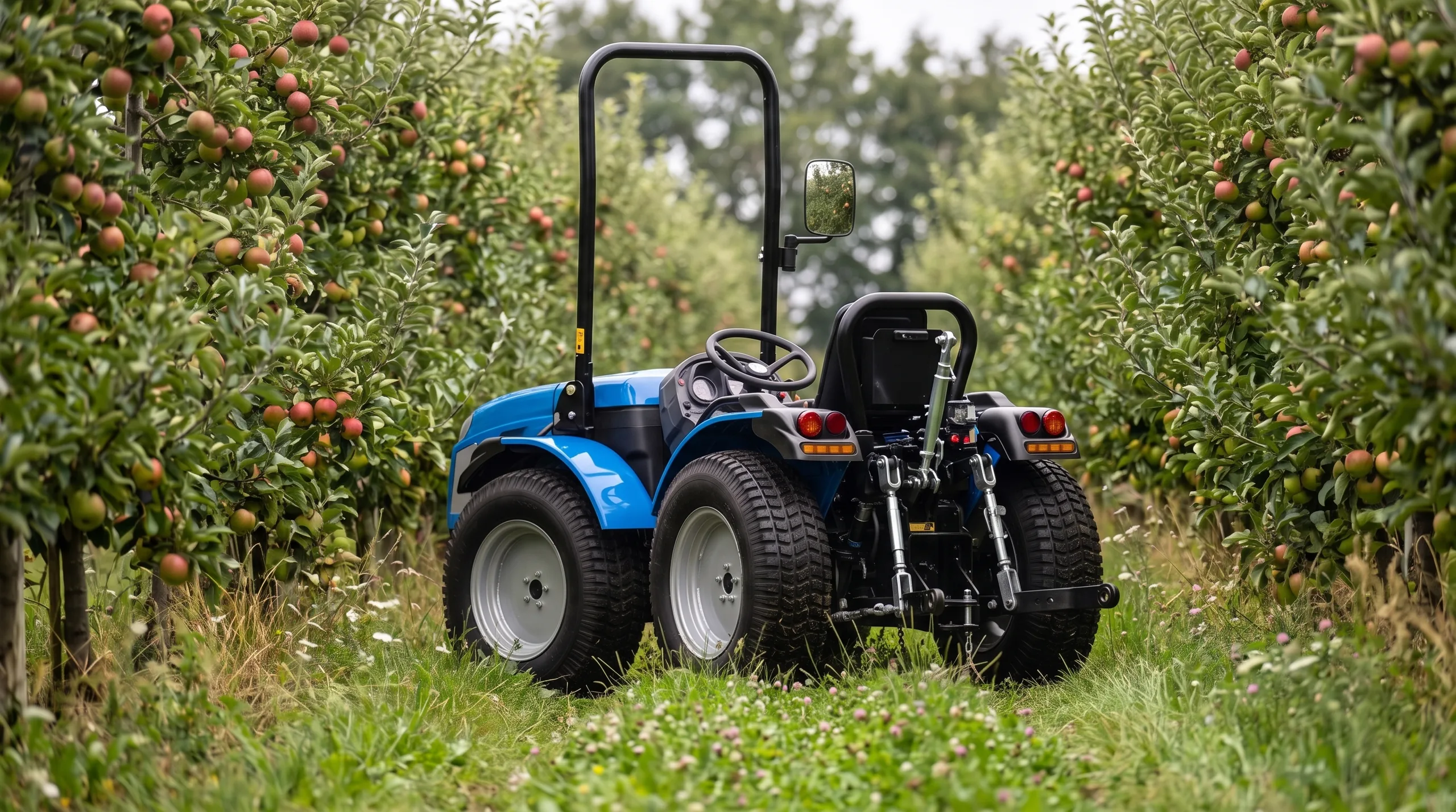
Articulated tractor in brief: an articulated tractor is a compact tractor with four equal-sized wheels that does not steer with its wheels, but with a pivot in the middle of the chassis. The front half with the engine turns relative to the rear half with the driver and the linkage. As a result, the rear wheels follow the exact track of the front wheels and the turning circle of a 25 hp tractor is about 2.3 metres. The best-known makes are BCS, Ferrari, Pasquali, Antonio Carraro (SRX), Valpadana and Goldoni.
Articulated tractor: first decode the type codes
The biggest source of confusion lies in the letters after the model name. For the makes in the BCS group (BCS, Ferrari and Pasquali), AR means “articolato”: an articulated chassis. RS stands for “ruote sterzanti”, steering wheels, so a rigid chassis that steers with the front axle. RS does not mean “reversible”, even though many buyers think so. DS or Dualsteer combines both: a centre pivot and steering front wheels, together good for a steering angle of around 70 degrees. SDT means the rear wheels are slightly larger than the front wheels. Junior is the entry-level version with a simpler linkage and fewer options, Micro the extra narrow version (around 95 cm wide) and MT the haymaking version with an extra low centre of gravity for steep slopes.
Antonio Carraro does it differently. There the SRX is the articulated, reversible tractor. The TRX, TTR, Tigre and TGF steer with the wheels. The TTR 4400 and the Tigre 3200 are regularly advertised as articulated tractors, but they are wheel-steered tractors with an oscillating chassis. Valpadana uses ARM for the articulated version, ISM for steering front wheels and VRM for larger rear wheels; the heavier VP models are called IS (reversible, steering wheels) or AR. Goldoni called the articulated version SN (snodato) and the wheel-steered version RS.
| Code | Make | Meaning |
|---|---|---|
| AR | BCS, Ferrari, Pasquali, Valpadana | Articulated chassis (articolato) |
| RS | BCS, Ferrari, Pasquali, Goldoni | Rigid chassis, steering front wheels (ruote sterzanti) |
| DS / Dualsteer | BCS, Ferrari, Pasquali | Articulation plus steering front wheels |
| SDT / VRM | BCS group / Valpadana | Larger rear wheels |
| Junior / Micro / MT | BCS group | Entry-level version / extra narrow / haymaking on slopes |
| SRX | Antonio Carraro | Articulated, reversible, isodiametric |
| TRX, TTR, Tigre, TGF | Antonio Carraro | Steering wheels (TRX and TTR reversible, TGF low-profile) |
| ARM / ISM / IS | Valpadana | Articulated / steering front wheels / reversible with steering wheels |
| SN | Goldoni | Articulated chassis (snodato) |
Articulated tractor: how articulated steering works
An articulated tractor consists of two half chassis joined by a central pivot. The engine sits on the front part, above or ahead of the front axle; the driver, the gearbox and the linkage sit on the rear part. You do not steer with the wheels but with the whole front section: one or two hydraulic steering cylinders at the centre pivot pull the front half at an angle to the rear half. The wheels themselves always stay straight on their axle. As a result, the rear wheels run exactly in the track of the front wheels, even in a tight bend. If you mow between trees or vines, that is the whole story: you only need to watch your front wheels.
The pivot also lets the two halves oscillate lengthwise relative to each other, up to about 15 degrees on most makes. This keeps all four wheels in contact on uneven ground, without a separate oscillating front axle. Depending on model and manufacturer, the steering angle of the centre pivot is roughly between 35 and 45 degrees (indicative).
What this means in practice shows in the turning circle of the same model in two versions. The BCS Invictus K300 and K400 in AR form turn in a circle of about 2.3 metres; the same tractor as an RS version with steering wheels needs 2.7 to 3 metres, depending on the tyres. On the larger BCS Volcan the difference is even clearer: 3.2 metres with steering wheels only, 2.7 metres with articulation only and 2.2 metres with Dualsteer (factory figures, indicative).
Advantages of articulation
- Smallest turning circle in its class, with rear wheels that follow the front track. Ideal in narrow rows and around obstacles.
- Low centre of gravity and four equal wheels. An isodiametric tractor spreads its weight roughly 60/40 over the front and rear axle; with an implement on the linkage that becomes almost 50/50. This gives plenty of traction and stability on slopes, as long as you drive straight up or down.
- Compact: most models from 25 to 35 hp are less than a metre wide and weigh around 1,000 kilos.
Disadvantages of articulation
- Across a slope an articulated tractor loses stability as soon as it articulates. The centre of gravity of the front half, with the heavy engine, then shifts towards the downhill side. Measurements on narrow-track articulated tractors show that the tipping threshold at full articulation is noticeably lower than when driving straight (indicative). That is why BCS offers the Dualsteer, which can combine articulation on slopes with wheel steering or replace it.
- Heavy soil work such as ploughing and subsoiling is not what these machines are built for; the articulation and the low weight are a disadvantage there.
- Wear on the centre pivot. The bushes and pins in the pivot take every steering movement, and the hydraulic hoses run across the pivot. That calls for greasing and for replacing a hose now and then.
- Price and dealer network. A new 25 hp articulated tractor easily costs twice as much as a comparable used Japanese compact tractor, and there are fewer dealers.
Reversible tractor: the driving position turns 180 degrees
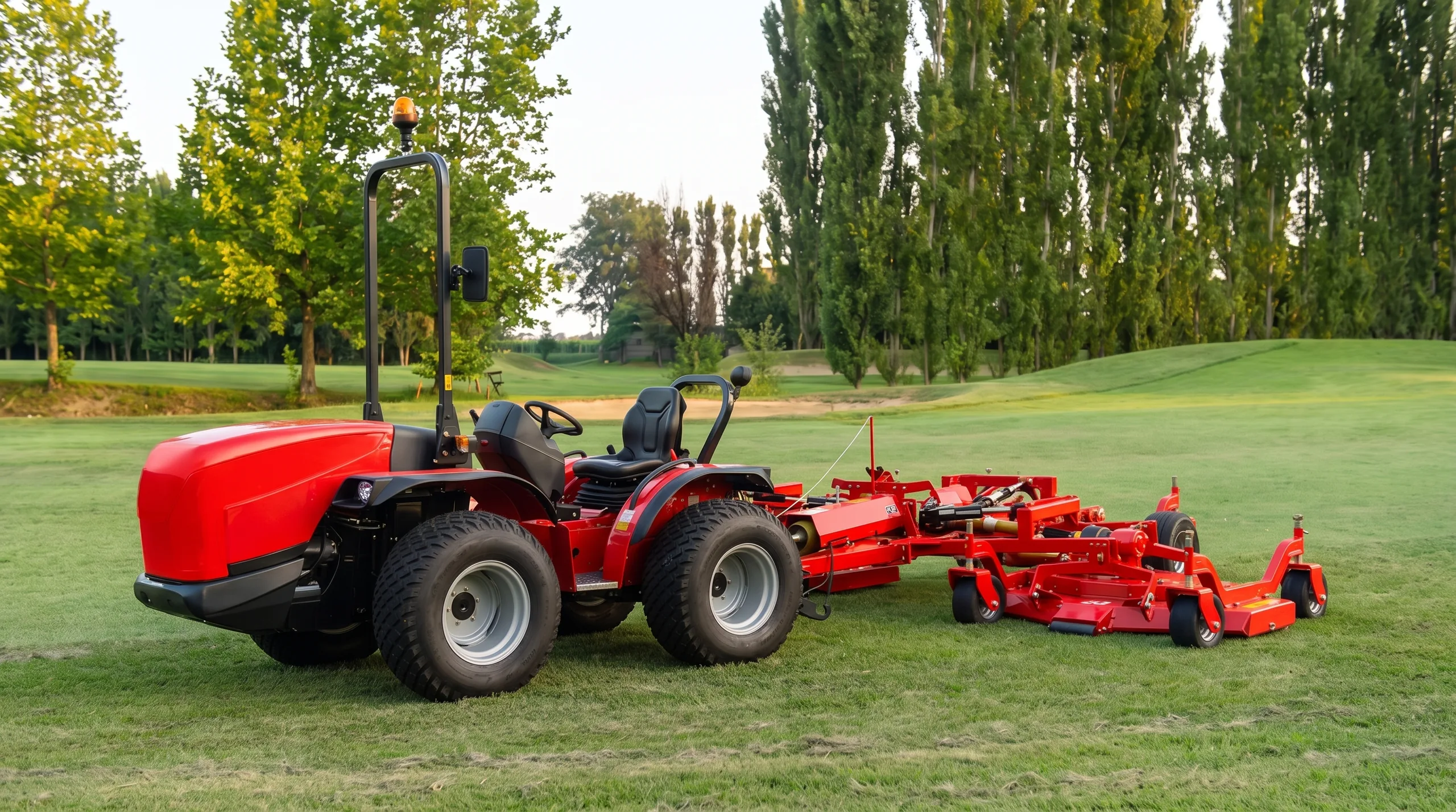
On a reversible tractor (in Italian “reversibile”, at Antonio Carraro “Rev-Guide”) the complete driver module turns round: seat, steering wheel, dashboard and the suspended pedals sit on a platform that you turn 180 degrees in a few seconds. On older models it is secured with a locking pin; on newer ones it works with a lever. A changeover valve makes sure the steering also turns the right way in reverse. From then on you drive with the linkage and the PTO in front of you instead of behind you.
The aim is simple: you can see the implement all the time. A flail mower along a bank, a sweeper brush on a yard, a snow blower, a shredder or a sprayer in the orchard: everything you would otherwise have to watch over your shoulder is now straight ahead of you. If you mow or sweep all day, your neck and back will thank you. A hydrostatic transmission makes it even easier, because you drive steplessly in both directions without using the clutch or changing gear. Mechanical gearboxes usually have a synchronised shuttle, so all gears are available in both directions.
Important to know: reversible and articulated are two separate features. There are reversible articulated tractors (Ferrari Mizar and Vega AR, BCS Valiant and Vithar AR, Antonio Carraro SRX), reversible tractors with steering wheels (Ferrari Vega RS, Carraro TRX and TTR, Valpadana IS) and non-reversible articulated tractors. In the 25 to 35 hp class, where the BCS Invictus, Ferrari Cromo 35 and Pasquali Siena 35 sit, the driving position is not reversible as standard. In practice, reversible starts with the 50 hp models such as the BCS Valiant 60 and the Ferrari Mizar 70, and is standard or optional on the 75 hp models (Vega, Vithar, Volcan). So if you are looking for a reversible machine for a council or a landscaper, you will almost automatically end up with Antonio Carraro, Valpadana or the heavier BCS group models.
The ordinary compact tractor: steering front axle and large rear wheels
The classic compact tractor, such as the Kubota B series, the Iseki TX and TU or the Yanmar F series, has a rigid chassis, small steering front wheels, large rear wheels and a higher seat platform. It is designed to pull and lift: most of the weight is on the rear axle, the linkage is high and the bonnet is clear for a front loader. The centre of gravity is higher than on an isodiametric tractor and the turning circle is larger, but on flat land with a front loader, a tipping trailer or a rotavator that is rarely a problem.
For comparison: a new 26 hp Kubota B2-261 lifts about 970 kilos at the ball ends, has a hydraulic pump of just over 33 litres per minute and costs around 21,000 euros excluding VAT at the dealer (indicative). An articulated tractor of the same 26 hp lifts around 1,000 kilos, pumps some 16 to 22 litres per minute and usually costs more new. On the used market, Japanese compact tractors are also available in far greater numbers and at lower prices, and parts supply is broad.
Articulated, reversible or compact tractor: the differences side by side
| Articulated tractor (AR) | Isodiametric with steering wheels (RS) | Reversible tractor | Ordinary compact tractor | |
|---|---|---|---|---|
| Steering | Centre pivot between front and rear half | Steering front wheels, rigid chassis | Articulation or wheels, driving position turns | Steering front axle |
| Wheels | Four equal wheels | Four equal wheels | Four equal wheels | Small front, large rear |
| Turning circle 25-35 hp | Approx. 2.3 m | Approx. 2.7-3.0 m | As articulated or RS | Approx. 2.5-3.5 m (indicative) |
| Rear wheels follow front track | Yes | No | Depends on type | No |
| Centre of gravity | Very low | Very low | Very low | Higher |
| Across a slope | Take care when articulating | Good | Depends on type | Moderate |
| Implement visible at the front | No | No | Yes | No |
| Front loader | Possible to a limited extent | Possible | Rarely | Standard option |
| Heavy soil work | Limited | Limited | Limited | Good |
| New price 25-35 hp | High | High | High (from approx. 50 hp) | Lower, many used machines |
Why an articulated tractor?
You choose an articulated tractor for three reasons: the smallest turning circle in its class, rear wheels that run exactly in the track of the front wheels, and a centre of gravity lower than on any ordinary compact tractor. In an orchard, vineyard, nursery or greenhouse, where you have to get round a tree or post every ten metres, that saves hours and damaged trees every day. Driving straight up a slope, a 1,000 kilo isodiametric tractor with four-wheel drive is also remarkably stable and has good pulling power. The downside: an articulated tractor costs more new than a Japanese compact tractor with the same hp, is not built for heavy soil work, loses stability when you articulate across a slope and is less practical with a front loader. If you mainly work on flat land with a front loader, tipping trailer and rotavator, an ordinary compact tractor is cheaper and a better fit. If you work between rows, choose articulation.
Articulated or compact tractor: which suits your work?
- Orchard, vineyard, nursery, greenhouse and narrow rows: articulated tractor (AR). The rear wheels that follow the front track and the turning circle of just over two metres beat everything else here.
- Slopes and banks: isodiametric with steering wheels (RS) or a Dualsteer. Straight up and down, articulation is fine, but if you drive across a lot, you are better off with a rigid chassis. For haymaking on really steep slopes there is the MT version.
- Landscaper, council, verges, sweeping, snow: reversible tractor, preferably hydrostatic. Implement at the front, a clear view of it, and back and forth without changing gear.
- Flat land, livestock, hobby farmer with front loader and tipping trailer: ordinary compact tractor. Cheaper, wider choice, a front loader without compromises and enough pulling power for a rotavator or a small plough.
- Limited width (paths, greenhouses, gates): look at the Micro and Junior versions of around 95 centimetres wide, or a 750 kilo Goldoni Base 20.
What can you realistically do with 25 hp? Enough for a flail mower of 1.20 to 1.40 metres, a rotavator of just over a metre, a mist sprayer for the orchard, a tipping trailer of a few tonnes and a sweeper. From 25 hp engine power you usually have 20 to 22 hp left at the PTO; pulling power is more a matter of weight and traction than of hp, and that is where a 1,000 kilo isodiametric tractor with four-wheel drive does surprisingly well.
What to look for when buying an articulated tractor
All 25 to 35 hp articulated tractors from the BCS group run on a Kubota engine: the three-cylinder D1105 (1,123 cc, 25 to 26 hp) in the Invictus K300, Cromo 35 and Siena 35, and the four-cylinder V1505 (1,498 cc, 35.6 hp) in the Invictus K400, Cromo K40 and Siena K6.40. In this class Antonio Carraro and Valpadana use Yanmar engines (3TNV76 and 3TNV88), while Goldoni chose Lombardini. That directly determines how easy and affordable filters, glow plugs, water pumps and gaskets are to get: for Kubota and Yanmar they are on the shelf, for Lombardini and VM the choice is narrower. Also check for play in the centre pivot (with a helper at the steering wheel you feel it straight away), leaking steering cylinders, the condition of the hydraulic hoses across the pivot, and test the reversing mechanism and the PTO under load. More on that in the blog on the most popular models.
Frequently asked questions
What is the difference between an articulated tractor and a reversible tractor?
An articulated tractor steers via a pivot in the chassis; a reversible tractor has a driving position (seat, steering wheel, pedals) that turns 180 degrees so you work with the implement in front of you. They are two separate features: there are reversible articulated tractors (Ferrari Vega AR, Carraro SRX) and reversible tractors with steering wheels (Carraro TTR, Valpadana IS).
What do RS and AR mean on BCS, Ferrari and Pasquali?
AR stands for articolato: an articulated chassis. RS stands for ruote sterzanti: a rigid chassis with steering front wheels. So RS does not mean reversible. Dualsteer (DS) combines articulation and steering front wheels, SDT has larger rear wheels and Junior is the entry-level version.
Is a BCS Invictus or Ferrari Cromo reversible?
No. The BCS Invictus K300 and K400, the Ferrari Cromo 35 and K40 and the Pasquali Siena 35 and K6.40 have a fixed driving position. Reversible starts with the 50 hp models such as the BCS Valiant 60 and Ferrari Mizar 70, and with Antonio Carraro (TTR, TRX, SRX) and Valpadana IS.
How big is the turning circle of an articulated tractor?
A BCS Invictus K300 or K400 in articulated form (AR) turns in about 2.3 metres; the same tractor with steering wheels (RS) needs 2.7 to 3 metres. A larger BCS Volcan with Dualsteer gets down to 2.2 metres (factory figures, indicative).
Which engine is in a 25 to 35 hp articulated tractor?
On BCS, Ferrari and Pasquali a Kubota D1105 (3 cylinders, 1,123 cc, 25 to 26 hp) or V1505 (4 cylinders, 1,498 cc, 35.6 hp). On Antonio Carraro and Valpadana a Yanmar 3TNV76 or 3TNV88. On Goldoni a Lombardini. Filters, glow plugs and water pumps for Kubota and Yanmar are common parts.
Product tip: filters for the Kubota and Yanmar engines in articulated tractors
- Filter set BCS Invictus K300/K400, Ferrari Cromo K40 and Pasquali Siena K6.40 (SKU-10092): oil, fuel and air filter for the Kubota D1105 and V1505 in the BCS group.
- Filter set Antonio Carraro TTR 4400 and Tigre 3800/4000 with Yanmar 3TNV88 (SKU-100150).
- Fuel filter for BCS Invictus, Ferrari Cromo, Pasquali Siena, Carraro TTR 4400 and Valpadana (SKU-150005).
- Air filter BCS Invictus, Ferrari Cromo K40, Pasquali Siena and Carraro TTR 4400 (SKU-20004).