



Articulated tractor faults: will not start, heavy steering, linkage does not work, PTO will not engage
Articulated tractor faults fall into two groups: the engine faults any Kubota D1105, V1505, Yanmar 3TNV88 or Lombardini can have (will not start, smokes, runs hot, oil pressure light), and the faults typical of an articulated or reversible tractor: heavy or jerky steering, play in the centre pivot, a linkage that will not lift, a hydrostatic drive that is weaker forwards than in reverse, a PTO that engages intermittently and a start safety switch that does nothing. In this blog we cover both groups by symptom, with the likely cause and the fix.
The engine faults come from the official Kubota and Carraro troubleshooting tables; the machine faults from the same manuals, supplemented with experiences from owners and workshops. Further down you will find, per make and model, which engine is fitted and which problems owners of BCS, Ferrari, Pasquali, Antonio Carraro, Valpadana and Goldoni report most often, with a note on whether it is a single case or a recurring pattern. Part numbers are for reference: always verify them against your machine’s serial number.

Articulated tractor will not start or starts badly
| Symptom | Likely cause | Fix |
|---|---|---|
| Starter motor does nothing, no click | Start safety switch: clutch pedal not fully depressed, PTO engaged, seat switch, reversing platform not locked; or flat battery, corroded earth cable, ignition switch | Press the pedal fully down, PTO off, sit on the seat, lock the platform. Then measure battery voltage and earth, test the switches |
| Starter motor clicks but does not turn | Battery too weak, poor terminal clamp, worn starter motor or solenoid | Charge the battery and load test it, clean the clamps; replace the starter motor (note 9 or 13 teeth on the Kubota 05 series) |
| Turns over, will not fire in the cold | Faulty glow plugs or glow relay, oil too thick, summer diesel in frost | Preheat for 10 to 20 seconds; measure glow plug resistance (approximately 0.9 ohm on Kubota), check relay and supply; 10W-30 or 15W-40, winter diesel |
| Turns over, will not fire, even when warm | No fuel: tap closed, air in the system after a filter change, blocked filter, water in the sediment bowl, stop solenoid does not pull in | Bleed via the filter housing and pump, replace the filter, drain the sediment bowl, check the stop solenoid clicks with the ignition on |
| Fuel reaches the pump, but does not get through | Lift pump sucks air (reported by owners after fitting a cheap replacement lift pump), cracked line on the suction side | Check the suction side, original or good-quality lift pump, bleed again |
| Starts badly and smokes white | Poor compression (valves, piston rings), incorrect injection timing, water in the fuel | Measure compression (Kubota 05 series: limit 2.26 MPa), have the injectors tested, replace the fuel |
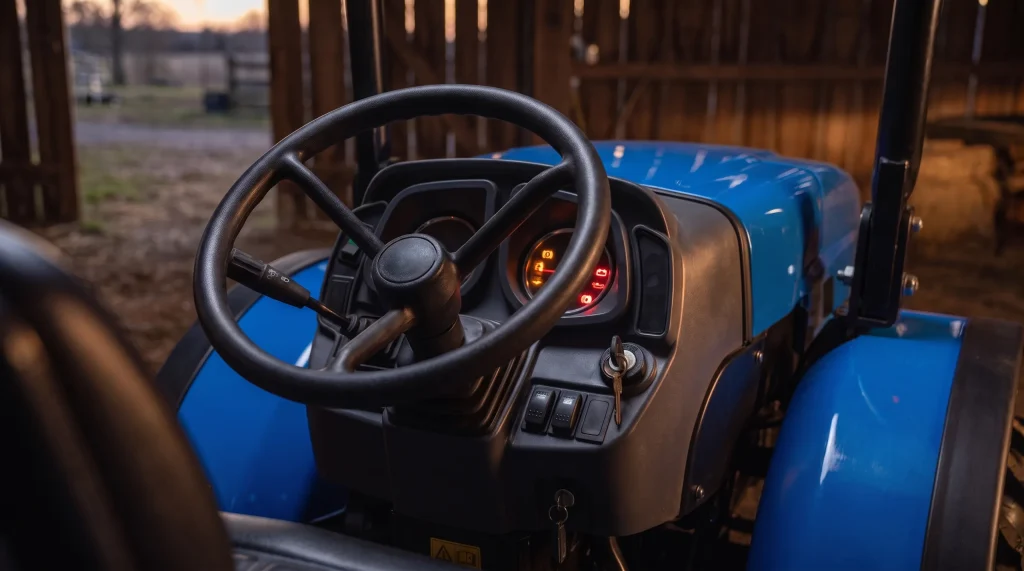
The small Kubotas have a detail that is often overlooked: the start safety switch on the clutch pedal. The Carraro manual literally lists it as the first cause of a starter motor that does nothing. On a reversible tractor, the lock on the turntable is added to that.
Articulated tractor steering is heavy, jerky or uneven
On an articulated tractor all steering force goes via the orbitrol (the steering valve under the steering wheel) to one or two steering cylinders at the centre pivot. Workshop experience with articulated machines keeps showing the same picture: the orbitrol rarely fails, the steering cylinder does.
- Heavy steering to one side, or the steering wheel “runs on” when stationary: internal leakage past the piston of the steering cylinder. Oil flows from one chamber to the other, so you have to turn more for the same angle. Fix: a seal kit for the steering cylinder, or an exchange cylinder. On the Carraro Tigre series the orbitrol is an OSPM 50 type (for reference); a seal kit for the cylinder is almost always the cheaper and correct first step.
- Heavy steering to both sides, worse at low revs: oil level too low, blocked hydraulic filter, worn pump, or air in the system after a hose or cylinder change. Level and filter first, then measure pump pressure.
- Jerky or knocking steering, noise from the centre pivot: play in the bushes and pins of the pivot or in the cylinder eyes. Have someone move the steering wheel back and forth while you watch the pivot. Replace worn bushes; carrying on too long also wears the pin and the housing.
- Steering works the wrong way round after turning the seat: the changeover valve of the reversing mechanism does not switch over. Check the platform lock and the valve.
- Oil trail across the centre pivot: a hose chafing against the chassis. Replace it before it bursts, because then you lose the power steering in one go, and often the linkage too.
Linkage will not lift, drops or shakes
- Linkage does not lift or lifts slowly: implement too heavy (the small models lift 500 to 1,050 kilos at the ball ends, less further out), oil level in the gearbox too low, blocked hydraulic filter, system pressure too low. Carraro lists exactly these three in its troubleshooting table: weight, oil level and pressure. Level and filter first, then have the pressure measured (Invictus: 125 bar, TTR 4400: 130 to 140 bar, for reference).
- Linkage drops slowly with an implement: leakage past the lift cylinder or the control valve. On a Junior version with a single cylinder that is a smaller job than with a double one.
- Linkage works, but the power steering drops out when you lift: on machines with one pump for both functions, a sign of a worn pump or a priority valve that no longer closes.
- Milky oil when draining: water in the gearbox, usually condensation or a leaking breather. Change the oil with the filter, and check the gearbox breather.
PTO engages intermittently or slips
On the Cromo, Invictus and Siena with electro-hydraulic PTO engagement, owners report a PTO that engages one time and not the next, and a selector that crunches when you change position while driving. In the cases we came across, the transmission oil had never been changed. So start with the oil and filter; then the electrical controls (switch, relay, connector at the valve) and only then the wet multi-plate PTO clutch. On the mechanical PTO of the Junior versions, a slipping PTO is a matter of the control cable or the clutch itself. A PTO that runs synchronised with the gearbox stops as soon as you press the clutch; that is not a fault, but the nature of a ground-speed PTO.
Clutch: judder, slipping or not releasing
The Invictus, Cromo and Siena have a dry single-plate clutch. Judder on engagement points to a worn or glazed plate or a warped pressure plate; slipping under load to a worn plate or too little free play; not releasing after winter to a plate that has rusted onto the flywheel (see the storage blog). With heavy front loader work or a lot of stopping and starting, the plate wears faster than with mowing. A clutch kit for the Invictus comes in two diameters (210 and 216 mm, for reference), so measure or check by serial number. On the Carraro TTR the “clutch” is a hydrostatic drive: there, a free play of about 15 mm at the pedal is the only adjustment.
Hydrostatic drive (Carraro TTR): weak forwards, fine in reverse, runs hot
A classic case from practice with the TTR 4400 HST: the machine drives in reverse with full power, but forwards it is weak and slow, and the oil gets hot. The cause was not in the pump but in the pedal linkages that had come loose, and in a pressure relief valve that stuck half open. With a complaint like this, always test in the opposite driving direction (turn the seat round): if the weak direction stays on the same side of the pump, the problem is in the hydrostatic circuit; if it changes with it, the problem is in the controls. Otherwise the same applies to every hydrostatic drive: oil level, the hydrostatic filter as soon as the clogging light comes on (and every 400 hours), the right oil for the temperature, and a clean oil cooler. Sluggishness at low revs is normal for a hydrostatic drive; give it some revs.
Engine runs too hot
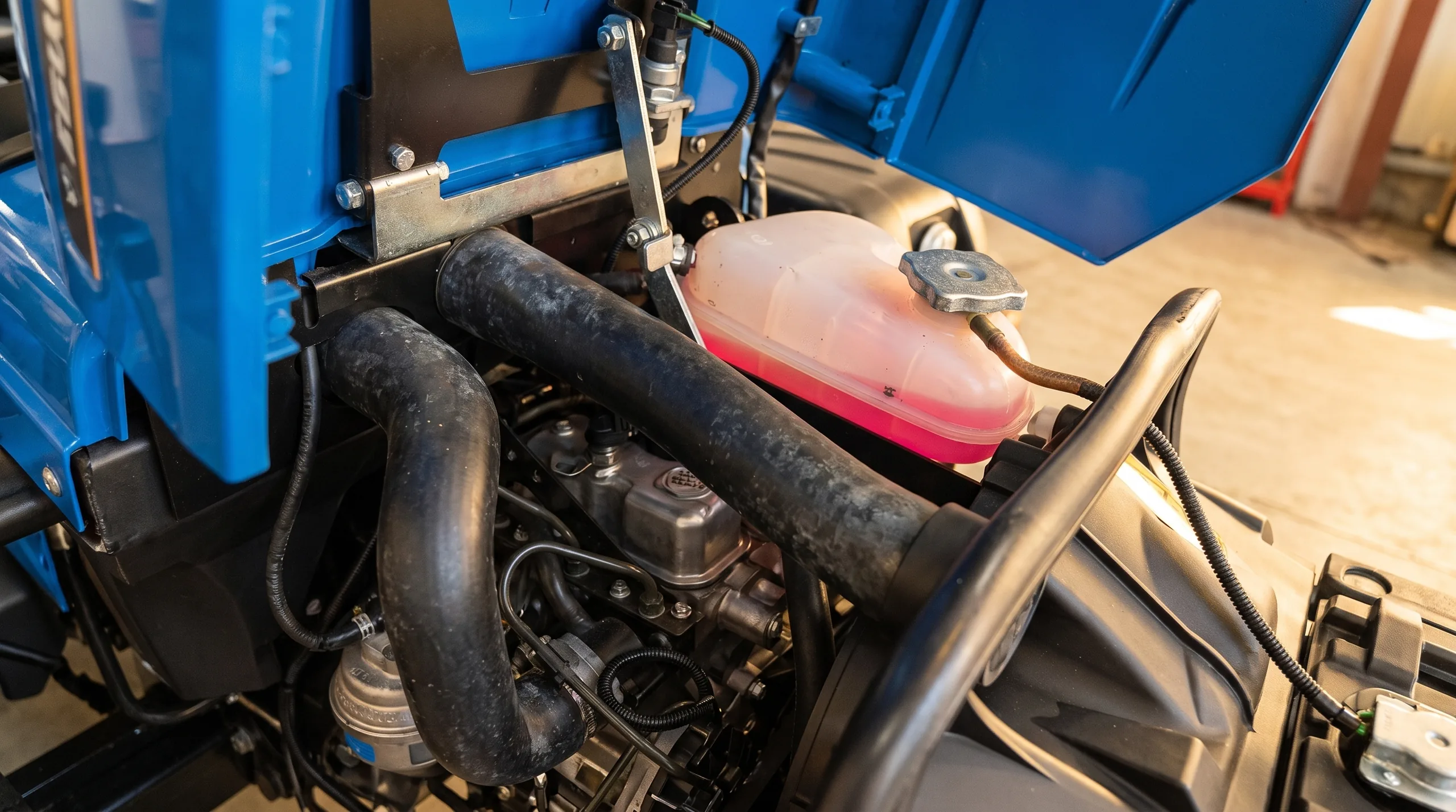
The radiator of an articulated tractor sits low and behind a flail mower. In practice, clogged fins are the number one cause of overheating, ahead of the thermostat and the water pump. Kubota’s troubleshooting table also lists: oil level too low, loose or broken V-belt, too little coolant, thermostat not opening (it should open at 69.5 to 72.5 °C), leaking head gasket and overloading. On the air-cooled Goldoni Base 20: cooling fins and fan. Clean the radiator with compressed air or running water from the inside out; never with a screwdriver between the fins. Air in the cooling system that kept coming back after replacing the head gasket turned out, on a D1105 in practice, to come from twisted injector sleeves; in that case have the head checked.
Smoke, oil pressure and charging (Kubota D1105/V1505)
| Symptom | Cause | Fix |
|---|---|---|
| White or blue smoke | Too much oil in the sump, worn piston rings or cylinders, incorrect injection timing | Correct the level, measure compression, have the timing adjusted; with wear, an in-frame overhaul kit (pistons, rings, bearings, gaskets) |
| Black smoke | Overloading, blocked air filter, poorly spraying injectors, poor fuel | Replace the air filter and fuel filter, have the injectors tested (opening pressure 140 bar) |
| Oil pressure light on with a warm engine | Level too low, wrong viscosity, blocked oil strainer, relief valve, worn bearings, oil pressure switch | Level and oil, replace the switch and measure the pressure (limit 147 kPa at rated speed, 49 kPa at idle) |
| Charge light on, battery goes flat | Slipping or broken V-belt, faulty alternator or rectifier, poor earth | Tension the V-belt (7 to 9 mm deflection at 98 N) or replace it, test the alternator |
| Water in the oil, oil in the coolant | Head gasket, cracked head or block | Replace the head gasket with a head set; have the head skimmed and pressure tested |
Other complaints from practice
- Hand throttle will not stay put (Carraro Tigre 3200): worn locking nut or lever friction; the oscillating movement of the chassis can affect controls if cables are adjusted too tight.
- Forward/reverse lever sticks: on new machines a warranty case; on older ones the cable, the pivot points and the shuttle adjustment.
- Engine stalls as soon as the hydraulics are loaded: in one reported case, injection timing that had been knocked out after hydraulic work. A healthy 25 hp engine should not stall at full lift.
- Rear drive drops out (older Pasquali): broken drive shaft or splined sleeve between the gearbox and rear axle.
- Oil at the PTO stub: PTO shaft oil seal (on older Pasquali a 25x52x7, for reference).
- Brakes: long pedal travel or uneven: adjust, on hydraulic brakes (Carraro) bleed and check the DOT 3 brake fluid, on drum brakes inspect the brake shoes and adjusters.
Which engine is in my articulated tractor?
With a fault, the first question is which engine is fitted, because that determines which glow plugs, filters, water pump, thermostat and gaskets you need. The model name does not always tell you: the same type name has often had two or three engines over the years. The table below is compiled from factory brochures and parts lists by serial number; always check the type plate on the engine block.
| Model | Engine (years indicative) | Details |
|---|---|---|
| BCS Invictus K300 / Ferrari Cromo K30 and 35 / Pasquali Siena K6.30 and 35 | Kubota D1105, 3 cyl., 1,123 cc, 25-26 hp (2011 to date; Stage V version since 2022) | Indirect injection, glow plugs, no particulate filter. Dry single-plate clutch, drum brakes |
| BCS Invictus K400 / Ferrari Cromo K40 / Pasquali Siena K6.40 | Kubota V1505, 4 cyl., 1,498 cc, 35.6 hp (2011-2023) | Same parts family as the D1105 (oil filter M20x1.5, glow plugs, thermostat 71 °C) |
| BCS Invictus K600 MT | Kubota V2203 M-DI, 2,197 cc, 48 hp | Wet multi-plate clutch |
| BCS Vivid 300 / 400 / 35 | Lombardini LDW 1003 / LDW 1404 / Kohler KDW 1404, 26-34 hp | FOCS engine with timing belt; no electronics, no particulate filter |
| BCS Valiant 60 / Ferrari Cobram 60 / Pasquali Eos 60 | Kohler KDI 1903 TCR, 3 cyl., 1,861 cc, 49 hp (Stage V) | Common rail, EGR, DOC + particulate filter (DPF) with regeneration; wet clutch |
| Ferrari Cobram 50 / 55 (2010-2015) | Lombardini LDW 2204 (4 cyl.) / VM 3 cyl. 49 hp | Differs per version; check the type plate |
| BCS Vithar 750 / 850 / 950 (2006-2016) | VM 3 cyl. turbo 2,230 cc 70 hp / VM 4 cyl. 2,970 cc 79 and 91 hp (D703/D754 family) | Wet multi-plate clutch, wet brakes, electro-hydraulic PTO |
| BCS Vithar 85, Volcan 85 and L80 / Ferrari Vega 85 / Pasquali Orion 85 | Kohler KDI 2504 TCR, 4 cyl., 2,482 cc, 75 hp | Stage V with DPF + DOC (L80 as Stage IIIB with EGR + DOC) |
| BCS Vithar K90 and Volcan K90/K105 / Ferrari Thor K90 / Pasquali K90 models | Kubota V3800 CR turbo, 4 cyl., 3,769 cc, 75-98 hp | Common rail; starter motor and alternator differ from the 05 series |
| Ferrari Thor F90 / Thor 95 / Pasquali Orion 8.85 | VM D754 / D704, 4 cyl., 2.8-3.0 l, 82-95 hp | Separate starter motor (2.3 kW, 9 teeth) |
| Antonio Carraro Tigre 3200 | Lombardini (until approx. 2011) / Yanmar 3TNV76, 1,115 cc, 26 hp (current) | 3TNV76 has indirect injection with glow plugs |
| Antonio Carraro Tigre 4000 / Tigre Country 4300 / Tigre 4400 F | Yanmar 3TNV82A turbo 31 hp / Lombardini LDW 1503 / Yanmar 3TNV88 | Three different engines in one model family |
| Antonio Carraro TTR 4400 HST (1999 to approx. 2007) | Yanmar 3TNE88, 1,642 cc | Predecessor of the 3TNV88; many parts the same, filters by serial number |
| Antonio Carraro TTR 4400 HST (approx. 2007 to 2021) and TTR 4400 II | Yanmar 3TNV88-BDCR / -DCR, 1,642 cc, 38 hp | Mechanical direct injection, no particulate filter |
| Antonio Carraro TTR 3800 HST II / TTR 4800 HST (current) | Yanmar 3 cyl. 25.7 hp / Yanmar 1,568 cc common rail turbo 38.7 hp | Stage V |
| Antonio Carraro Tigretrac 3800 HST | Lombardini LDW 1503B, 34 hp (also a Perkins variant) | |
| Antonio Carraro TTR 7600 Infinity | Kohler KDI 2504 TCR, 2,482 cc, 75 hp | Stage IIIB, later Stage V |
| Antonio Carraro TTR / TRX / SRX / TGF 7800 and 9800 | Yanmar 4TNV98(T), 4 cyl., 3,319 cc, 70-85 hp | Common rail on the Stage V versions |
| Antonio Carraro TTR / TRX / SRX 8400, 9400, 10400 and TGF 9400/10400 | VM D703 (3 cyl.) / D704 and D754 (4 cyl.) | Same VM family as the older BCS Vithar and Ferrari Thor |
| Antonio Carraro TRX 9900 / TTR 10900 | Kubota V3800, 3,769 cc, 89 hp | |
| Antonio Carraro Tigrone / Supertigre (1980s-90s) | VM 298, VM HR394, Ruggerini P101, Lombardini 11LD626 | Engine parts for Ruggerini are scarce |
| Valpadana 4630 / 4645 / 4655 | Yanmar 3TNV76 (1,115 cc, 23 hp) / 3TNV88 (1,642 cc, 35 hp) / 4TNV88 (2,189 cc, 47 hp) | 3TNV76 indirect injection; 3TNV88 and 4TNV88 mechanical direct injection |
| Valpadana 2730 HST | Yanmar 3TNV76 | |
| Valpadana 6560 / 6575 (2006-2018) | Yanmar 4TNV84T turbo 54 hp / John Deere 4024TF 2.4 l turbo 67 hp | So the 6575 has no Yanmar; parts via the John Deere engine line |
| Valpadana VP 1545 / 1550 / 1560 (2017) | Yanmar 4TNV84 / 4TNV88 / 4TNV84T | |
| Valpadana VP 1550 / 1560 (current) | Kohler KDI 1903 TCR, 49 and 57 hp, Stage V | |
| Valpadana VP 7000 / 9000 | FPT F5A 3.2 l (2016) or Deutz TCD 2.9 l (2020), depending on year of manufacture | |
| Goldoni Base 20 | Lombardini 12LD475/2, 2 cyl., 954 cc, air-cooled, 22 hp | No coolant; keep the cooling fins and fan clean |
| Goldoni Boxter 25 | Yanmar 3TNV76 | Same engine as the Valpadana 4630 and Carraro Tigre 3200 |
| Goldoni Euro 30 / 40 (old) | Lombardini 9LD626/2 and 11LD626/3, air-cooled | |
| Goldoni Euro 40 EVO, Aster 35, Idea 40 | Lombardini LDW 1503 (CHD) | Gear-driven timing, hydraulic tappets |
| Goldoni Euro 45 EVO, Ronin 40/50, Aster 45 | Lombardini LDW 1603 / LDW 2204 (CHD) | |
| Goldoni Maxter 60 / Cluster 70 | VM D703 (L, E3, IE3) | |
| Goldoni Star 3050 / 3070 / 3080, Energy 80, Quasar 85 | VM HR394 and HR494 (older) / VM D754 and D704 (newer) | Glow plugs and glow controller due for replacement around 4,000 hours |
| Goldoni (Keestrack, 2021 to date) | Doosan and Hyundai G2 engines, Stage V |
Known problems per make and model
What follows comes from experiences of owners and workshops in Italy, Germany, Austria, the Netherlands, Belgium and the United States, from trade magazine tests and from parts lists. For each point we indicate whether it is a single reported case or something that several owners report independently of each other. An honest caveat first: surprisingly little fault information can be found on the modern models (Invictus, Cromo, Siena, Valiant, TTR 4400 II, Tigre 3200, Valpadana 4600). That is partly good news, because they are simple machines with reliable Kubota and Yanmar engines. Older models are much better documented, and that is also where most of the used machines are.
BCS Invictus, Ferrari Cromo and Pasquali Siena (Kubota D1105/V1505)
The three makes come from the same factory and share chassis, axles, gearbox and engine; only the colour, the hydraulic options and the dealer differ. So a problem reported on one colour usually applies to the other two as well.
- Crunching, notchy gear changes, especially between ranges. Several owners and also a trade magazine test of the Cromo K40 report that the range change is stiff and “almost always” crunches, and that this does not improve over the years. The cause is not a defect: the range gearbox is not synchronised. Fix: only change range when stationary, and change the gears themselves with the clutch fully depressed and a little patience.
- Selector and gears start to crunch after an hour or two of work (Cromo K40, 316 hours). The transmission oil, which on these machines is also the hydraulic oil, had never been changed; only the filter had been replaced. Fix: change the oil and filter together, using the oil your model’s oil chart specifies. One reported case, but a classic cause.
- Electro-hydraulic PTO engages intermittently. Same machine, same old oil. First oil and filter, then the switch, relay and the connector at the valve.
- Starter motor does nothing. On these models the start safety switch sits on the clutch pedal and the PTO. Press the pedal fully down, PTO off. Only then the battery, earth cable and the stop solenoid (the 12 volt solenoid on the injection pump is a common wear part on the Kubota 05 series).
- Rust and ageing plastic. Owners in the Alps report that the chassis has no real anti-corrosion primer and that plastic parts fade and become brittle. For winter service use or near the sea: extra protection.
- Maintenance points are sometimes hard to reach. The hydraulic oil level is behind a small cover near the pedals, grease nipples are hidden and the battery is under the tank. Not a defect, but a reason why maintenance on these machines is often skipped.
What owners praise: the manoeuvrability, the low fuel consumption, the quiet Kubota and the hydraulics that “really have power” where competitors cut corners. Wear parts that parts shops offer for the Invictus K400 and Invictus 35: air, oil and fuel filters, clutch plates and complete clutch kits in several variants (so measure or order by serial number), release bearing, clutch cable, top and bottom radiator hoses, expansion tank, throttle cables, V-belt, alternator, fuel gauge float and the gear lever gaiter. The hydraulic filter is the same cartridge for almost the entire older BCS group (BCS 581A3617, formerly 58173642, for reference).
BCS Valiant, Ferrari Cobram and Pasquali Eos (49-60 hp)
- Shuttle crunches in reverse, gears feel “rubbery”, wet clutch drags. Reported on a Vithar with 4,500 hours and on a Vanguard 500; two reports. The suspicion in both cases: a UTTO oil that is not suitable for wet multi-plate clutches, or a clutch that does not fully release. On models with a wet clutch (Valiant, Cobram, Vithar, Volcan, Vega) the oil specification is therefore not a minor detail.
- Centre section broken after 190 hours (Valiant 500 RS). First the gears jumped out, then the nose dropped on the road. One reported case, cause not established; the owner blames road use with potholes. It does teach you something: noise or play from the centre section of an articulated tractor is never something to wait and see about.
- Exhaust cracked after about 100 hours due to vibration (Valiant 500). One reported case.
- Electrical (Cobram 55 AR, 5 years old, steep slopes): dashboard full of condensation, thin and partly unprotected wiring, flimsy socket. One report, but described in detail. Prevention: keep connectors and dashboard dry, check the wiring for chafing.
- Digital rev counter fails (Ferrari Vipar 30): faulty voltage regulator. One case.
What owners praise: the Cobram 50 AR with Lombardini four-cylinder “without any problems” since 2010, the 12+12 shuttle gearbox, the electronically controlled PTO soft start that spares the equipment, and the stability on steep slopes.
BCS Vithar and Volcan, Ferrari Thor and Vega, Pasquali Orion and Mars (70-100 hp)
- Tractor rolls away with the engine off. Leaving it in gear does not hold it; the handbrake is a must. Design characteristic, not a defect.
- VM three-cylinder turbo (Vithar 750, Cobram 55): loud and some black smoke, even without heavy load. Several owners call the three-cylinder “heavily loaded” compared with the four-cylinder. The four-cylinder VM, on the other hand, is praised for its low-down torque.
- Overheating when mulching steep verges (Orion 850). Even after an overhaul and a new radiator core, the engine was still too hot after two hours; one reported case, unresolved. The water pump and dirt build-up in the engine bay are the next suspects.
- Dualsteer. One owner of a 95 hp model reports wear, seizing and broken gear teeth in the Dualsteer system after two years; another owner calls the manoeuvrability “exceptional”. Two opposite experiences, so test the system thoroughly on a used machine with Dualsteer.
- Stage V models with Kohler KDI (Valiant 60, Vega 85, Vithar 85, Volcan 85): these have a particulate filter with regeneration. There are no owner reports of problems yet, but a particulate filter needs regular work at operating temperature; short runs at idle are bad for it. The Invictus 35 and Vivid 35 have no particulate filter.
Antonio Carraro Tigre, TTR, TRX, SRX and TGF
- Hydraulic oil loss, after which steering and linkage fail. This is the most reported complaint on Carraro, across several models (TTR 8400, SRX 10900, TRX 9400). A leaking hose, often the return line at the centre pivot or in the centre tunnel, slowly empties the reservoir until the pump sucks air. Symptoms: heavy steering when mowing, foam in the reservoir at high revs, oil under the front axle, hydraulic oil pressure warning light. Fix: replace the hose, top up, bleed. For two owners of a TTR 8400 it was exactly the same hose.
- Weak brakes on older and mid-sized models (drum brakes). Widely known. Dust and oil on the brake shoes; after replacement they are often not adjusted properly via the hole in the backplate. On the HR 6500 the brake worked on one side only: brake balance valve. The TTR 4400 brakes on the rear axle only as standard; hydraulic four-wheel braking was an option, so take care with a trailer downhill.
- Radiator clogged and engine too hot when flail mowing and mulching, also when working in reverse with the mower in front of the radiator. Several reports, from Tigrone 5500 to TGF. Clean the screen and fins daily.
- Stiff or “wobbly” steering. On a Tigrone 5500 there turned out to be 15W-40 engine oil in the hydraulics instead of the specified tractor oil; after changing the oil and filter (8 litres) the problem was gone. On a Tigrone 7700 everything pointed to the orbitrol (around 1,000 euros). Internal leakage in the steering cylinder and a low oil level are the other common causes.
- Hydrostatic drive TTR 4400 HST. Several independent reports: weak forwards and strong in reverse (pedal linkages, forward pressure relief valve that sticks, also causes heat); a hydraulic pump where only the third one was good; a leaking hydrostatic oil seal that made the oil disappear into the engine sump (2002 model); a broken pedal linkage connector that required the whole control valve to be replaced; a broken rear left drive shaft after 2,500 hours (1999 model). Owners also find 38 hp with a hydrostatic drive a bit tight on steep slopes. Maintenance rule from the manual: hydrostatic filter and oil after 50 hours and then every 400 hours, or as soon as the clogging light comes on.
- Lowest range hard to engage (TTR 4400, 3,000 hours): worn selector or loosened selector fork lock. One case.
- Clutch. New clutch after about 1,400 hours (TTR 7800), squealing release bearing after 2,400 hours (TGF 10400), clutch complaints on articulated models. Several reports; the release bearing is a common wear part.
- Gears jump out (Tigrone 8008, older non-synchronised gearboxes). Several reports on old models: worn selector forks and selectors.
- Oil seals and weeping transmission when the machine is warm (TN 6500, TRX 9400, TTR 9400, TRX 9900 at the front). Several reports.
- Electrical. A fuse bridged with copper wire that damaged the wiring loom (Tigre Country 4300), a PTO that keeps turning with the switch off (TTR 7400: cold oil makes the plates stick, or the solenoid valve), a joystick controller with no power after a short circuit (SRX 9800), brake lights that stay on. Several separate reports; according to one owner the electrics do not cope well with moisture and dust.
- Hand throttle creeps back (Tigre 3200): worn self-locking nut on the lever. One case, easy to fix.
- Engine stalls as soon as you get off the seat with the PTO running (Tigre 4000): that is the seat switch and it is meant to do that. We advise against bypassing it.
- Tractor keeps rolling after pressing the clutch with a flail mower (Tigre 2600): the mass of the mower pushes through the PTO. Solved with an overrunning clutch in the PTO shaft.
- Fracture at the clutch housing during front loader work (TRX 8400, 2 years old, with a heavy front loader). One reported case; the manufacturer pointed to loose and missing bolts between the engine and transmission. The repair was estimated at many thousands of euros. Lesson: with a front loader on an isodiametric tractor, check the connecting bolts periodically and do not work beyond the loader specification.
- Parts. Opinions differ: one owner gets a hydraulic pump within a week, another waits months or has to buy a complete assembly. The original orbitrol for the TTR 4400 and the TC/TN series is no longer available and is replaced by a common OSPC 50 type (for reference). Brake and clutch cylinders, release bearing, hydraulic pump and brake shoe sets are the common wear parts.
What owners praise: the stability and grip on slopes thanks to the oscillating chassis, the reversible driving position, the low weight, and the Yanmar and VM engines (“uses a bit, but never dies”). In the Alps and South Tyrol, TTRs have been running 300 hours a year for twenty years without major damage.
Valpadana
- Wheel hub oil seals leak oil (6550 ARM under 3,000 hours, 6575 rear left). Two independent reports. The wheel and half shaft have to come off to replace the seal.
- Bushes that fail. A 4645 ISM with 200 hours crept forwards with the clutch depressed: faulty front bush. On a 6575 ISR a bronze/PTFE bush failed and damaged the PTO shaft in the process, especially with heavy implements such as a shredder. Two cases.
- Steering hydraulics. On a 6575 the steering wheel turned when stationary, but the wheels did not respond, and many turns were needed when driving: steering cylinder or orbitrol. Several owners mention leaking steering hydraulics and fuel, oil and water hoses that give out.
- Water in the lever controls (6575 ISR without cab): water got in via the gaiter, after which the internal circuit had to be replaced. One case; on machines stored outside, check the gaiters.
- Water pump failed under 1,000 hours (9065) and overheating on Deutz engines: separate reports.
- Clutch pedal responds unpredictably (96105), which makes manoeuvring in reverse awkward. One case.
What owners praise: the almost 50/50 weight distribution on slopes, the reversible seat, and above all the Yanmar engines; an 8085 with a Perkins ran more than 8,000 hours. Notably, older Valpadanas get praise, while the generation from roughly 2005 to 2015 gets more criticism of build quality. Those are opinions, not failure statistics.
Goldoni
- Power steering heavy or without pressure after an oil and filter change (Star 3050 and the 3000 series). Several reports. Cause: air in the system or a pump that does not build up pressure. Fix: loosen the pressure connection directly after the pump and bleed. An oxidised steering column also gives heavy steering; clean and grease it.
- Glow plugs and glow controller (Star 3050/3070 with VM engine) fail around 4,000 hours; this is seen as normal wear. On a Euro 45 RS (LDW 1603) the preheat light did not come on: hold the key in the intermediate position and preheat for 10 to 15 seconds.
- Fuel filter blocked by contaminated diesel and poor starting after standing (3070): several reports. Tank full and a fresh filter before storage.
- Transmission oil gets too hot during heavy hydraulic work (Star); later versions were given an oil cooler. One report.
- Overheating above 100 degrees during continuous work: dirty radiator or faulty thermostat. One report.
- Base 20: differential locks seized due to oxidation after years of non-use. Degrease, grease and engage with the wheels driven. One case.
- Linkage does not lift enough with a heavy load (Star 3050): not a defect, the relief valve is doing its job.
- Parts after the bankruptcies. Goldoni shut down in 2015, went to Lovol, went into liquidation again in 2020 and has been owned since 2021 by Keestrack, which mentions a parts warehouse with over 30,000 items and a dealer portal. From practice: a hydraulic pump arrived within a week in 2021, while a rev counter for a 1990 machine could not be found anywhere in 2020. Engine parts (Lombardini/Kohler, Yanmar, VM) are the easiest; small body and instrument parts from before 2000 the hardest.
What owners praise: the purely mechanical construction (“an honest tractor”, twenty years of few problems with a 2000 Star 3050), the Dual Power shuttle on the steering wheel, and the Base 20, which dealers call “indestructible”.
The engines themselves: what to look for per engine family
- Kubota D1105 and V1505. The biggest risk is overheating: on these engines a stuck thermostat is more likely to lead to a cracked cylinder head (from the exhaust valve to the pre-chamber) than to a blown head gasket; one mechanic reports dozens of cracked heads against not a single cracked block. Coolant in the oil more often comes from the core plugs or the front gear case gasket than from the head gasket. With diesel leaking at the injector seat: clean the seat and fit one new copper washer, never stack washers. Also: the electric lift pump (engine cuts out at three-quarters of a tank, then starts badly), the stop solenoid and its wiring, an oil pressure light that only comes on below 0.5 bar (measure mechanically first), and two versions of water pump (60 or 70 mm impeller) and starter motor (9 or 13 teeth). Compression below 28 bar after 1,500 to 2,000 hours explains poor starting.
- Yanmar 3TNV76, 3TNV88 and 4TNV88. The mechanically injected versions in the Carraro TTR 4400, Tigre and Valpadana 4600 have no EGR and no particulate filter and are regarded as very reliable; owners rarely name them as the cause of faults. The 3TNV76 has indirect injection with glow plugs, the 3TNV88 direct injection. On the common rail versions (3TNV88C, Stage IV/V) dirty diesel is the enemy: a damaged suction control valve on the high-pressure pump gives rail pressure faults and an engine that stalls after 10 to 15 seconds. Replace the fuel filter and water separator on time, and never fill up from a rusty jerrycan.
- Lombardini LDW. The FOCS engines (LDW 502 to 1404, in the BCS Vivid 400, and in the Cobram 50 as LDW 2204) have a timing belt that must be replaced as soon as it has been removed and that on older engines should simply be replaced on age. The CHD engines (LDW 1503, 1603, 2004, 2204 in the Goldoni Euro EVO, Aster and Ronin) have gear-driven timing and hydraulic tappets. For both: only have injection pumps and injectors overhauled on a test bench, and when fitting the pump do not bend the governor fork (the engine will then run away and will not stop with the lever). Air-cooled Lombardinis (Base 20, old Euro): cold starting is a matter of compression, thin winter oil and good preheating.
- Kohler KDI 1903 and 2504. Common rail with up to six injections per cycle, cooled EGR and DOC; the Stage V versions in the BCS group have a particulate filter. Kohler explicitly warns against dirty diesel and water in the fuel (“serious engine damage”) and against galvanised jerrycans. Fuel filter, pre-filter and water separator every 250 hours. There are hardly any practical reports of EGR or sensor faults yet; the engines are too new.
- VM D703, D754, HR394. Purely mechanical diesels with a good reputation (“thirsty, but never dies”), loud, and on the three-cylinder some black smoke. Glow plugs and glow controller around 4,000 hours, and filters that clog due to dirty diesel. Parts are easy to get through the usual engine suppliers.
Frequently asked questions
My articulated tractor will not start, where do I begin?
With the start safety switch: clutch pedal fully depressed, PTO off, sitting on the seat and, on a reversible tractor, the platform locked. If the starter motor still does nothing, measure the battery and the earth cable. If it turns over but does not fire: preheat for 10 to 20 seconds, measure the glow plugs (approximately 0.9 ohm on Kubota), bleed the fuel system.
Why is the steering on my articulated tractor heavy or jerky?
Heavy to one side or a steering wheel that keeps turning points to leaking seals in the steering cylinder; that is the most common cause, the orbitrol rarely fails. Heavy to both sides: oil level, hydraulic filter, pump. Jerky with noise from the centre pivot: worn bushes and pins in the pivot.
Why will the linkage on my articulated tractor not lift?
Usually an implement that is too heavy (500 to 1,050 kilos at the ball ends on the small models), an oil level in the gearbox that is too low or a blocked hydraulic filter. Then have the system pressure measured (Invictus 125 bar, Carraro TTR 4400 130 to 140 bar, for reference) and check the lift cylinder and control valve for leaks.
Why does my articulated tractor run too hot when mowing?
Almost always a radiator clogged with cuttings and dust, because it sits low and behind the flail mower. Clean the fins from the inside out with compressed air or water, check the V-belt, the coolant level and the thermostat (opens at 69.5 to 72.5 degrees on Kubota). If it still runs hot: water pump and head gasket.
Why will the PTO on my Ferrari Cromo or BCS Invictus not engage?
With the electro-hydraulic PTO, first the transmission oil and filter (in reported cases the oil had never been changed), then the switch, the relay and the connector at the valve, and only then the wet multi-plate clutch. A ground-speed PTO that stops as soon as you press the clutch is not a fault.
What are known problems with the Antonio Carraro TTR 4400?
From owners’ experiences: hydraulic oil loss from a leaking hose at the centre pivot (steering and linkage then fail), a hydrostatic drive that is weaker forwards than in reverse (pedal linkages, pressure relief valve), leaking hydrostatic oil seals, a worn selector for the lowest range, weak drum brakes and a radiator that clogs up when flail mowing. The Yanmar 3TNV88 itself is regarded as very reliable.
What are known problems with the BCS Invictus and Ferrari Cromo?
Mainly the notchy, crunching range changes: the range gearbox is not synchronised, so only change range when stationary. Also a PTO or selector that starts to crunch if the shared transmission and hydraulic oil has never been changed, a start safety switch on the clutch pedal and PTO that blocks the starter motor, and on machines in the mountains or by the sea, rust on the chassis and plastic that becomes brittle. The Kubota D1105 and V1505 themselves are rarely the cause.
Product tip: parts for the most common articulated tractor faults
- Glow plug Kubota D1105/V1505 (SKU-55209), glow relay Kubota (SKU-123007) and glow plug Yanmar 3TNV88 (SKU-551213)
- Starter motor Kubota D1105/V1505, 9 teeth (SKU-129002) and starter motor Yanmar 3TNV88 (SKU-129028)
- Thermostat Kubota 05 series 44 mm (SKU-45005), water pump Kubota D1105/V1505 (VAR-0034) and V-belt (SKU-1240041)
- Head gasket Kubota D1105 (VAR-0052), head gasket V1505 (VAR-65019-1-54) and head gasket Yanmar 3TNV88 for Carraro TTR 4400 (SKU-65084)
- In-frame overhaul kit Kubota D1105 (VAR-850065) and V1505 (SKU-850062)
- Complete injector Kubota D1105/V1505 (SKU-47013-s, standard version SKU-47012-s)
- Fuel filter BCS, Ferrari, Pasquali, Carraro, Valpadana (SKU-150005)