



Winterising and storing an articulated tractor: the checklist for BCS, Ferrari, Pasquali and Carraro
Winterising an articulated tractor is much like winterising any other compact tractor, with a handful of extra points you should not skip on a BCS Invictus, Ferrari Cromo, Pasquali Siena, Antonio Carraro or Valpadana: the centre pivot, the bright rod of the steering cylinder, the shared transmission and hydraulic oil, the reversible driving position and the dry clutch on the small models. Most articulated tractors also stand idle from November to March, because the orchard, the vineyard and the landscaping season are at a standstill. It is exactly those months that cause the expensive damage you find in spring.
This checklist is based on the storage instructions in the Kubota, Yanmar, Lombardini and Carraro manuals, supplemented with the winter damage we see in practice. The general basics (coolant, oil, fuel, battery, tyres, covering) are covered in detail in our general storage checklist for compact tractors, loaders and mini excavators; here we concentrate on what is different on an articulated tractor, and briefly summarise the rest.
Storing an articulated tractor: the extra points at a glance
| Component | Risk in winter | What you do |
|---|---|---|
| Centre pivot (bushes and pins) | Moisture in the bushes, rust, play in spring | Grease until fresh grease comes out, after the last wash |
| Steering cylinder | Pitting on the bright piston rod, leaking seal on the first stroke | Park the machine straight (rod retracted as far as possible), grease the exposed part |
| Hydraulic hoses across the centre pivot | Hardening, cracking in the cold | Check for chafing, replace porous hoses now |
| Transmission and hydraulic oil (shared) | Condensation, milky oil, corrosion in the gearbox | Check level and colour, if in doubt change it with the filter |
| Reversible driving position | Seized turntable and locking pin | Grease the turning mechanism and pin, turn it round once, cover it |
| Dry single-plate clutch (Invictus, Cromo, Siena) | Plate rusts onto the flywheel | Secure the clutch pedal in the depressed position |
| Linkage and implement | Pressure on the system, rust on lift rods and cylinders | Implement on the ground or detached, lower the linkage, grease bright parts |
| Drum brakes | Brake shoes stick to the drum | Parking brake off, use wheel chocks |
Step 1: test the coolant, or skip it on the Goldoni Base 20
For every water-cooled articulated tractor, this is the most important check. For the D1105 and V1505, Kubota specifies an ethylene glycol coolant in a 50 per cent mix with soft water, good to about minus 37 degrees. Never more than 50 per cent antifreeze, and do not mix brands. Measure with a refractometer or an antifreeze tester; for the Netherlands and Belgium, protection to minus 25 degrees is enough, in Germany, Austria and Poland you go for minus 35 to minus 40. If the coolant is more than two years old, change it; if the history is unknown, flush with a cooling system cleaner first. Kubota’s manual also mentions the option of draining the system if there is no antifreeze in it, but then hang a clear tag on the steering wheel.
The Goldoni Base 20 with its air-cooled Lombardini two-cylinder has no coolant and skips this step. Do clear the cooling fins and the fan of grass and dust, because that is where the first overheating comes from in spring.
Step 2: change the engine oil before storage
Used oil contains acids and water that attack bearings and cylinder walls for months. So change it in autumn: 5.1 litres for the Kubota D1105 (Invictus K300, Cromo 35, Siena 35), 6.0 litres for the V1505 (Invictus K400, Cromo K40, Siena K6.40), 6.7 litres for the Yanmar 3TNV88 (Carraro TTR 4400, Valpadana 4645) and 4.4 litres for the Lombardini LDW 1603 (indicative, fill to the dipstick). A 15W-40 of API CF or higher suits all these engines. Then run the engine for a quarter of an hour at just over 2,000 rpm so the new oil gets everywhere. Kubota advises oiling the valve stems and valve guides before the first start in spring after a standstill of more than five to six months.
Step 3: check the transmission and hydraulic oil
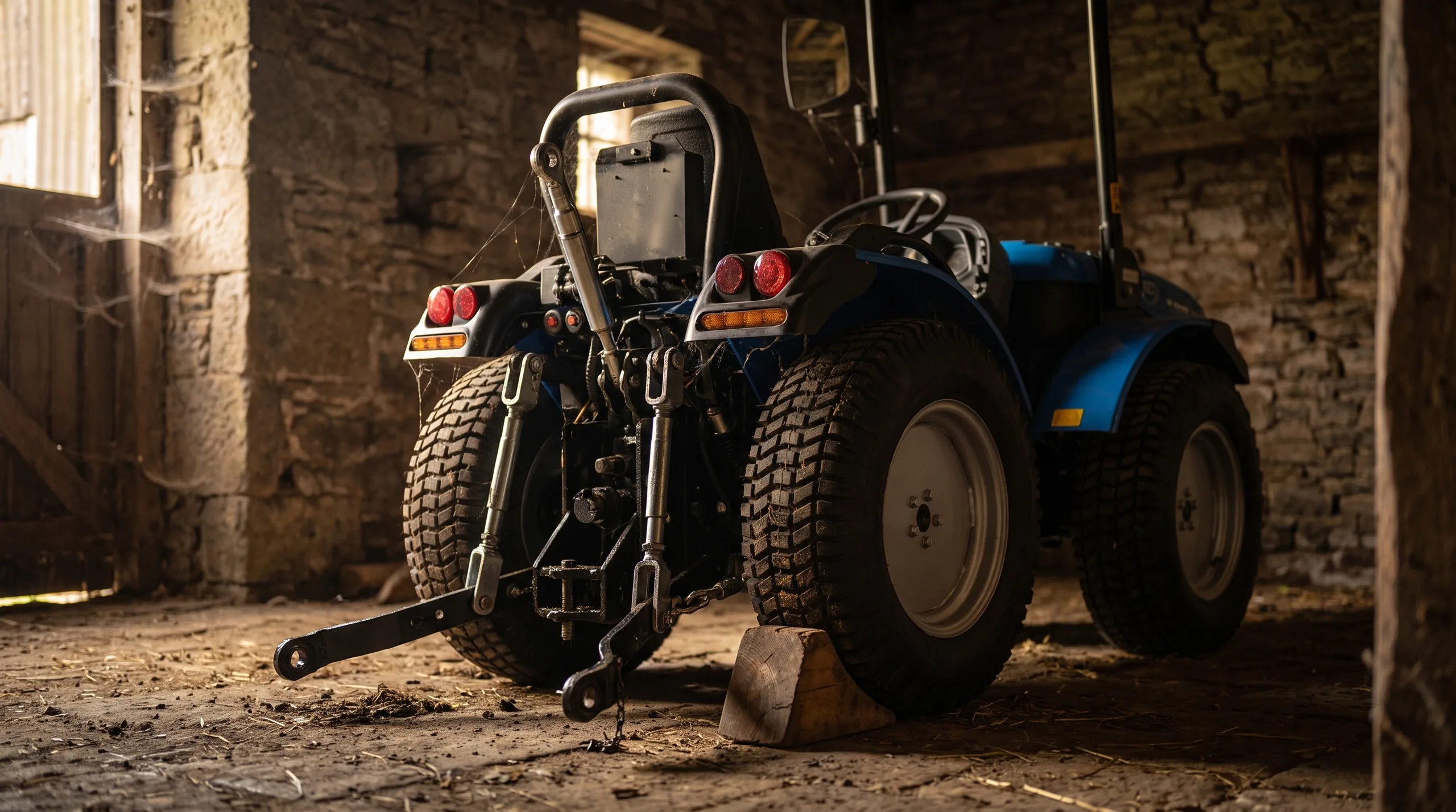
In the BCS group the linkage shares its oil with the gearbox; on the Carraro TTR the hydrostatic drive runs in the same oil as the rear transmission. Condensation in that oil is a bigger risk in winter than in summer, because the gearbox never warms up. Check the level and draw a drop from the drain plug: milky or grey means water. Change it now, with a new hydraulic or hydrostatic filter, rather than waiting until spring. For the rear transmission Carraro specifies a UTTO oil above zero degrees and a thinner hydrostatic oil below zero; if your TTR pushes snow in winter, bear that in mind. Lower the linkage and put implements on the ground, so there is no pressure left on cylinders and seals. Grease the bright rods of the lift and steering cylinders.
Step 4: grease the centre pivot and grease nipples
Do this last of all, after washing. A pressure washer forces water into the bushes of the centre pivot, the steering cylinder eyes, the lift arms and the stub axles; fresh grease pushes that water out again. Grease until clean grease comes out of the bushes. Then, with the engine running, turn the steering from lock to lock a few times so the grease spreads, and park the tractor straight with the steering cylinder retracted as far as possible. Check the hoses across the centre pivot at the same time: rubber that was already hard in summer will crack in frost.
Step 5: free the clutch and brakes
The Invictus, Cromo and Siena have a dry single-plate clutch, as do most older Japanese compact tractors. Press the pedal down and secure it in the depressed position with a block, a ratchet strap or the lock if there is one; otherwise the plate will rust onto the flywheel in a damp shed. Do not leave the parking brake on for months: the drum brakes on these tractors stick just as easily. Use wheel chocks. Machines with a wet clutch (BCS Valiant, Ferrari Cobram and Mizar) or a hydrostatic drive (Carraro TTR) do not have this problem.
Step 6: reversible driving position
If your tractor has a reversible seat (Carraro TTR and TRX, Valpadana IS, BCS Valiant, Ferrari Mizar and Vega), turn it all the way round and back once before you put it away, and grease the turntable, the locking pin and the steering column guide. A platform that stands all winter with moisture in the guide will be stuck in March. Cover the seat, steering wheel and dashboard against dust and mice; the wiring under the turntable is a favourite spot for rodents.
Step 7: fuel, battery, tyres and covering (in brief)
- Tank full with winter diesel and a diesel additive in the last fill, drain the sediment bowl, replace the fuel filter if there is water or sludge in it. A half-full 35 to 43 litre tank builds up condensation all winter long.
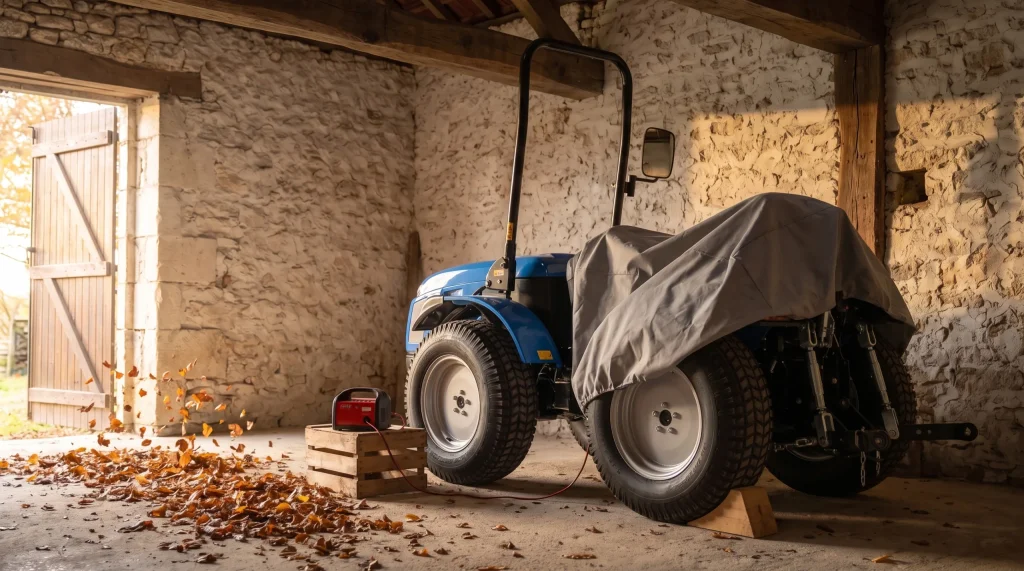
- Battery: charge fully, disconnect (negative terminal first) or remove it, top up the charge every four to six weeks or use a trickle charger with a maintenance mode. Take the key out.
- Tyres: inflate slightly above working pressure and put the machine on boards, not on a damp concrete floor. On isodiametric tractors the tyre size is the same front and rear, so make sure you set both axles back to their own pressure in spring.
- Mice. Cover the exhaust and the air filter housing, clean the engine bay and hang a reminder on the steering wheel.
- Cover with a breathable sheet, only once the engine and exhaust are cold, dry and ventilated, not next to hay or straw.
- Running it in between only makes sense if the engine really reaches operating temperature and you drive a lap so the gearbox, linkage, brakes and centre pivot also move. Kubota advises ten to fifteen minutes every one to two months; five minutes at idle does more harm than good.
Articulated tractor that keeps working through winter
Many reversible tractors belonging to landscapers and councils clear snow, grit and sweep precisely in winter. Then it is about preheating (10 to 20 seconds in frost, with all glow plugs working), winter diesel, warming up before you load the hydrostatic drive or the linkage, the right winter oil in the rear transmission of a hydrostatic machine, and putting the battery on the charger regularly. Keep the radiator and the air filter clean in winter too: salt, grit and snow slush build up on the fins.
Spring check for the articulated tractor
- Remove the covers from the exhaust and air filter, take the tags off the steering wheel.
- Check the levels: engine oil, transmission and hydraulics, front differential, coolant, brake fluid (Carraro).
- Refit the battery, negative terminal last.
- Tyres to working pressure, front and rear.
- Remove the clutch block and the wheel chocks.
- Preheat, start, warm up. Watch the oil pressure and charge warning lights.
- Steering from lock to lock: no jerks, no noises from the centre pivot, no leaks at the steering cylinder.
- Test the linkage, PTO, reversing mechanism and brakes without load.
- Combine with the annual service: filter set, V-belt and oil, see the maintenance blog.
Frequently asked questions
What is different about winterising an articulated tractor?
Five points on top of the ordinary checklist: grease the centre pivot after washing, grease the bright rod of the steering cylinder with the tractor parked straight, check the shared transmission and hydraulic oil for condensation, turn the reversible driving position round once and grease it, and on the Invictus, Cromo and Siena secure the dry clutch in the depressed position.
Which antifreeze goes in a BCS Invictus or Ferrari Cromo?
An ethylene glycol coolant at 50 per cent with soft water, good to about minus 37 degrees, as Kubota specifies for the D1105 and V1505. Never more than 50 per cent antifreeze and do not mix brands. The engine alone takes 3.1 litres (D1105) or 4.0 litres (V1505); more with the machine radiator.
Should I secure the clutch of my articulated tractor in winter?
Yes, on the BCS Invictus, Ferrari Cromo and Pasquali Siena with a dry single-plate clutch. Press the pedal down and secure it with a block or ratchet strap, otherwise the plate will rust onto the flywheel. Machines with a wet clutch (Valiant, Cobram, Mizar) or hydrostatic drive (Carraro TTR) do not need this.
Can an articulated tractor spend the winter outside?
Preferably not. If there is no other option, use a breathable sheet, tyres slightly harder, battery out, tank full, centre pivot and cylinder rods freshly greased, exhaust and air filter covered and the coolant tested to at least minus 25 degrees. Check monthly for mice and condensation.
Product tip: winterising your articulated tractor
- Coolant down to -40 °C for any compact tractor (SKU-125001)
- Cooling system cleaner (SKU-125007) and radiator cap (SKU-3240)
- Engine oil 15W40 (SKU-15W40) and transmission and hydraulic oil STOU GL-4 (SKU-15W402)
- Filter set BCS Invictus, Ferrari Cromo, Pasquali Siena (SKU-10092) and filter set Carraro TTR 4400 (SKU-100150)
- Diesel injector cleaner for the last tank fill (SKU-60003)
- Glow plug Kubota D1105/V1505 (SKU-55209) and glow plug Yanmar 3TNV88 (SKU-551213)