



Finishing mower, pasture topper or flail mower: which mower suits your compact tractor?
Which mower suits your compact tractor? In short: a finishing mower for lawns, driveways and orchards that you mow regularly and want to look neat. A pasture topper for rough grazing that you keep in check once or twice a year. And a flail mower for everything in between, from verges to rough ground with thin branches, because it chops finely and throws less debris. If you want to get rid of the clippings or the leaves, choose a flail mower with a collector. You determine the width by the power at the PTO, not by the engine power in the brochure.
Still unsure about the tractor itself? Start with our guide on which compact tractor to buy. If you keep horses, also read the compact tractor for horse farms. Below, for each mower: how it works, the power it needs and the right width for 15 to 45 hp.
Finishing mower, pasture topper or flail mower: the four mowers at a glance
Four types of mower are the ones you most often see behind a compact tractor. They differ in cut quality, in what they can handle and in how much power they need. All figures in this table are rules of thumb and guide prices (indicative, 2025-2026 price level).
| Type | Used for | Rough growth and branches | Hp per metre (indicative) | Price (indicative) |
|---|---|---|---|---|
| Finishing mower (grooming mower) | Lawns, driveways, orchards, regular mowing | Clogs above approx. 20 cm of grass, no wood | approx. 13 | approx. €1,100-3,250 for 1.0-2.1 m |
| Pasture topper | Rough grazing, tussocks and clumps, 1-2 times a year | Rough growth and scrub up to approx. 2-3 cm, heavy-duty version up to approx. 5 cm | approx. 16-17 | — |
| Flail mower | Verges, rough growth, orchards, mulching | Y-flails: rough growth up to approx. 1-2 cm; hammer flails: branches up to approx. 3-5 cm | 10-20 | approx. €1,550 (90 cm) to €3,500 (132 cm), incl. VAT |
| Flail mower with collector | Lawns, leaves, scarifying, removing clippings | No rough growth or wood | 17-30 | — |
Finishing mower behind your compact tractor: neat lawns and driveways
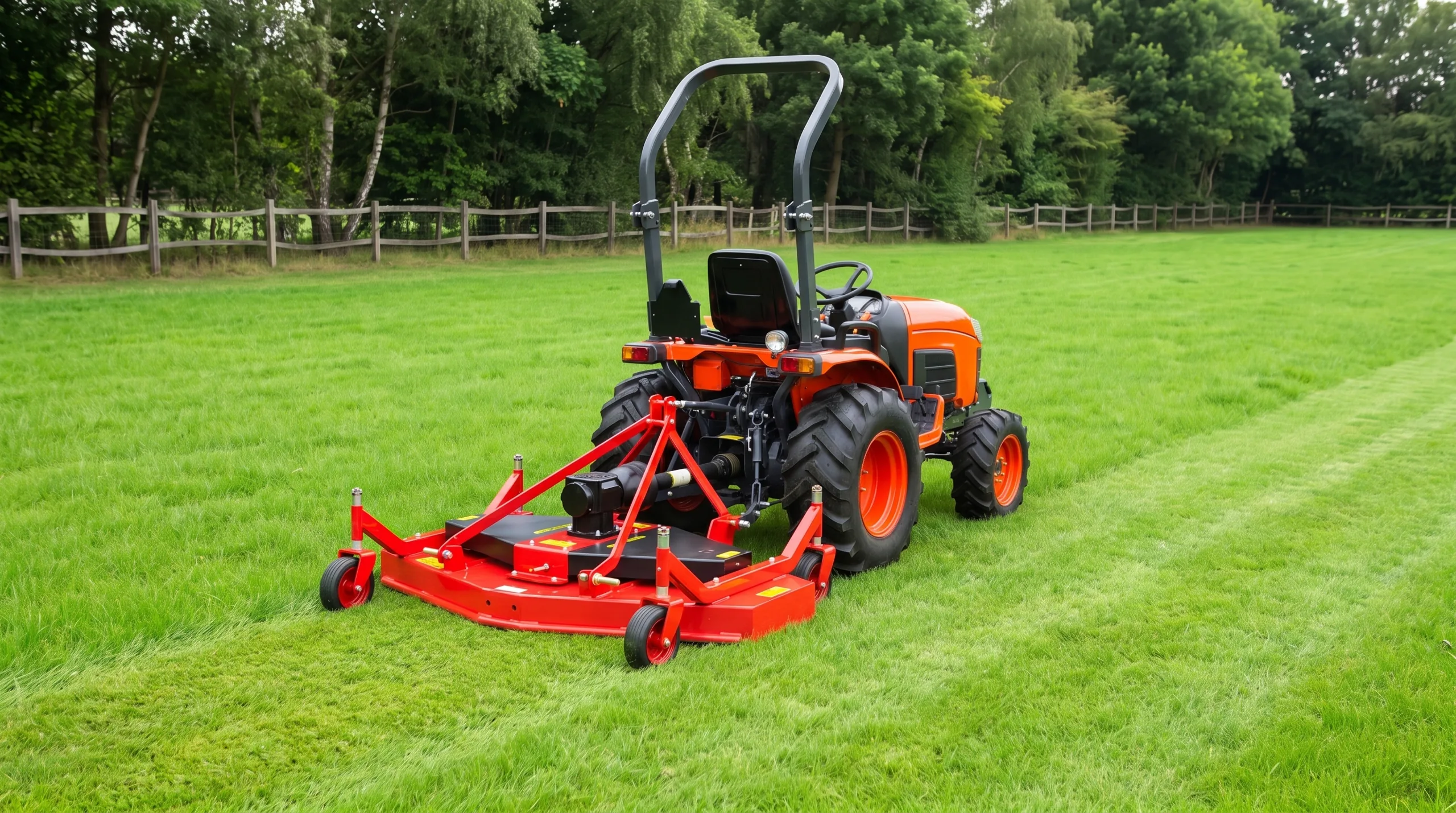
A finishing mower, also known as a grooming mower, usually has three rotors with overlapping blades under one deck; narrow versions of around 1 metre often have two. The deck runs on castor wheels and an anti-scalp roller stops the blades digging into the ground on a bump. On a Wessex CMT the cutting height can be set from 19 to 110 mm. The result is a neat, even finish.
Its weak point is long grass. Above about 20 cm a finishing mower starts to clog and leaves tufts behind. So a finishing mower is a machine for people who mow often: a lawn, a driveway, the grass between the rows in an orchard. It also throws stones and twigs further than a flail mower, so take care near windows, cars and cycle paths.
The power requirement is modest: allow about 13 hp per metre of working width. A 120 cm Majar with three blades needs at least 12 hp and costs approx. €1,750; the 150 and 180 cm versions approx. €1,950 and €2,150 (indicative). Maintenance costs are roughly 20 to 30 percent lower than for a flail mower (indicative). For long driveways and large lawns on a country estate, read more in our article on the compact tractor for a country estate.
Pasture topper for your compact tractor: rough grazing
A pasture topper has one to three heavy blades under a sturdy deck, made for rough grass: tussocks the animals leave standing, clumps, a field that has not been mown for a season. It takes rough growth and scrub up to about 2 to 3 cm, a heavy-duty version up to about 5 cm (indicative). The finish is coarser than with a finishing mower, but that is not why you buy one.
Its big advantage is simplicity. Few blades, few bearings, little that can break. Sharpening the blades and keeping the gearbox topped up is most of the work. A pasture topper does need more power per metre than a finishing mower: allow 16 to 17 hp per metre; the rule of thumb is 5 hp per foot of working width (indicative).
Pasture topper or finishing mower? Mowing a lawn weekly: finishing mower. Rough grazing once or twice a year: pasture topper. Both with one machine: flail mower.
Compact tractor flail mower: Y-flails or hammer flails
A flail mower has a horizontal rotor across the full width carrying dozens of flails that chop the crop finely. In the Netherlands this is the most widely used mower behind a compact tractor. The clippings stay on the ground as a mulch layer and break down quickly. A flail mower throws much less than a finishing mower, which is handy along paths and buildings. With hammer flails it also handles branches up to about 3 to 5 cm (indicative). Thicker wood is a job for a forestry flail mower behind a much heavier tractor.
You choose between two types of flail:
- Y-flails: lots of narrow blades, for grass and fine chopping. Gives the cleanest finish.
- Hammer flails: fewer but heavy flails. Tougher against branches, rough growth and the odd stone. The finish is coarser.
An example: the Del Morino Funny 132-C is 132 cm wide, suitable for 12 to 30 hp, weighs 170 kg and has 40 Y-flails or 20 hammers, with an overrunning clutch. Guide price approx. €2,600 incl. VAT (indicative). An entry-level 90 cm model for 10 to 15 hp costs approx. €1,550 (indicative). Light flail mowers need 10 to 20 hp per metre.
For verges, ditch banks and along fences or tree rows, a side shift is handy. It moves the mower 35 to 45 cm sideways, so you mow outside the tractor’s track. The Del Morino Flipper comes in 80 to 214 cm (176 to 438 kg) with side shift as an option; the 132-C costs approx. €3,500 incl. VAT (indicative). There are also versions that can be angled for verge work. Read more about flail mowers behind an articulated tractor in implements and front loader on an articulated tractor.
Flail mower with collector: lawns, leaves and scarifying
A flail mower with a collector mows, collects the clippings and scarifies in one pass. In autumn it also picks up leaves. That makes it the favourite for large lawns, parks and yards where you don’t want to leave clippings lying around.
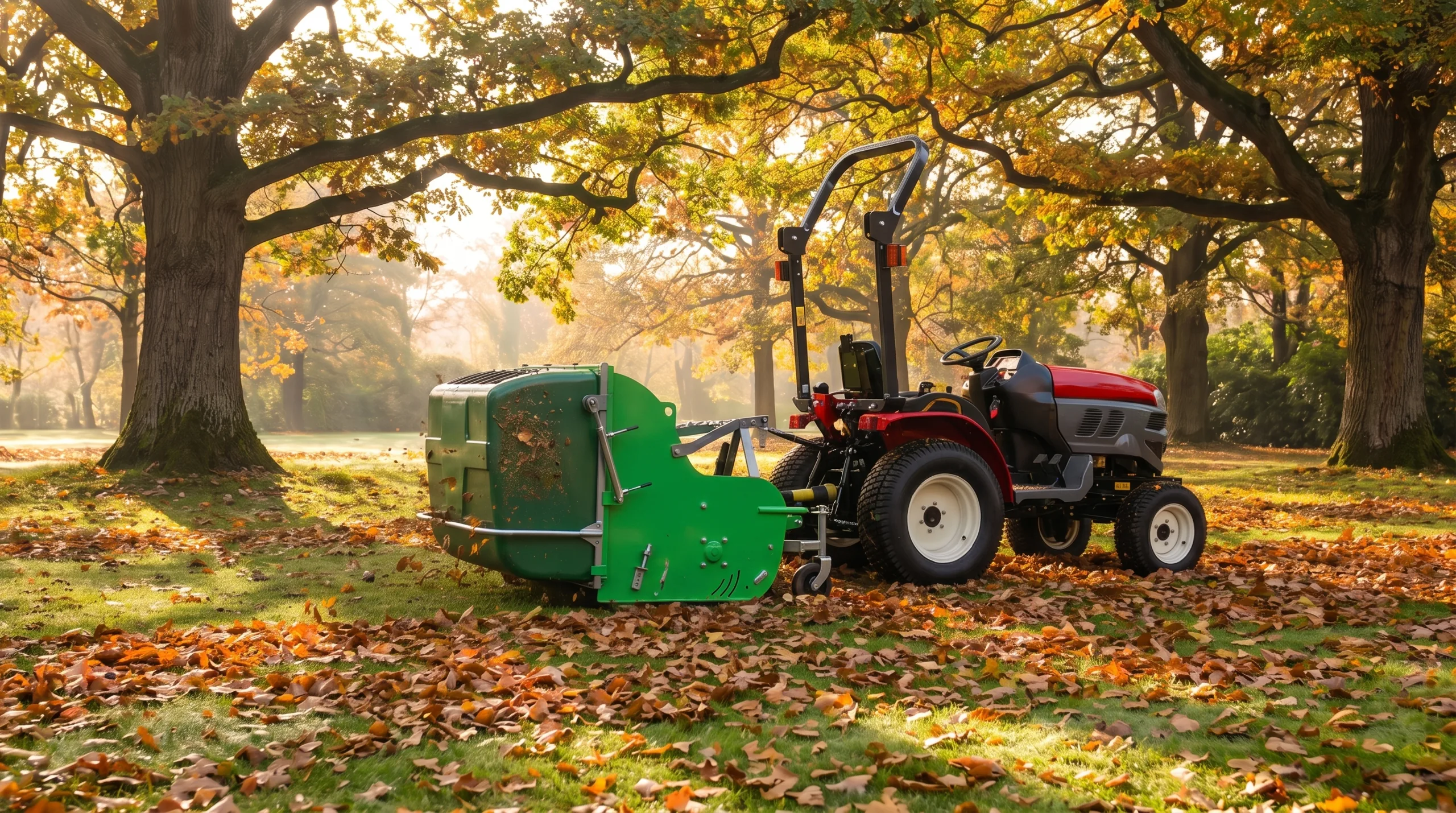
| Model | Working width | Tractor power | Collector | Weight |
|---|---|---|---|---|
| Peruzzo Koala 1000 | 995 mm | 18-22 hp | 600 l | 240 kg |
| Peruzzo Koala 1200 | 1,175 mm | 20-25 hp | 700 l | 280 kg |
| Peruzzo Koala 1600 | 1,475 mm | 25-35 hp | 900 l | 310 kg |
| Peruzzo Panther 1200-2000 | — | 30-60 hp | 1,200-2,100 l, hydraulic tipping | — |
The Panther has a cutting height of 15 to 70 mm. For a collector mower allow 17 to 30 hp per metre (indicative), clearly more than for a flail mower without a collector. Watch the weight: the table gives the empty weight, and with a full collector more hangs on the three-point linkage. A collector flail mower does not clear up horse manure, by the way. There are dedicated paddock cleaners for that.
Making hay with a compact tractor: drum mower and sickle bar
For hay, a mower that chops is no use: the grass has to stay whole to dry. For that there are small drum mowers and the sickle bar mower.
- Drum mower: the Talex 135 mini is 1.35 m wide, suitable from 14 hp, weighs 180 kg and has an overrunning clutch as standard.
- Cyclomower: 1.35 m, needs at least 24 hp.
- Sickle bar mower: 1.5 m, 18 to 35 hp, approx. 200 kg. Can also be used as a hedge cutter, but produces a lot of vibration.
Which mower width for how many hp?
Always calculate with the power at the PTO. That is about 80 to 85 percent of the engine power. A Kubota B2301 has 20.9 hp engine power and 17.5 hp at the PTO, a B2601 24.3 and 19.5 hp. The table below is based on engine power and already takes that into account (indicative).
| Engine power | Finishing mower | Flail mower | Flail mower with collector |
|---|---|---|---|
| 15 hp | 100-120 cm | 90-110 cm | — |
| 20 hp | 120-150 cm | 110-130 cm | Koala 1000 |
| 25 hp | 150-180 cm | 120-150 cm | Koala 1200 |
| 35 hp | 180-210 cm | 150-160 cm | Koala 1600 |
| 45 hp | 210 cm and wider | 160-200 cm | — |
Two more rules. Choose a mower at least as wide as your tractor’s track, otherwise you flatten the grass before you cut it. And stay within the mower’s hp range. With too little power, the rotor speed drops in heavy growth: the finish gets poor, the deck clogs and the engine can stall.
Mowing a horse paddock: cutting height, manure and ragwort
You don’t mow a horse paddock like a lawn. Keep roughly to 7 to 10 cm and never go below about 7.5 cm (indicative). Topping or mulching once or twice a year is usually enough, more often if there are a lot of clumps. A pasture topper and a flail mower are both suitable for that.
- Clear the manure first, then harrow. Harrow after mowing, but only in a dry spell or when it is freezing. If you spread wet manure, you spread worm eggs across the whole paddock.
- Don’t feed fresh clippings. That risks colic. Only put the horses back once the clippings are dry or well spread.
- Don’t mulch ragwort. Mow it twice a year before it flowers: after mid-July and at the end of August or early September. Dried, it stays poisonous and horses will then eat it. Remove the clippings or dig the plants out.
- Dig out dock, 10 to 20 cm deep, and stop it from setting seed.
For harrowing and rolling, use a chain harrow and possibly a Cambridge roller. Read more about the tractor, front loader and implements for horses in compact tractor for horse farms.
PTO: overrunning clutch, slip clutch, shear bolt and mid PTO
A finishing mower, pasture topper and flail mower all have a heavy rotor that keeps spinning after you switch off. Without an overrunning clutch in the driveline, that mass pushes the tractor forward through the PTO, even when you press the clutch. Many brands fit an overrunning clutch to the mower as standard; otherwise it is an option of about €50 (indicative). Never work without one.
A slip clutch or a shear bolt protects your PTO and gearbox against obstacles. If the shear bolts snap often, look for the cause: engaging the PTO at high engine speed, obstacles, play or a worn bolt hole, or the wrong bolt. A stronger bolt is not the answer, because then the gearbox or the PTO shaft breaks instead. If your tractor’s PTO does not fit the implement’s connection, an adapter solves that.
Watch out for the mid PTO. Many Kubotas with a belly mower deck have a mid PTO running at around 2,500 rpm, compared with 540 rpm at the rear PTO. An implement built for 540 rpm does not fit there without a reduction. The speeds of your tractor vary by model; check the manual.
Maintaining your mower
A flail mower needs a service roughly every 100 to 150 operating hours (indicative). A finishing mower and pasture topper need less. The standard list:
- Check the gearbox oil before every use. Use the oil specified in the mower’s manual.
- Sharpen or replace the blades or flails. Blunt blades tear the grass and need more power.
- Check the belt tension on belt-driven mowers.
- Grease the universal joints and sliding tubes of the PTO shaft; replace a universal joint with play before it breaks.
- Clean or replace the tractor’s air filter more often, because mowing creates dust.
- Blow out the radiator and grille, because clippings and dust clog them quickly.
- Wear hearing protection, especially on long days.
You can find the parts for maintaining your tractor and driveline with us; see also maintenance: schedule, oil and filters.
Frequently asked questions
What is the difference between a flail mower and a finishing mower?
A finishing mower usually has three rotors (narrow models two) with horizontally spinning blades and gives a neat lawn finish, but clogs in grass above about 20 cm. A flail mower has a horizontal rotor with flails that chop the crop finely into a mulch layer. It handles rough growth and, with hammer flails, branches up to about 3 to 5 cm (indicative) and throws less. For frequent mowing the finishing mower, for rough growth and verges the flail mower.
How many hp do you need for a 1.20 metre flail mower?
A light flail mower needs about 10 to 20 hp per metre at the PTO (indicative). For 1.20 metres that puts you at a tractor of about 20 to 25 hp engine power, because you keep 80 to 85 percent at the PTO. If you work in heavy growth or rough ground, or want a collector, go for the higher end of that range.
Flail mower with Y-flails or hammer flails?
Y-flails are narrow blades for grass and fine chopping and give the cleanest finish. Hammer flails are heavier and tougher; they cope better with branches, rough growth and the odd stone, but the finish is coarser. If you mainly mow grass and lawns, choose Y-flails. If you mow verges, rough ground or an orchard with prunings, hammer flails are the better choice.
Pasture topper or flail mower for a horse paddock?
Both are suitable for topping a horse paddock once or twice a year. A pasture topper is simpler and cheaper to maintain and copes well with rough tussocks. A flail mower chops more finely, so the clippings break down faster. Keep roughly to a 7 to 10 cm cutting height (indicative). If there is ragwort, don’t mulch but remove the clippings, because it stays poisonous when dried.
Why does a mower need an overrunning clutch in the PTO?
The rotor of a finishing mower, pasture topper or flail mower is heavy and keeps spinning for a while after you switch off. Without an overrunning clutch, that spinning mass pushes the tractor forward through the PTO, even with the clutch pressed. Many brands fit the overrunning clutch to the mower as standard; otherwise it is a cheap option of about €50 (indicative). A slip clutch or shear bolt also protects against obstacles.
Can I put a 540 mower on the mid PTO of my Kubota?
No, not without a reduction. The mid PTO of many Kubotas with a mower deck runs at around 2,500 rpm, while a normal mower is built for 540 rpm at the rear PTO. If you put it on the mid PTO anyway, it spins far too fast. So hang a 540 mower on the three-point linkage and the rear PTO. The exact speeds vary by model, so check the manual.
Product tip: parts for the driveline and the tractor behind your mower
- PTO slip clutch for compact tractors 8-30 hp (SKU-43006): protects the PTO and gearbox if the mower hits a stump or stone.
- PTO adapter 1 1/8″ 6-spline to 1 3/8″ 6-spline (SKU-43004): when your tractor’s PTO and your mower’s connection are not the same size.
- Universal joint 25×65 mm for PTO and drive shaft Iseki, Kubota, Yanmar (SKU-35002-3) and universal joint 20×57 mm Kubota B/F/G, Iseki TU/TX (SKU-35000-1): replace when there is play.
- Linch pin / split pin PTO universal (VAR-900001): always keep a few spares in the toolbox.
- Transmission and hydraulic oil STOU GL-4 (SKU-15W402): for tractors whose manual specifies a universal tractor oil; for the mower’s gearbox, follow the implement’s manual.
- Air filter Kubota, Yanmar, Mitsubishi (SKU-20004): mowing creates dust, and this is the first filter to clog.
Questions about parts for your model? Send us the make, type and serial number via the contact page and we will look up the right part.