



Tiller, rotary tiller or power harrow: which soil cultivation suits your compact tractor?
Which soil cultivation suits your compact tractor? For a vegetable garden or seedbed on sand and light soil, a tiller is fine, including the Japanese tiller that often comes with an imported tractor. On heavy clay and for breaking up grassland, choose a European rotary tiller with a slip clutch. If you want a level, fine seedbed without a smeared layer below working depth, go for a power harrow. For a light rotary tiller, allow roughly 15 to 20 hp per metre of working width, and for a power harrow 20 to 30 hp per metre (indicative).
Below you will read how each machine works, which width suits your power and how to get the PTO and hitch right. Not sure yet which tractor you need? Start with our guide on which compact tractor to buy. If it is mainly about mowing, read finishing mower, pasture topper or flail mower: which mower suits your compact tractor.
Japanese tiller on your compact tractor: why the supplied tiller doesn’t always suit
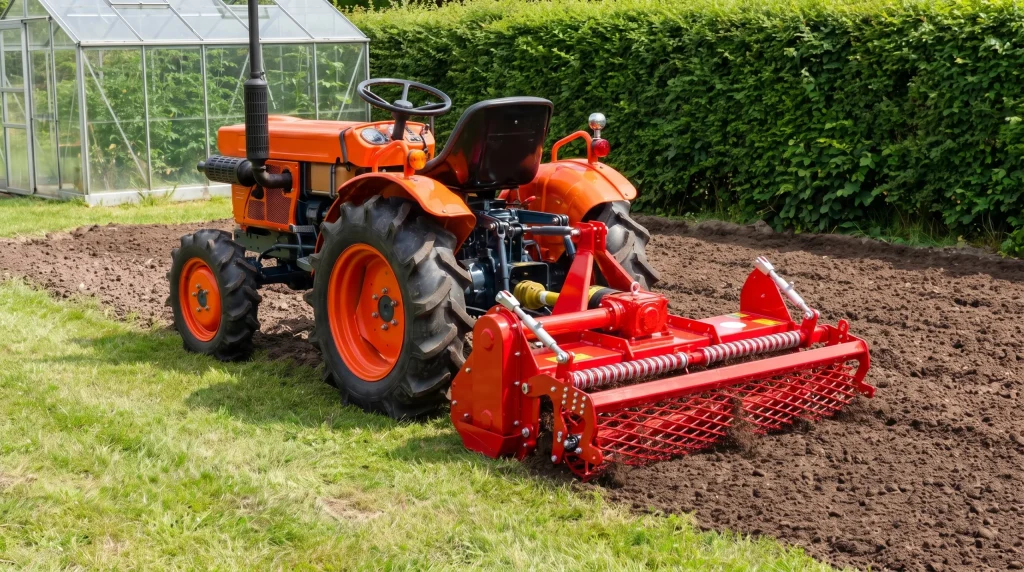
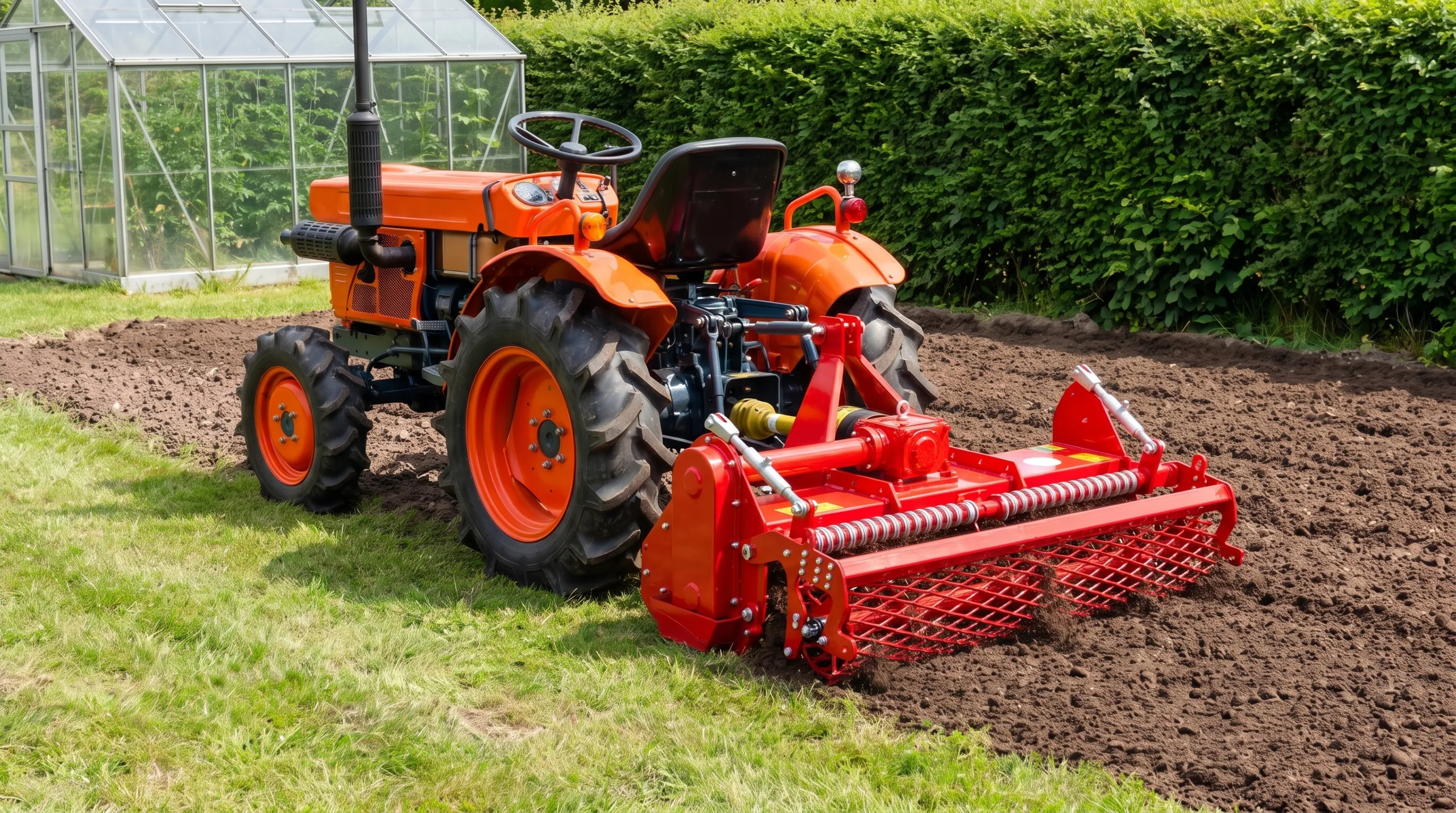
Many Japanese compact tractors from grey import come with a tiller on the back. That is a paddy field tiller (called a “rotary” in Japan), built to grind soil under water very finely: puddling. The bite per blade (pitch) is 3 to 5 cm, and 15 to 16 cm for coarse work.
The drive runs through a low chain case on one side. It is stiff and cheap to repair, but it limits the working depth to about 15 cm and leaves a track. These tillers are 1.1 to 1.5 metres wide (RS1200, RS1351, RS1400: width in mm) and weigh about 180 to 200 kg.
On Dutch clay and grassland, a tiller like this reaches its limits. The well-known complaints from practice:
- Smearing and a pan. On wet clay the tiller smears the soil shut just below blade depth.
- Too fine. The soil is crumbled so finely that it caps after a shower.
- Too shallow. Because of the low chain case you cannot go deeper than about 15 cm.
- Clogs on grassland. In a grass sward the tiller quickly fills up.
- Wear. The side blades wear fastest.
On top of that, the tiller hangs on a Japanese hitch system. For European implements you need to convert the linkage to category 1 (see below).
What the Japanese tiller does do well, and how to use it properly
For a vegetable garden, a seedbed on sand or light soil and working previously cultivated soil to a fine tilth, the Japanese tiller is fine. This approach gets the most out of it:
- Work in two passes. First till shallow, 7 to 10 cm. Then go over the plot a second time at an angle, at 10 to 15 cm. Don’t go deep in one go.
- Run 540 rpm at full revs. Higher PTO settings (around 750 or 1,000) are meant for working at lower throttle, not for making the tiller spin faster. If the tiller gets 600 to 700 rpm, you will get damage. An Iseki TX1500, for example, gives 472, 752 and 1,177 rpm at 2,700 engine rpm (indicative).
- Don’t till wet clay. Wait until the soil is dry enough.
| Japanese tiller blade type | Use |
|---|---|
| Nata blade | Standard blade, most tillers are supplied with it |
| L-blade | Field work |
| Flower-shaped blade | Shallow and fine work |
Which blades belong on your tiller varies by model: check the manual or compare with the old blade.
European rotary tiller for your compact tractor: chain or gearbox
A European rotary tiller hangs on a category 1 three-point linkage and runs at 540 rpm. A light chain-drive tiller is fine for sandy soil; a heavier tiller with a side gearbox goes deeper and suits clay better. A tiller works in manure and green manure well and is suitable for breaking up grassland. Expect the rotor to push the tractor forward. On clay and stony ground, a slip clutch between tractor and tiller is essential.
| Rotary tiller | Working width | Power | Drive | Working depth | Weight | Price (indicative) |
|---|---|---|---|---|---|---|
| Stark RS 115/125/135 | 1.15-1.35 m | 20-25 hp | Chain | 15 cm | 153-173 kg | approx. €1,200-1,300 |
| Stark RX 140/160 | — | 30 / 40 hp | Side gearbox | 19.5 cm | 360-385 kg | approx. €2,200-2,500 |
| Majar RDM 125 | — | 15-35 hp | — | — | 151 kg | approx. €1,900 |
| Breviglieri B40F 125 | — | 20-40 hp | Chain in oil bath, 48 mm rotor shaft | — | 200 kg | — |
| Sicma T5 | 52-60 inch (approx. 1.32-1.52 m) | 20-35 hp | With slip clutch | — | — | — |
Specifications as stated by the manufacturer or seller; prices at 2025-2026 price level, indicative.
Which tiller width for how many hp?
As a rough guide, allow 15 to 20 hp per metre for a light tiller and 20 to 30 hp per metre for a power harrow (indicative). On heavy clay or for deep work, choose the narrow end. The manufacturer’s hp range always takes priority, and check the weight against your tractor’s lift capacity.
| Tractor engine power | Light rotary tiller (15-20 hp/m) | Power harrow (20-30 hp/m) |
|---|---|---|
| 15 hp | approx. 0.75-1.0 m | — |
| 20 hp | approx. 1.0-1.3 m | approx. 0.7-1.0 m |
| 25 hp | approx. 1.25-1.6 m | approx. 0.85-1.25 m |
| 30 hp | approx. 1.5-2.0 m | approx. 1.0-1.5 m |
| 40 hp | approx. 2.0 m and more | approx. 1.35-2.0 m |
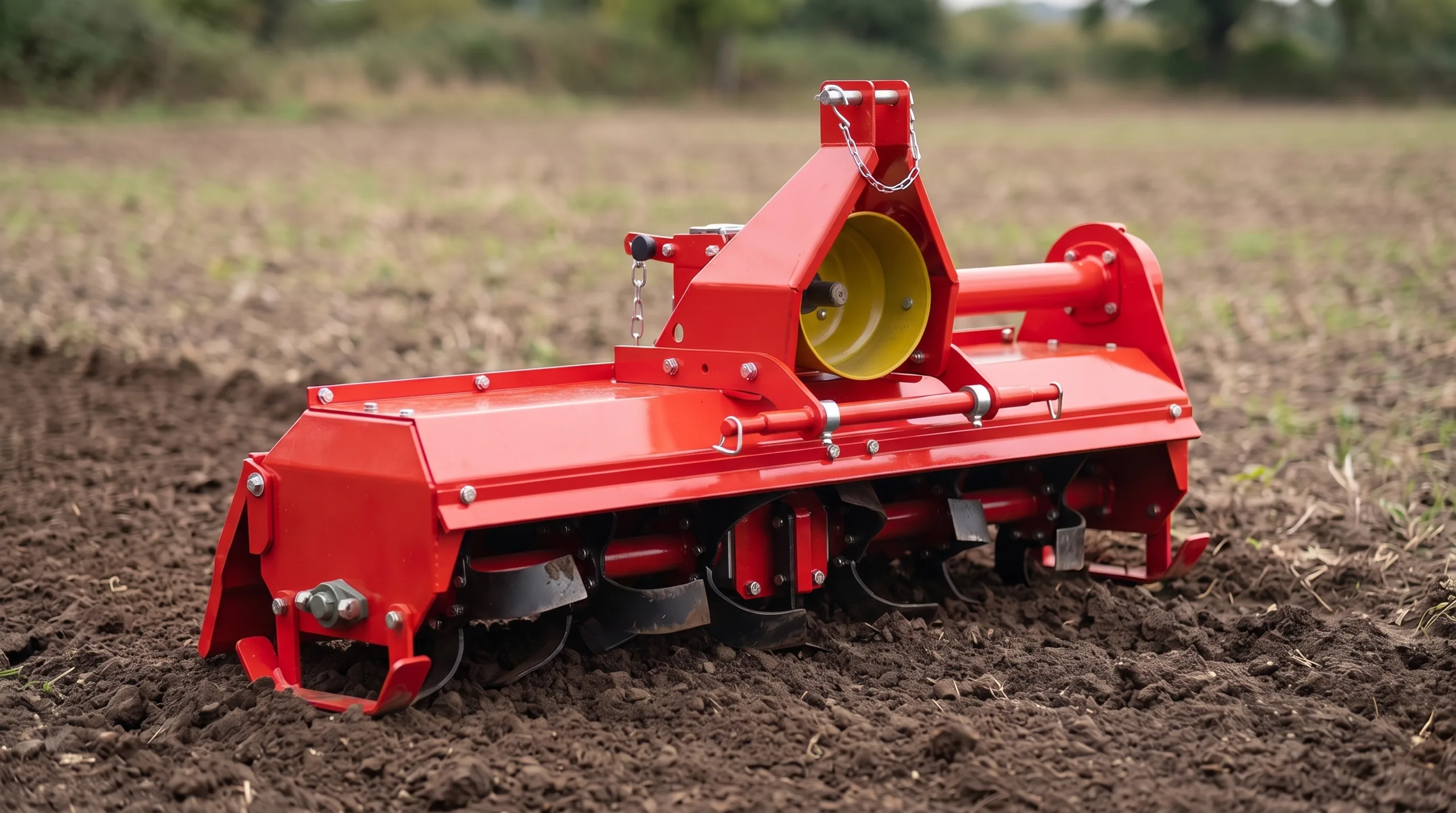
Power harrow behind a compact tractor: level seedbed without a pan
A power harrow has vertical tines that rotate against each other, followed by a levelling board and a roller. The soil is broken between the tines rather than smeared against the machine. So you don’t get a smeared pan, but a level seedbed with an even tilth. Research shows that on hard sandy loam a tiller only reaches half its depth, while a power harrow reaches almost the full depth.
Limitations: a power harrow does not cut through green material, so it is not suitable for breaking up fresh grassland. It tends to separate organic material rather than work it in, and it needs stone protection. The usual order is therefore: till or plough first, then the power harrow for a fine seedbed. There are also power harrows with a seed hopper, such as the Muratori ME1 with seeding kit.
| Power harrow | Working width | Power | Specification | Weight | Price (indicative) |
|---|---|---|---|---|---|
| Geo MG130 | 130 cm | from 25 hp | 12 blades, tube bar roller, Cat. 1, max. 20 cm deep | 260 kg | approx. €2,150 |
| Geo MG170 | — | from 30 hp | — | 320 kg | approx. €2,400 |
| Deleks KR-160 | 165 cm | 30-50 hp | Rotor 300 rpm, cage roller | 330 kg | approx. €2,760 |
Specifications as stated by the manufacturer or seller, prices at 2025-2026 price level, indicative. A power harrow of over 300 kg is a hefty load on the linkage of a light compact tractor.
Tiller or power harrow: which machine for which job
Power harrow or tiller? It depends on the job.
| Job | First pass | Finishing | Watch out |
|---|---|---|---|
| Vegetable garden | Tiller (a Japanese tiller will do) | — | Two passes, not on wet clay |
| Laying a lawn | Tiller or spading machine | Power harrow or cultivator, then roll | A level bed matters more than depth |
| Renewing pasture | Spraying off and tilling, or ploughing | Power harrow with seeder | Or overseed after tine weeding; watch the ploughing-up deadline |
| Levelling a paddock | Chain harrow, levelling blade or cultivator | — | No tiller needed |
| Orchard rows | Narrow power harrow or tiller with side shift | — | Implement narrow enough for the row |
Spading machine, plough and cultivator
These implements complement the tiller and power harrow (prices indicative, 2025-2026 price level):
- Spading machine. Does not create a pan and also works on clay. Imants supplies a 120 cm version from about 20 hp.
- Mini reversible plough. Single furrow, 12 to 20 hp, about 90 kg, approx. €1,050. A two-furrow Cat. 1 plough costs around €550.
- Spring tine cultivator. 110, 135 or 160 cm, approx. €750 to €950 excl. VAT. Loosens the soil and makes it ready for sowing.
- Levelling blade, chain harrow and disc harrow. For levelling.
- Grassland subsoiler. For compaction in grassland.
Breaking up or renewing grassland: soil type and date
Before you till a pasture, first check what state the grassland is in. Breaking it up is not always necessary.
- More than 80% good grasses: do nothing.
- 50 to 80% good grasses: tine weed and overseed.
- Less than 50% good grasses, or more than 20% couch grass: renew.
If you are going to renew, the date matters. Under the RVO (Netherlands Enterprise Agency) rules, you may break up grassland on sandy soil until 1 September and on clay and peat until 15 September. These rules change regularly; check the current dates with RVO before you start. For a horse paddock, overseeding in September and October is preferred. Read more about pasture management in the compact tractor for horse farms.
On clay, timing counts double: a tiller on wet clay smears a dense layer below working depth. Only work when the soil is dry enough.
PTO and hitch: Japanese linkage to Cat. 1, slip clutch and shortening
The linkage of a Japanese compact tractor often does not fit European implements directly. You will come across:
- Japanese three-point system with a short top link, in sizes JIS0 or JIS1. An Iseki TU1700, for example, has JIS0, a Yanmar FX235 JIS1 (indicative).
- Quick hitches: A-1 (Iseki), A-2 (Yanmar), B (Kubota) and the S-hitch from implement manufacturers.
- Two-point linkage without top link below about 20 hp, as on the Yanmar KE-4.
For European implements you convert to category 1; how varies by model. Three-point linkage kits are available for a number of Kubota, Yanmar, Shibaura and Iseki models (see the product tip). Also watch the direction of rotation: the PTO of a Kubota B6000 turns anticlockwise, so many European implements won’t fit without a reversing gearbox.
Slip clutch
If the tiller hits a stone or root, the shock goes through the PTO, the right-angle gearbox and the transmission. A slip clutch between tractor and tiller absorbs it and is essential on clay and stony ground.
Shortening the PTO shaft
A new PTO shaft is often too long for a small tractor:
- Measure in the shortest position, with the shaft pushed in furthest.
- Shorten both halves and both guards by the same amount.
- Deburr the cut edges and grease the profile tubes.
- Check the longest position: extended, the shaft should not be longer than about 1.5 times the retracted length (rule of thumb, indicative; follow the shaft manufacturer’s instructions).
Maintaining your rotary tiller: tiller blades, oil and chain case
Replacing tiller blades
- Replace blades when about 2 to 2.5 cm of width is left.
- Don’t swap left and right blades. Fit them as they were.
- The curved back of the blade, where the cutting edge is, enters the soil first. So the tip does not point in the direction of rotation.
- Always use new bolts and nuts, and re-tighten them after the first hours.
We supply tiller blades for Japanese tillers, including for Iseki, Yanmar and Hinomoto, in eight types. Stock varies; check the tiller blades category to see which types are currently available.
Oil in the chain case and right-angle gearbox
On a Japanese tiller, the chain case and right-angle gearbox together hold about 4 litres of oil, usually GL-4/5 SAE 90 or 80W-90. Some chain cases need heavier oil: check the manual. Change the oil roughly every 150 to 200 operating hours (indicative). For tillers whose manual specifies 80W-90, 80W90 GL-4 in a 4 litre can (SKU-80W90) is a suitable quantity.
PTO shaft and universal joints
Grease the universal joints and profile tubes according to the shaft’s manual and replace a universal joint with play in time. For tiller shafts with Walterscheid W2200 or Bondioli S2 universal joints, use size 23.8 x 61.3 mm.
Frequently asked questions
How many hp do you need for a rotary tiller?
For a light rotary tiller, allow roughly 15 to 20 hp per metre of working width (indicative). A 20 hp tractor then pulls a tiller of about 1.0 to 1.3 metres, a 25 hp tractor about 1.25 to 1.6 metres. On heavy clay or for deep work you need more power, so choose the narrower size.
What is the difference between a tiller and a power harrow?
A tiller has a horizontal rotor shaft with blades that turn the soil over; it works in manure and green manure and can break up grassland. A power harrow has vertical tines that rotate against each other. It breaks up the soil without creating a pan and makes a level, fine seedbed, but does not cut through a grass sward. Often you use the tiller or plough first and then the power harrow.
Is a Japanese tiller suitable for clay soil?
To a limited extent. The Japanese paddy field tiller is built to grind soil finely under water. On wet clay it smears a dense layer just below working depth and crumbles the soil too finely. Because of the low chain case you cannot go deeper than about 15 cm. For heavy clay, a tiller with a gearbox or a spading machine is better.
When should you replace tiller blades?
Replace tiller blades when about 2 to 2.5 cm of width is left. The side blades wear fastest, so check those most often. Fit left and right blades in the same position, with the sharpened back of the blade (the cutting edge) entering the soil first, and always use new bolts. Re-tighten them after the first operating hours.
What PTO speed should a tiller run at?
A tiller is built for 540 rpm at the PTO at full engine speed. Higher settings such as around 750 or 1,000 rpm are meant for working at lower throttle, not for making the tiller spin faster. If the tiller gets 600 to 700 rpm, you risk damage. For normal tilling, choose the 540 setting.
Until when can you break up grassland?
Under the RVO rules, you may break up grassland on sandy soil until 1 September and on clay and peat until 15 September. These rules change regularly, so check the current dates with RVO before you start. Breaking up is often not necessary: with 50 to 80 percent good grasses, tine weeding and overseeding are enough. A horse paddock is best overseeded in September or October.
Product tip: parts for tiller, PTO and linkage
- Universal joint 23.8 x 61.3 mm for rotary tiller PTO shaft, Walterscheid W2200 and Bondioli S2 (SKU-35003-4): for the tiller PTO shaft.
- PTO slip clutch for compact tractors from 8 to 30 hp (SKU-43006): protects the PTO and transmission against stones and roots.
- Three-point linkage kit Kubota B5000-B7001, Yanmar, Shibaura (SKU-14003) and three-point linkage kit Iseki TX1000-TX155, TU1400-TU1601 (SKU-14004): for Cat. 1 implements on a Japanese tractor.
- Cat. 1 top link for compact tractors (VAR-0004): to set up the tiller or power harrow properly.
- Linch pin / split pin PTO universal (VAR-900001): spares for the PTO and linkage pins.
- Tiller blades for Japanese tillers: eight types for Iseki, Yanmar and Hinomoto, among others; stock varies.
Questions about parts for your model? Get in touch with the make and type of your tractor and tiller, and we will look up the right part.