



Compact tractor on the public road: registration, T licence, lights and why 30 km/h matters
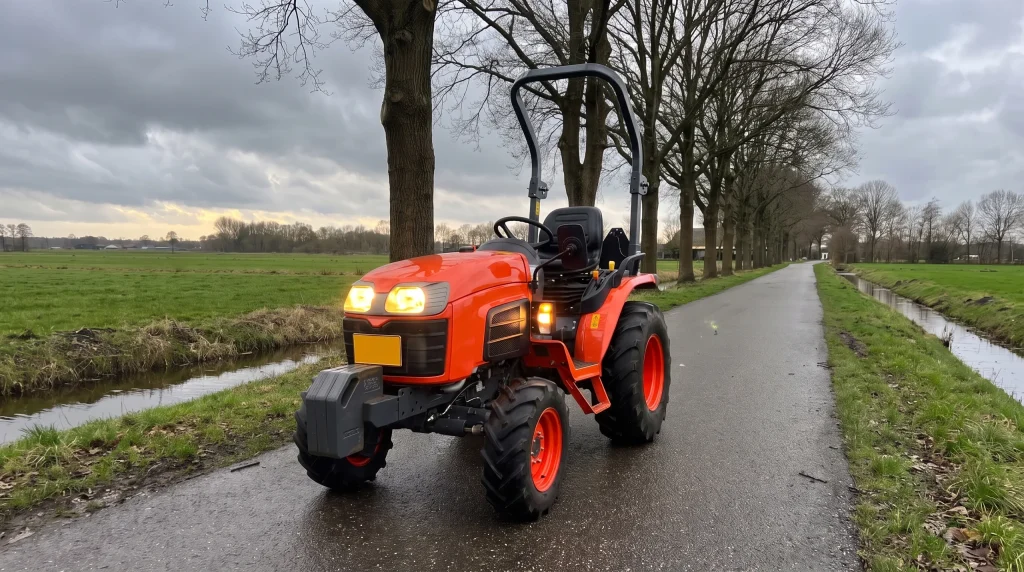
Yes, in the Netherlands a compact tractor may go on the public road, but only if it is registered with the RDW (Dutch vehicle authority), carries a number plate, has third-party liability (WA) insurance and you hold a T driving licence. That also applies if you only briefly cross the road to another plot. A Japanese grey import first has to pass an RDW inspection. And a Japanese import manages 12 to 15 km/h, while a European compact tractor usually does 25 to 34 km/h and an Italian articulated tractor about 30 km/h: you notice that difference on every kilometre.
This blog is information, not legal advice. We set out the rules for the Netherlands, with a short section on Belgium and Germany (last checked on 24 September 2026; check the current rules with the RDW). Still choosing which tractor to buy? Then first read the guide on which compact tractor to buy. If you drive long distances, also look at the compact tractor for a country estate.
Can a compact tractor go on the public road?
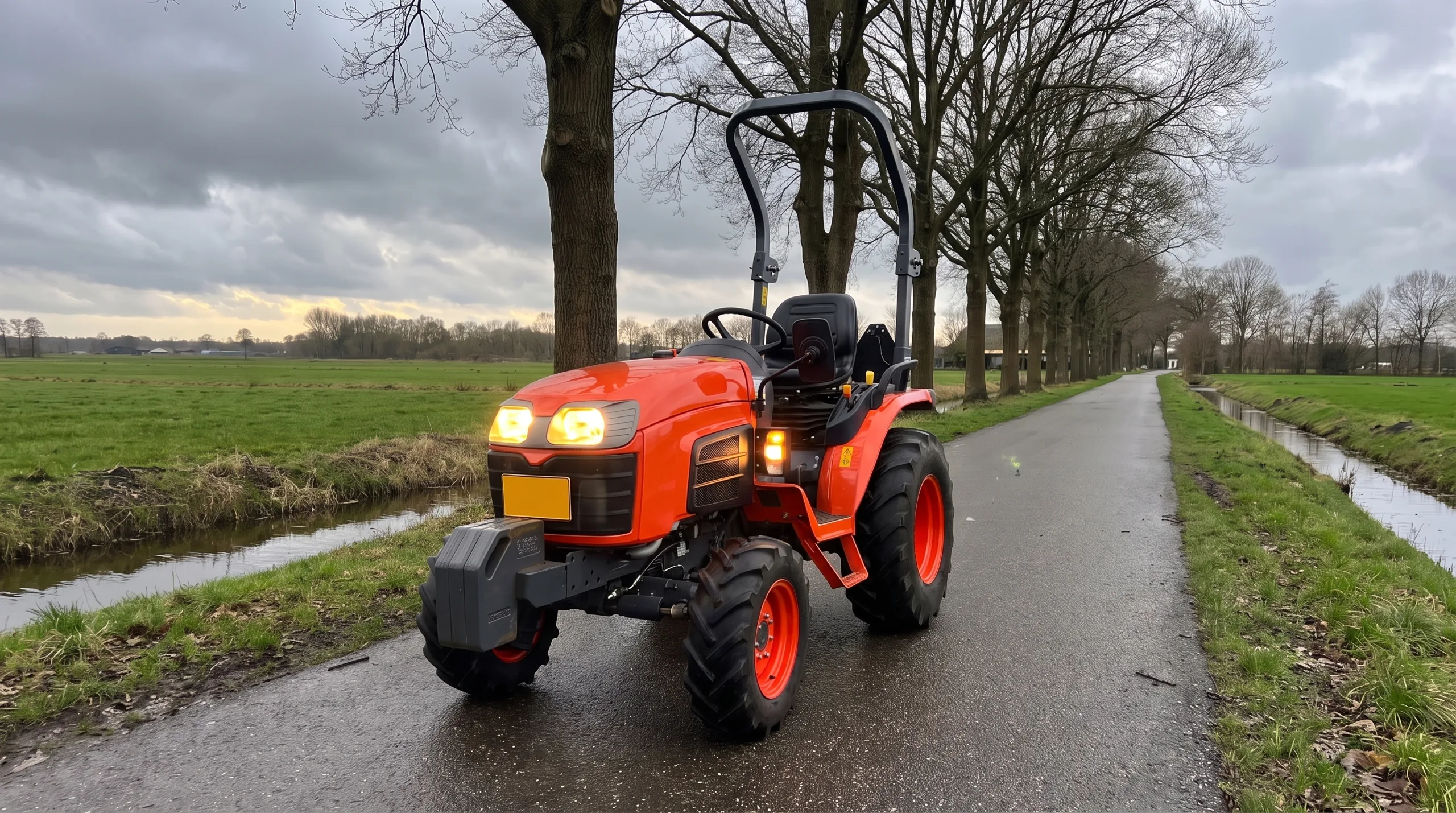
According to the RDW, registration is compulsory for agricultural vehicles with a design speed of 6 km/h or more that use the public road. Every compact tractor falls under this, even a Kubota B7001 doing 13 km/h. Crossing between two plots counts as public road, and so does any land that is accessible to others.
If the tractor never goes on the public road, it does not need to be registered. Third-party liability insurance is still compulsory, though.
If you do want to go on the road, you need:
- A registration with the RDW with a registration certificate.
- A number plate on the tractor.
- Third-party liability (WA) insurance.
- A T driving licence (with a few exceptions).
- Lights, reflectors, mirrors and a horn that meet the requirements.
Compact tractor registration: what has applied since 2021, 2022 and 2025
The registration requirement for agricultural vehicles was introduced in stages. The sequence:
| Date | What changed |
|---|---|
| 2021 | Start of registration of agricultural vehicles with the RDW |
| 1 January 2022 | Registration certificate compulsory for agricultural vehicles on the public road |
| 1 July 2022 | Police check for registration |
| 1 January 2025 | Number plate compulsory for every single registered agricultural vehicles (Act 35.188) |
If you drive without a registration certificate, according to the OM (Dutch Public Prosecution Service) you risk a fine of €410 (offence code K026a). Check the current amount with the OM.
If you buy a new European tractor with a Certificate of Conformity (CoC), registration is simple. Such a tractor is supplied with a number plate and lights. The real work is with grey imports.
Registering a grey import: RDW inspection, VIN, Lelystad and costs
A grey import is a Japanese compact tractor originally built for the Japanese market, without EU type approval. Think of a Kubota B1600, an Iseki TX2160 or a Yanmar YM2000. With a tractor like this, the RDW also inspects its technical condition, including brakes and lights. On an import, those lights are often missing or incomplete.
- VIN legible. The chassis number (VIN) must be legible. If not, an identity investigation and possibly re-stamping follow.
- Date of first admission. If the date of first admission is on or after 1 January 2018 and the tractor has no EU approval, according to the RDW an individual approval in Lelystad follows, with emission declarations. If the tractor has never had a date of first admission, the RDW goes by the year of manufacture on the type plate; for most Japanese imports that is well before 2018.
- Foreign registration does not count. A Japanese registration is not carried over.
- Don’t drive to the inspection yourself. Without a number plate you may not use the road to get to the inspection station. Use a one-day plate, trade plate or trailer, or have it inspected at home.
- ROPS and speed limiter. We have not been able to confirm whether a roll-over protective structure (ROPS) or a speed limiter is an approval requirement. Ask the RDW.
According to Rijksoverheid (the Dutch government), registration via an RDW inspection costs from about €140. With a grey import, extra items are added:
| Item (RDW fee) | Amount (indicative) | When |
|---|---|---|
| Identification | €120 | Establishing the identity |
| Assessment | €110 | Technical inspection |
| Registration | €50 | Entry in the vehicle register |
| Transfer of ownership | €13.10 | Registration in your name |
| Call-out fee for inspection at home | €145 | Inspection at your place |
| Identity investigation | €59 | If there is doubt about the VIN |
| VIN re-stamping | €59 | If the VIN is illegible |
Check the RDW’s current fees before your appointment. Also allow for the number plate and any lights you still need to fit.
T driving licence for a compact tractor: who, from what age and the 130 cm exception
On the public road you need a T driving licence for a tractor and for a mobile machine. You can take the theory test from 15.5 years, the practical test from 16. For 16 and 17-year-olds a limit of 40 km/h applies (indicative, check with the CBR, the Dutch driving test authority). On your own land no licence is required.
There is one exception where you don’t need a T licence, and it concerns the vehicle itself (separately from this, you may also drive a tractor with a valid C driving licence). The vehicle must then meet all three conditions:
- No wider than 130 cm, including any implement at the front.
- Used as a forklift, or for mowing, weed control, sweeping, snow clearing or gritting.
- Cannot tow a trailer or an interchangeable machine.
That third condition is the problem: a compact tractor with a three-point linkage or tow hitch usually does not meet it, even if it is narrow enough.
If you had a B driving licence from before 1 July 2015, the T category was added automatically when you renewed it. According to the CBR, that transitional arrangement ended on 1 July 2025. A German T licence and a Belgian G licence are recognised in the Netherlands.
Lights, mirrors, horn and reflectors: checklist
The lighting requirements are in the RDW’s APK (Dutch MOT) manual, but the legal source is article 5.8.51 of the Regeling voertuigen (Dutch vehicle regulations). They always apply on the road, even though a compact tractor does not have to undergo the APK. Before first admission, check with the RDW which requirements apply to your year of manufacture.
| Item | Requirement | Note |
|---|---|---|
| Dipped headlights | 2 | At the front |
| Position lights | 2 | At the front |
| Rear lights | 2 | Red |
| Direction indicators | Front and rear | Often missing on Japanese imports |
| Brake lights | 2 | If first used after 31-12-2000 |
| Hazard lights and number plate light | Compulsory | If first used after 31-12-2017 |
| Rear retroreflectors | 2 red | Without number plate: 1 truncated triangle |
| Left exterior mirror | Compulsory | No mirror requirement at max. 25 km/h with sufficient direct view |
| Right exterior mirror | If first used after 31-12-2017 | As above |
| Horn | Compulsory | — |
| Rotating beacon | Only if wider than 2.60 m, for roadworks, gritting or with an exemption | Usually not applicable to a compact tractor |
On a Japanese import the lights are often incomplete or worn. You can find headlights, rear lights, indicators and reflectors for many Kubota, Iseki and Hinomoto models in our lighting category. Whether your lights meet the inspection requirements after fitting is up to the RDW; ask the RDW if you are unsure about a part or its position.
Speed: 25 or 40 km/h, and why 30 km/h matters
With a number plate, an agricultural vehicle may do a maximum of 40 km/h outside built-up areas. Within built-up areas that is only allowed on roads with a separate cycle path, on roads closed to cyclists and on 70 km/h roads; otherwise 25 km/h applies. The old rule that without a number plate you may do a maximum of 25 km/h has, since 2025, only been relevant for vehicles exempt from registration; every registered agricultural vehicle now needs a plate. According to the RDW, your tractor may technically be capable of at most 5 km/h more than the design speed recorded in the register; if it can go faster, that counts as a modification to the vehicle. Tractors are not allowed on expressways and motorways.
In practice, the tractor determines how fast you go:
| Model | Type | Top speed (indicative) |
|---|---|---|
| Kubota B1750 | Japanese import | 12.6 km/h |
| Kubota B7001 | Japanese import | 13 km/h |
| Iseki TU1700 | Japanese import | 14.3 km/h |
| Yanmar YM2000 | Japanese import | 15 km/h |
| Yanmar SA221 | European compact tractor | 13 km/h |
| Kubota B2 series | European compact tractor | 18.5-23 km/h (brochure: max. 25) |
| Kubota L1-382 | European compact tractor | 25 km/h |
| Yanmar YT235 | European compact tractor | 29.7 km/h |
| Iseki TH4365 / TG5390 | European compact tractor | 30 km/h |
| Massey Ferguson 1700 M | European compact tractor | up to 34 km/h |
| BCS Invictus K300 / K400 | Italian articulated tractor | 30 km/h |
| Antonio Carraro TTR 4400 | Italian articulated tractor | 30 km/h |
So a Japanese grey import manages 12 to 15 km/h, a European compact tractor usually 25 to 34 km/h and an Italian articulated tractor 30 km/h. Note the Yanmar SA221: a new European tractor that still only does 13 km/h.
Work it out for a plot 5 kilometres away. At 13 km/h it takes you just over 23 minutes, at 30 km/h 10 minutes; there and back, that is a difference of almost half an hour. At 13 km/h you also hold up a queue of cars on a busy road, and overtaking cars are a risk. If you regularly drive between plots, that is a serious reason to choose a European or Italian tractor over a cheap import.
Third-party liability insurance and APK for a compact tractor
Third-party liability (WA) insurance is compulsory for all self-propelled agricultural vehicles. This follows from the WAM (Dutch Motor Insurance Liability Act) and applies even without registration and even if you only drive on your own yard.
The APK does not apply to a compact tractor. The APK only applies to agricultural vehicles that can go faster than 40 km/h: the first time after four years, then every two years. None of the compact tractors in this blog come close. Brakes and lights must of course always be in order on the road.
Compact tractor on the road in Belgium and Germany
Belgium. A tractor must be registered with a number plate at the DIV (Belgian vehicle registration service); tractors are not exempt. Anyone born after 30 September 1982 needs a G driving licence. Holders of a B or C licence may drive within the weight limit of their licence. The theory test for G can be taken from 15 years and 9 months, the practical test from 16. The G licence is a Belgian category that has also been recognised in the Netherlands since 1 July 2025. Tractors are not allowed on motorways. There are two classes: Ta up to 40 km/h and Tb above 40 km/h. Whether a tractor itself needs periodic inspection is not clear-cut; ask the GOCA (Belgian vehicle inspection association). A new Highway Code is coming in 2027: check the rules again then.
Germany. Above 6 km/h a Zulassung (registration) is compulsory. A grey import goes through an Einzelgenehmigung (individual approval), for example at the TÜV. With a tax exemption for agricultural and forestry use you drive with a green number plate (grünes Kennzeichen). The licence is Klasse L (up to 40 km/h, from 16) or Klasse T (up to 60 km/h, from 16, above 40 km/h from 18). A B licence includes L, but only for agricultural and forestry use, which includes park and garden maintenance. Tractors up to 40 km/h must go for the Hauptuntersuchung (HU) every 24 months.
Austria in one sentence: a tractor up to 25 km/h does not need the periodic inspection (Pickerl), and with a Führerschein F you may drive from 16 at up to 50 km/h.
Checklist: getting a grey import ready for registration
Work through this list before you apply for an inspection:
- Find the VIN. Clean it and check that it is legible. Illegible means extra costs for an identity investigation and re-stamping.
- Ask the RDW about the date of first admission. If it is on or after 1 January 2018, an individual approval in Lelystad follows.
- Complete the lighting. Dipped headlights, position lights, rear lights, front and rear indicators, brake lights and reflectors as per the table above.
- Have the brakes checked. With a grey import the RDW inspects the technical condition, including the brakes.
- Mirrors and horn. A left exterior mirror and a working horn.
- Arrange transport. Trailer, one-day plate, trade plate or an inspection at home.
- Take out third-party liability insurance. It is compulsory anyway, even without a number plate.
- Check your driving licence. Does it include T? If not, plan the theory and practical tests.
Frequently asked questions
Does a compact tractor need a number plate?
Yes, if it goes on the public road. According to the RDW, registration is compulsory for agricultural vehicles with a design speed of 6 km/h or more that use the public road, even if you only cross to another plot. Since 1 January 2025, every registered agricultural vehicle must carry a number plate. If the tractor never goes on the road, registration is not needed.
What does registering a compact tractor cost?
According to Rijksoverheid, registration via an RDW inspection costs from about €140. With a grey import, extra items are added, such as identification (€120), assessment (€110), registration (€50) and transfer of ownership (€13.10), and possibly a call-out fee for an inspection at home (€145). All amounts are indicative; check the current fees with the RDW.
Can I drive a compact tractor with a B driving licence?
Only if your licence includes T. Anyone who had a B licence from before 1 July 2015 got the T automatically on renewal. According to the CBR, that transitional arrangement ended on 1 July 2025. Without T you may only drive if the vehicle is no more than 130 cm wide, is only used for work such as mowing, sweeping or snow clearing, and cannot tow a trailer or interchangeable machine.
How fast may a compact tractor go on the public road?
With a number plate, a maximum of 40 km/h outside built-up areas. Within built-up areas that is only allowed on roads with a separate cycle path, on roads closed to cyclists and on 70 km/h roads, otherwise 25 km/h applies. You are not allowed on expressways and motorways. In practice a Japanese import manages 12 to 15 km/h and a European compact tractor usually 25 to 34 km/h.
Does a compact tractor need an APK?
No. The APK only applies to agricultural vehicles that can go faster than 40 km/h, with a first inspection after four years and then every two years. No compact tractor reaches that speed. Third-party liability insurance is compulsory, though, even if you only use the tractor on your own yard. When registering a grey import, the RDW does inspect the technical condition.
Can a Japanese grey import be registered?
In many cases yes, after an RDW inspection that also looks at brakes and lights. The VIN must be legible and the Japanese registration is not carried over. If the date of first admission is on or after 1 January 2018, an individual approval in Lelystad follows. If the tractor has never had a date of first admission, the RDW goes by the year of manufacture on the type plate.
Product tip: lights and parts to make your compact tractor roadworthy
- Headlight Kubota B1200-B1600 (SKU-50005), complete headlight Iseki TX1000-TX2160 (SKU-50004) and headlight Kubota L1500-L2201 (SKU-50001): replacement for broken or dull headlights.
- Rear light Kubota L3008-L5018 (SKU-50031), rear light Kubota GL19-GL35, Hinomoto NX (SKU-50039) and rear light Kubota | Iseki (VAR-0016): for missing or broken rear lights.
- Universal indicator light 80×80 mm (SKU-50033): front and rear direction indicators are compulsory.
- Rear light reflector set Iseki Landleader TA207-5040 (SKU-16010): rear lights and reflectors in one set.
- Seat Kubota B5000-B7100, Iseki, Hinomoto, Yanmar (SKU-42007): on the road you sit for longer stretches.
Questions about parts for your model? Get in touch with the make and type, and we will look up the right lights or the right part.