



Compact tractor for a horse farm: which tractor, front loader and implements do you need?
Which tractor suits a horse farm? For a yard with a few hectares of pasture you’ll roughly end up with a compact tractor of 25 to 40 hp and 750 to 1,400 kg, with four-wheel drive, a hydrostatic transmission and a front loader with a third function. With that you lift bales, scrape manure and harrow and top the pasture. The most important figure when buying isn’t engine power, but what the front loader lifts 500 mm in front of the pivot point.
Still unsure which situation fits yours? Then first read the guide on which compact tractor to buy for each situation. Everything about the loader itself is in our blog on the front loader on a compact tractor.

What a horse farm asks of a tractor
A tractor on a horse farm does few heavy pulling hours, but a great many short jobs. Moving bales, carting manure away, levelling the paddock, harrowing and topping the pasture. That means a lot of turning, a lot of loader work and a different implement each season.
| Season | Job | Implement |
|---|---|---|
| All year | Clearing manure, mucking out, feeding bales | Front loader with bucket or manure fork, manure scraper, tipping trailer, bale spike |
| Spring | Harrowing the pasture (dry spell), levelling the paddock | Pasture harrow, rear blade, Cambridge roller |
| Summer and autumn | Topping, mowing ragwort, overseeding in September and October | Pasture topper, flail mower, flail mower with collector |
| Winter | Moving bales, harrowing during frost | Front loader, bale spike, pasture harrow |
Which tractor for a horse farm: hp, weight, 4WD and hydrostatic transmission
The class we recommend is roughly between 25 and 40 hp and between 750 and 1,400 kg (indicative). Lighter is possible, but then the loader quickly becomes the weak point.
- Four-wheel drive: never fit a front loader to a compact tractor with rear-wheel drive only. The steering knuckles and the front axle aren’t designed for it, and reversing with a full bucket you have no grip.
- Hydrostatic transmission: ideal for loader work with lots of changes of direction. If you mainly drive with a harrow and mower, a manual gearbox is fine too.
- Pump output: count on 20 to 40 l/min (indicative). With a slow pump every lift takes a long time.
- PTO power: at the PTO you’re left with about 80 to 85% of engine power. On the Kubota B2601 that is 24.3 hp engine and 19.5 hp at the PTO.
Worked example: a pasture topper needs roughly 16 to 17 hp per metre (indicative). For 1.5 metres you need around 25 PTO hp, so about 30 hp of engine power.
Front loader, pallet fork and bales: work with the figure at 500 mm
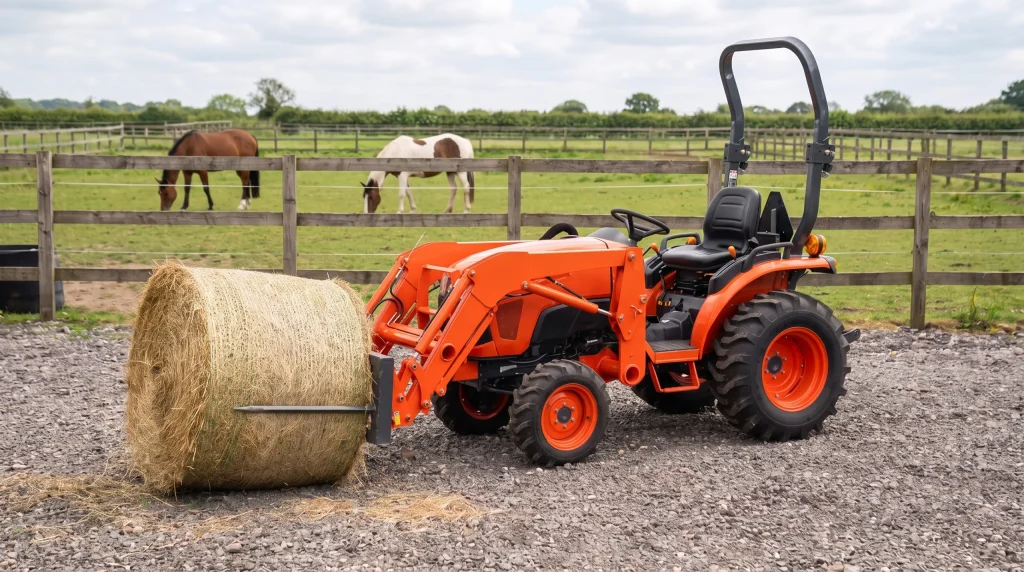
Manufacturers quote two lift capacities: at the bucket pivot point and 500 mm in front of the pivot point. The first is printed biggest in the brochure, the second tells you more. A bale on a bale spear hangs even further forward. A small bale of hay weighs 15 to 25 kg, a round bale of hay easily 300 to 600 kg and a round bale of haylage or silage 400 to 700 kg or more (indicative).
| Front loader | Fits | At the pivot point | At 500 mm in front | Lift height | Oil requirement |
|---|---|---|---|---|---|
| Kubota LA435 | Kubota B2301 / B2401 / B2601 | 430 kg | 300 kg | 1,995 mm | 18 l/min, 141 bar |
| Kubota LA525 | Kubota L2501 / L3301 / L3901 | 491-513 kg | 372-388 kg | 2,394 mm | 23.9 l/min |
| John Deere 220R (indicative) | John Deere 2032R / 2036R / 2038R | 509 kg | 365 kg | 2,160 mm | 20.2 l/min |
| New Holland 200LC (indicative) | New Holland Workmaster 25 | 727 kg | 552 kg | 2,386 mm | 30.1 l/min |
| MX / Iseki C2 (indicative) | Tractors of 20 to 50 hp | 570 kg | — | 2.25 m | 20 l/min, 140 bar |
The Kubota figures come from the manufacturer’s specification sheet. As a rule of thumb, with pallet forks, where the load hangs 60 to 75 cm in front of the pivot point, you’re left with about 60% of the pivot point figure. With a bucket it’s about 80% (indicative). So an LA435 with a bale spear lifts roughly 260 kg: a midi bale or a light hay bale is fine, an average round bale of hay or a silage bale isn’t.
Third function, self-levelling and ballast
For a bale clamp, shear grab or manure grab you need a third function: an extra double-acting valve, operated by cable or electrically. A separate valve block costs from about €200 excl. VAT (indicative). Mechanical self-levelling is simple and safe with pallets and bales. Preferably choose a Euro quick-attach, because that has the widest range of buckets and forks.
Make sure that with a full loader at least 25% of the total weight stays on the rear axle. The manual for the Kubota LA525 mentions a three-point weight and wheel weights; an 11.2-24 tyre filled to 75% takes about 105 kg of water, up to 160 kg with calcium chloride. For heavy bales a bale spike on the three-point linkage is often smarter; there are ones rated up to 1,100 kg for about €300 (indicative). Do allow for 30 to 50% less lift capacity at 61 cm behind the ball ends (indicative). Fitting a loader yourself? Read our article on front loader kits: installation and costs.
Looking after the horse pasture: harrowing, topping and mowing
Mow a horse pasture at 7 to 10 cm and never lower than about 7.5 cm. Top or mulch once or twice a year, or more often if there are a lot of tussocks. Never feed fresh clippings because of the risk of colic, and only let the horses back on when the clippings are dry or well spread.
- Clear manure first, then harrow. Only harrow in a dry spell or during frost, otherwise you spread worm eggs over the whole pasture.
- Ragwort: mow twice a year before flowering, from mid-July and at the end of August or early September. Dried, the plant stays poisonous and horses will eat it then. So remove the clippings or dig the plants out. Don’t mulch.
- Broad-leaved dock: dig out to a depth of 10 to 20 cm and prevent it from setting seed.
| Mower | On the horse pasture | Hp per metre (indicative) |
|---|---|---|
| Pasture topper | Rough grass and tussocks after grazing | approx. 16-17 |
| Flail mower | Topping and mulching; throws out less than a finishing mower | 10-20 |
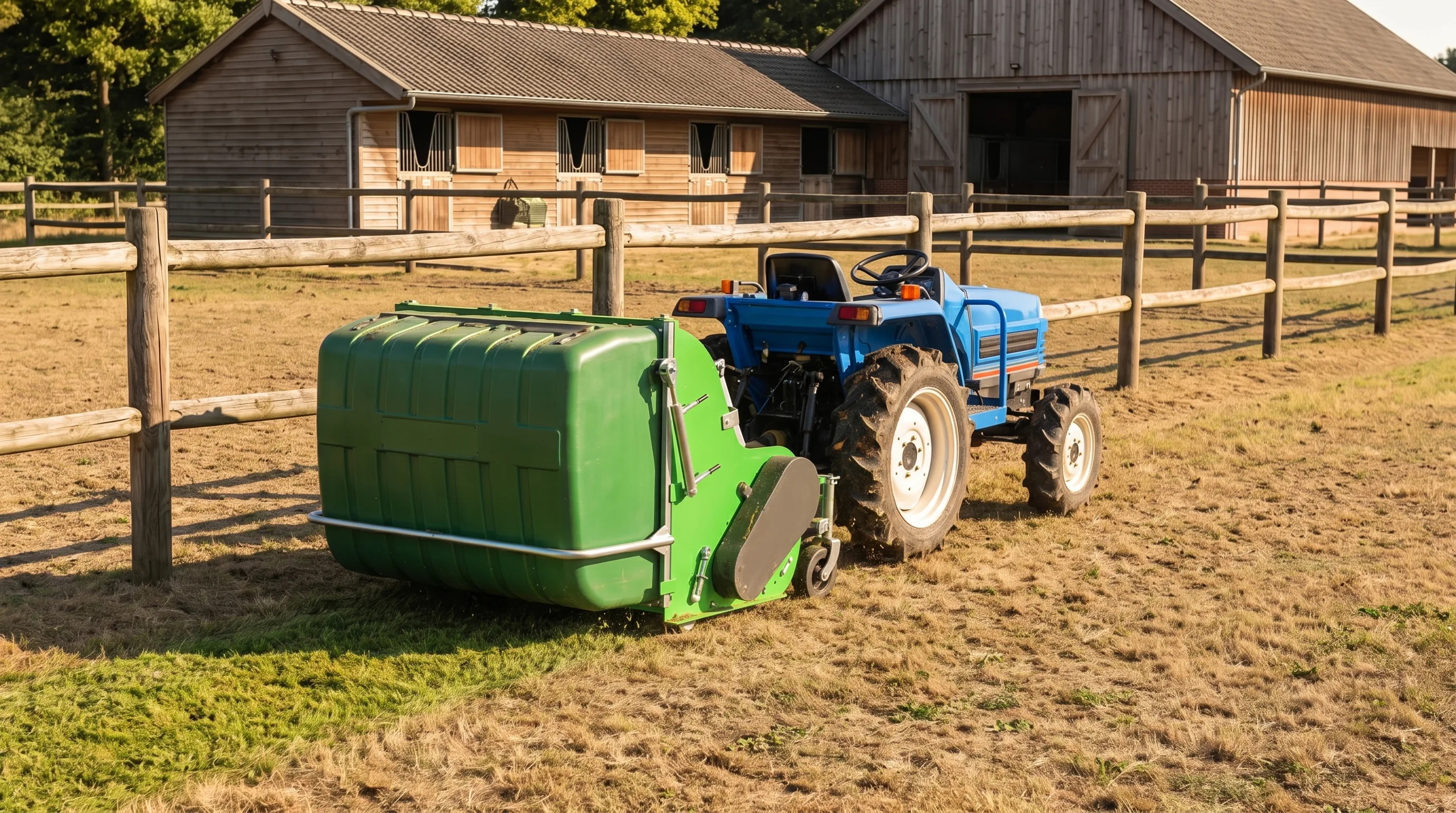
| Flail mower with collector | Collects the clippings, including ragwort that has to go | 17-30 |
| Finishing mower | Neat finish, clogs in grass above about 20 cm | approx. 13 |
The Peruzzo Koala 1000, 1200 and 1600 are 995, 1,175 and 1,475 mm wide, have a hopper of 600, 700 and 900 litres and need 18 to 22, 20 to 25 and 25 to 35 hp. It doesn’t pick up horse manure; there are separate paddock cleaners for that. Use an overrunning clutch in the PTO with every mower, otherwise the mass that keeps spinning can push the tractor forward. More in our blog on the finishing mower, pasture topper or flail mower.
Manure and stable: manure scraper, manure fork and tipping trailer
In the stable and on the paddock it’s all about short runs with a lot of turning. That’s where a hydrostatic transmission is worth most. For mucking out you use a loader bucket or a manure fork. A manure fork with a grab needs the third function and lifts less: well under half the pivot point figure (indicative). A manure scraper or rear blade pushes the manure into a heap and then levels the paddock. You cart it away with a tipping trailer on the tow hitch or a drawbar frame on the three-point linkage.
On a large yard with bales stacked high, a yard loader is sometimes handier. A Weidemann Hoftrac 1160 has a tipping load of 1,070 to 1,450 kg (with a bucket it may lift about half of that), compared with about 700 kg on the front loader of a 40 hp compact tractor. But a yard loader has no three-point linkage and no 540 PTO, so for harrowing and topping you still need a tractor.
Tractor for the horse farm: models new and second-hand
The technical figures are factory specifications, the prices are indicative (2025-2026 prices).
| Model | Engine | Weight | Rear lift | Pump | Transmission | Top speed | Price (indicative) |
|---|---|---|---|---|---|---|---|
| Kubota B2261 | 3-cyl, 26 hp | 730-760 kg | 970 kg | 18.9 l/min | 9F/9R or HST | 18.5-23 km/h | — |
| Iseki TM3267 | 30 hp | 820-865 kg | 600 kg | 20.6 l/min | 8/8 manual or HST | 22-24.4 km/h | HST approx. €21,000 incl. VAT (promotion) |
| Iseki TLE3410 | 40 hp | 1,405 kg | 1,000 kg | 28.3 l/min | 8/8 or HST | 25.9-26.4 km/h | — |
| Yanmar YT235 | 3TNV88C, 35 hp | 1,110 kg | 950 kg | 41.8 l/min | HST | 29.7 km/h | approx. €24,000 excl. VAT |
| New Holland Boomer 35 | Mitsubishi L3CRV turbo, 35 hp | — | 1,100 kg | 31.2 + 15.6 l/min | HST 3-range | — | €23,900 excl. VAT |
| Kioti CK3530 CH | 3-cyl CRDI, 35 hp | — | 1,030 kg | — | HST 3-range | — | — |
| Solis H26 | Mitsubishi 3-cyl, 26 hp | — | 750 kg | — | HST 2-range | — | from €11,850 excl. VAT |
At 600 kg, the Iseki TM3267 has the lightest rear linkage in this list; for heavy bales at the rear, look rather at the TLE3410, YT235 or Boomer 35. A TLE3410 with a front loader with third function lifts about 700 kg (indicative).
Second-hand and Japanese import
These figures come from third-party databases and are indicative.
| Model | Engine | Weight | Lift | Pump |
|---|---|---|---|---|
| Kubota B2150 (1988-96) | 4-cyl, 24 hp | — | 459 kg | 28 l/min |
| Kubota B2410 | D1105, 24 hp, HST | — | 750 kg | 16.7 l/min |
| Hinomoto E2304 (1982-92) | Toyosha, 22.7 hp | 1,021 kg | — | — |
| Yanmar FX235 (1987-92) | 22.7 hp | 1,030 kg | JIS1 | — |
| Iseki TM3267, nearly new (approx. €14,650 excl. VAT) | 30 hp | 820-865 kg | 600 kg | 20.6 l/min |
A Japanese import of 15 to 23 hp costs about €4,350 to €8,500 excl. VAT, with a front loader around €8,450 (indicative). It’s a grey import: built for the Japanese market, without EU type approval. ROPS and complete lighting are often missing, the linkage is JIS or 2-point (adapter to Cat. 1 needed) and you only reach 12 to 15 km/h. A Kubota B7100 (11.4 l/min) or Iseki TX2160 (10.2 l/min) delivers less oil than the 14 l/min of the smallest Kubota loader and is too light for a horse farm. You’ll find the parts for maintenance with us.
On the road to the other field: registration and 30 km/h
According to the RDW (Dutch vehicle authority), an agricultural vehicle that can do 6 km/h or more and goes on the public road must be registered, even if you only cross between two fields. Since 1 January 2025 that includes a number plate. You need a category T driving licence, and third-party liability insurance is always compulsory, even on your own property (last checked on 24 September 2026; check the current rules with the RDW).
Without a number plate you are no longer allowed on the road since 2025. With a plate you may drive at up to 40 km/h outside built-up areas, and usually 25 km/h inside them. A 3 km trip takes almost a quarter of an hour with a Japanese import at 13 km/h, and about six minutes at 30 km/h. The larger European compact tractors reach 25 to 32 km/h. More in our blog on the compact tractor on the public road.
Maintenance and wear with a lot of loader work
The front axle carries the weight of the loader plus the load. That’s where you see wear first: on bearings, oil seals, rims, tyres and steering parts.
- Greasing: all grease nipples on the loader every 10 hours, as the manual for the Kubota LA525 specifies.
- Daily: check bolts and hydraulic hoses.
- Subframe: retighten the bolts after the first hours and never let the frame rest directly on the sump.
- Front axle: look out for oil around the steering knuckles and differential and change the front axle oil as the manual says.
- Hydraulics: if the loader gets slower, check the oil level and filter first; only then the pump.
- Three-point linkage: pins and linch pins wear from frequent swapping between harrow, topper and bale spike.
Frequently asked questions
How much hp does a tractor for a horse farm need?
Roughly 25 to 40 hp at 750 to 1,400 kg (indicative). A pasture topper needs about 16 to 17 hp per metre, and at the PTO you’re left with 80 to 85% of engine power. For a 1.5 metre topper that comes to about 30 hp. Choose four-wheel drive and, for a lot of loader work, a hydrostatic transmission.
Can a compact tractor with a front loader lift a round bale?
A midi bale or light hay bale usually yes, an average round bale of hay often not and a silage bale not. A round bale of hay weighs 300 to 600 kg, a bale of haylage or silage 400 to 700 kg or more (indicative). Look at the lift capacity 500 mm in front of the pivot point. A Kubota LA435 manages 300 kg there; with a bale spear you’re left with roughly 260 kg (indicative). For heavy bales a bale spike at the rear is often better.
At what height do you mow a horse pasture?
At 7 to 10 cm, and never lower than about 7.5 cm. Top or mulch once or twice a year. Clear the manure first and harrow afterwards, only in a dry spell or during frost. Don’t feed fresh clippings, and only let the horses back on when the clippings are dry or well spread.
Can you mulch ragwort with a flail mower?
No. Dried ragwort stays poisonous and horses will eat it then. Mow twice a year before flowering, from mid-July and at the end of August or early September, and remove the clippings. A flail mower with collector gathers them in a single pass. You can also dig out individual plants.
Do you need a third function on the front loader?
Yes, as soon as you want to use a bale clamp, shear grab or manure grab. These have their own double-acting cylinder and therefore need an extra valve. A separate valve block costs from about €200 excl. VAT (indicative). With just a bucket, pallet fork or bale spear you can do without.
Does a compact tractor need registration to drive to another pasture?
Yes, as soon as you drive on the public road, even if you only cross it. According to the RDW, every agricultural vehicle that can do 6 km/h or more and goes on the road must be registered, since 1 January 2025 with a number plate. You also need a category T driving licence and third-party liability insurance. Check the current rules with the RDW.
Product tip: parts for linkage, front axle and hydraulics
- Drawbar frame / three-point hitch Cat. 1 (SKU-14002): to hitch a tipping trailer or muck spreader to the three-point linkage.
- Lower link pins 22×51 mm Cat. 1 (SKU-14023-s) and top link pins 19×127 mm (SKU-14022-s): they wear and go missing from frequent implement changes.
- 3-point linkage kit Kubota B5000-B7001, Yanmar, Shibaura (SKU-14003) and linkage kit Iseki TX/TU (SKU-14004): complete category 1 three-point linkage (12×500 mm lift arms, top link) for a Japanese tractor.
- Oil seals for front axle and rear axle: with a lot of loader work, the front axle is the first to leak.
- Transmission and hydraulic oil STOU GL-4 (SKU-15W402): for tractors whose manual specifies a universal tractor oil.
- Hydraulic pump Kubota B1200-B7100 (SKU-115001-7): when the linkage and loader get slower because of a worn pump.
Questions about parts for your model? Get in touch and we’ll find the right part for your tractor.