



Yanmar Ke-13 through Ke-18 storage & seasonal maintenance
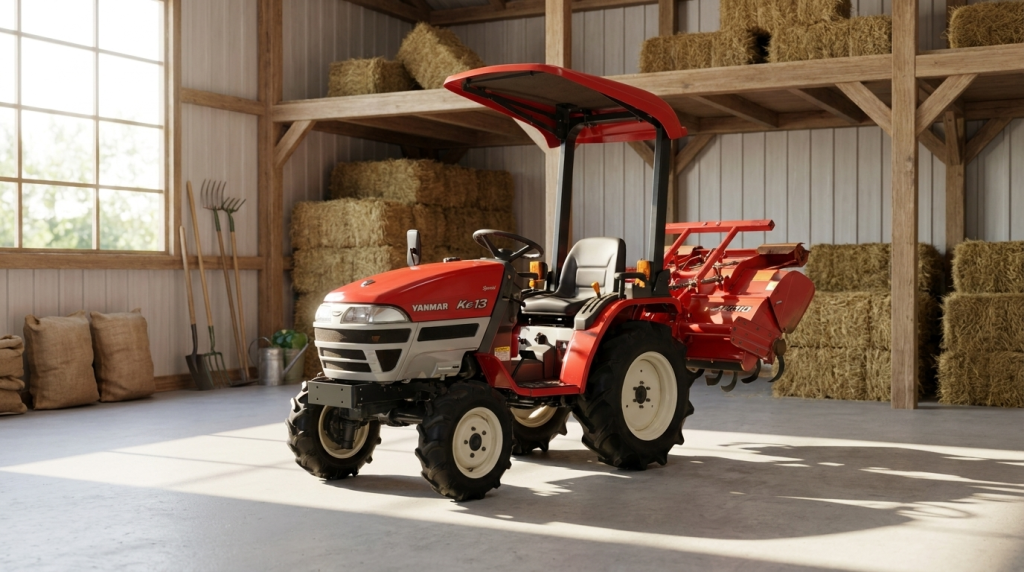
A Yanmar Ke-13, Ke-14, Ke-16 or Ke-18 that sits idle for months is more likely to break down from standing still than from actual work. That's why the Ke-series manual has its own storage chapter — here's the complete procedure, plus the spring checklist.
Suitable for the entire series: Yanmar Ke-13, Ke-14, Ke-16 and Ke-18 (all versions).
Yanmar Ke-series: after every working day
Spray down the tractor, wipe it dry, and then grease the fittings — right after washing, so you push the water out of the bearing points. Don't aim the water jet at the electrical components and dashboard. If you've been working in mud, grease it the same day.
Winterizing the Yanmar Ke-series: the procedure from the manual
| Step | Why |
|---|---|
| Wash, dry, grease | Remove moisture and acids built up during the season |
| Detach implement, remove ballast | Relieve load on the lift and tires; place the tiller on planks |
| Rust-preventive oil on bare parts | Protect exposed shafts and rods |
| Fill the tank completely | Prevents condensation and thus rust and bacterial growth in the tank |
| Set water separator to "off/closed" | Per the manual for extended storage |
| Fully charge the battery and (preferably) remove it | Self-discharge; recharge it monthly |
| Check antifreeze or drain the coolant | Prevent frost damage to the block and radiator |
| Cover the air intake, exhaust, and oil filler cap | Keeps out moisture (and mice) |
| Press and lock the clutch pedal | Prevents a seized (stuck) clutch plate |
| Tires at correct pressure, machine on blocks if possible | Prevents deformation |
| Remove the key, store dry and ventilated | Prevents electrical leakage and moisture buildup |
That clutch lock is a detail many owners miss: the Ke-series has a special lock for it. A stuck clutch after winter is an annoying and often costly job to free up again.
Yanmar Ke-series: the spring checklist
Before the season's first ride: reinstall the battery (grease the terminals), check oil level and coolant, set tire pressure to spec, remove the intake and exhaust covers, open the water separator, and check the free play of the clutch (15–25 mm) and brakes (25–35 mm). Start according to the procedure in the operating and starting guide and let the engine warm up thoroughly. Is there still winter diesel in the tank from before storage? That's fine — topping up with fresh summer diesel may be necessary after a full year of standing still; if you're unsure about the fuel, drain the water separator.
If the oil was already old before storage, change the oil and filters right away — that way you start the season with clean materials. You'll find the intervals in the maintenance schedule.
Product tip: plan ahead for the spring service: the filter set Yanmar Ke-13 through Ke-18 (SKU-10090) will be ready on the shelf, along with a spare glow plug (SKU-551216) for the first cold start.