



Starting and Operating the Mitsubishi MT160–MT240
How do you start and operate a Mitsubishi MT160, MT170, MT190, MT200, MT220 or MT240? On this page, we go through the starting procedure step by step, including preheating and warming up, and explain the key operating components: the gears, the PTO shaft, and the four-wheel drive.
Suitable for the entire series: Mitsubishi MT160, MT170, MT190, MT200, MT220 and MT240 (all 4WD).
Starting the Mitsubishi MT160–MT240
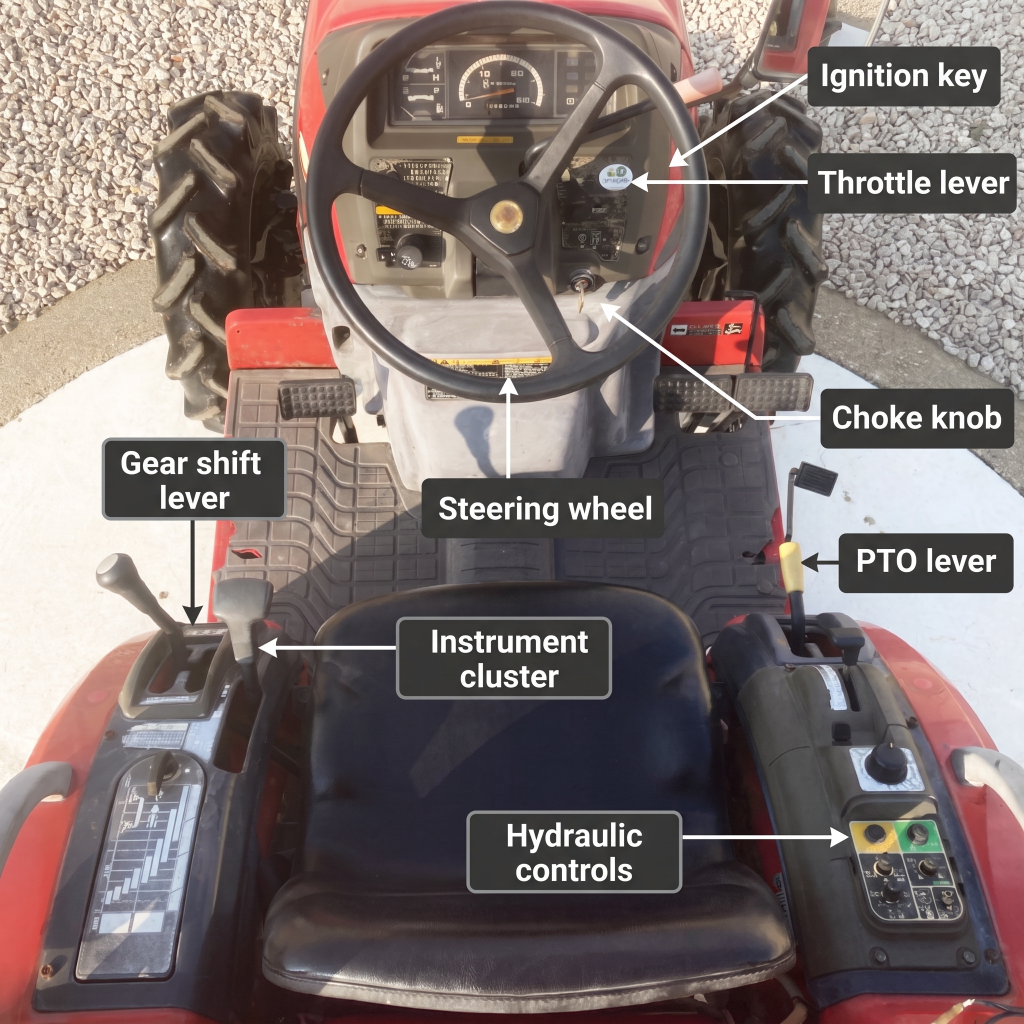
Always start the tractor from the seat, with the gear in neutral:
- Open the fuel valve and put the gear and PTO levers in neutral.
- Press the clutch and set the throttle to a low to medium position.
- Turn the ignition key to the preheat position and wait until the glow indicator shows that the glow plugs are warm. In cold weather, preheat a bit longer.
- Turn the key further to start. Once the engine starts, release the key and let it warm up gently before putting it under load.
If a tractor that has been standing still for a long time doesn't start, there is often air in the fuel system. Turn the ignition key to ON; the fuel pump will then run for about 15 seconds and bleed the system toward the injection pump. Repeat if necessary and bleed manually at the fuel filter. In winter, choose a diesel with good cold properties so the fuel doesn't gel.
Mitsubishi MT160–MT240 operation: gears
The MT160 through MT190 have a sliding gearbox with six forward gears and three reverse gears, plus a range lever with high, low, and super-low. The MT200 through MT240 have eight forward gears and two reverse gears, and (as an option) a super creep gear that adds four extra low gears for planting and precision work. Always shift with the clutch pressed and the tractor (nearly) stationary.
Mitsubishi MT160–MT240 power take-off (PTO)
The PTO shaft has three speeds, allowing you to drive the implement at the correct speed. On various versions, a reverse PTO direction is also available for certain implements. Only engage the PTO with the engine at low speed and the clutch pressed.
Mitsubishi MT160–MT240 four-wheel drive and diff-lock
All models are 4WD, but there is an important difference: the MT160, MT170 and MT190 are permanently four-wheel driven and have no front axle lever. On the MT200, MT220 and MT240, you engage and disengage the front axle with the 4WD lever — handy for saving tires on paved roads and for extra grip during heavy pulling work. Use the diff-lock (differential lock) only to get out of a slippery spot; never engage it while steering or on the road. Some versions also feature a microcomputer control and an automatic steering brake that slows the inner wheel during tight turns.