



Kubota GB110-GB200 engine oil & fluids
Kubota GB110-GB200 engine oil & fluids: types and quantities
Which engine oil does your Kubota GB need, and how much? Below you'll find all the fluids for the complete GB series, with the specifications from the factory manual and practical tips for changing them.
Suitable for the entire series: Kubota GB110, GB130, GB140, GB150, GB160, GB170, GB180 and GB200.
Kubota GB engine oil: which type?
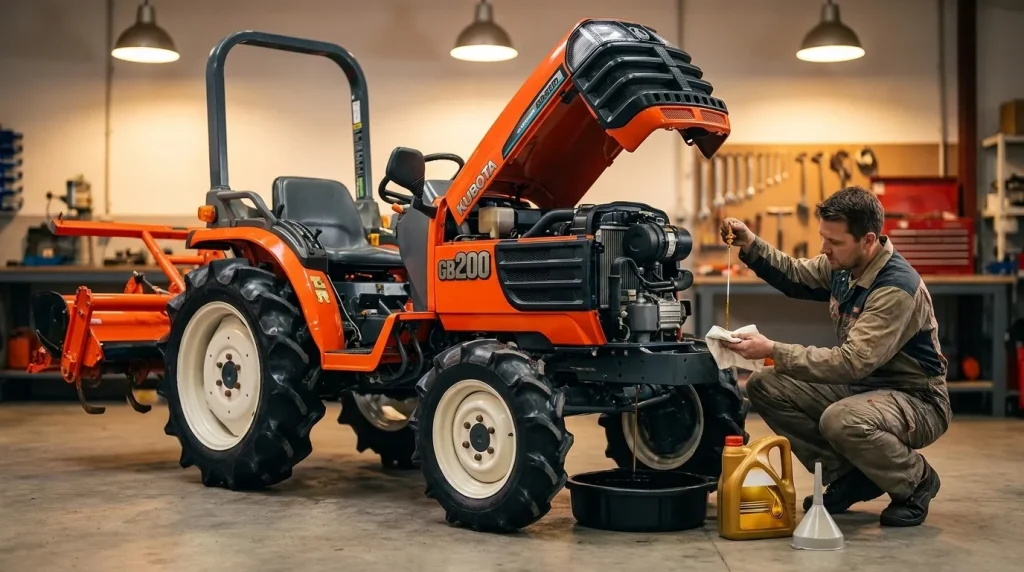
For the entire series, Kubota specifies a diesel engine oil of API class CC or CD, with viscosity SAE 30 or SAE 10W-30. In winter, the manual explicitly recommends 10W-30: at low temperatures, single-grade oil becomes too thick, preventing the starter motor from getting the engine up to compression smoothly. A modern 15W-40 diesel engine oil (API CD or higher) is in practice an excellent year-round choice for the Dutch climate.
| Model | Engine | Engine oil capacity (incl. filter) |
|---|---|---|
| GB110 | Z482 | 1.6 liters |
| GB130 | D662 | 2.4 liters |
| GB140 | D722 | 2.4 liters |
| GB150 / GB170 | D905 / D1005 | 2.7 liters |
| GB160 / GB180 / GB200 | D905 / D1005 / D1105 | 3.8 liters |
The capacity is measured up to the upper mark on the dipstick, including the filter fill. Change every 100 hours or at least annually; the oil filter every 200 hours (the first time already after 50 hours).
Kubota GB transmission oil: one oil for three systems
The transmission oil in a GB does three things at once: it lubricates the gearbox and rear differential, feeds the hydraulic lift system (and power steering where present), and cools the wet disc brakes. Therefore, always use a UDT oil (Universal Dynamic Tractor fluid) such as Kubota Super UDT or an equivalent transmission/hydraulic oil — never regular engine oil or EP gear oil. The capacity is 11.5 liters (GB110–GB170) or 12 liters (GB160/GB180/GB200); change every 300 hours, along with the hydraulic filter, which is due every 200 hours. Use the same UDT for the front axle drive: 3.0 liters for the compact group (3.7 liters for the high-speed turn version), and for the large group 2.3 liters in the gear housing plus 4.6 liters in the front axle. The steering gearbox of models with mechanical steering contains an additional 0.2 liters.
Kubota GB coolant
The cooling system holds 2.9 liters in the radiator plus 0.7 liters in the reserve tank (GB110–GB170), or 3.1 + 0.6 liters (GB160/GB180/GB200). The manual specifies clean water with antifreeze — in our climate: a 50% mixture of long-life coolant year-round, so you have both frost and corrosion protection. Replace the coolant every two years and flush the radiator at the same time. Important detail from the manual: at a coolant temperature approaching 125 °C, the temperature gauge is in the red zone and you must stop immediately — then check the coolant level, V-belt tension, and whether the radiator and insect screen are clogged.
Kubota GB fuel: watch out during extended downtime
All models run on regular diesel oil (tank: 13 liters for the compact group, 20 liters for the large group). Two practical points: never run the tank completely empty — after running dry, the fuel system must be bled before the engine can start again — and don't use diesel that has been sitting for longer than a season. Old diesel and condensation water in the tank are, for these engines, the number one cause of starting problems and stuck injector needles.