




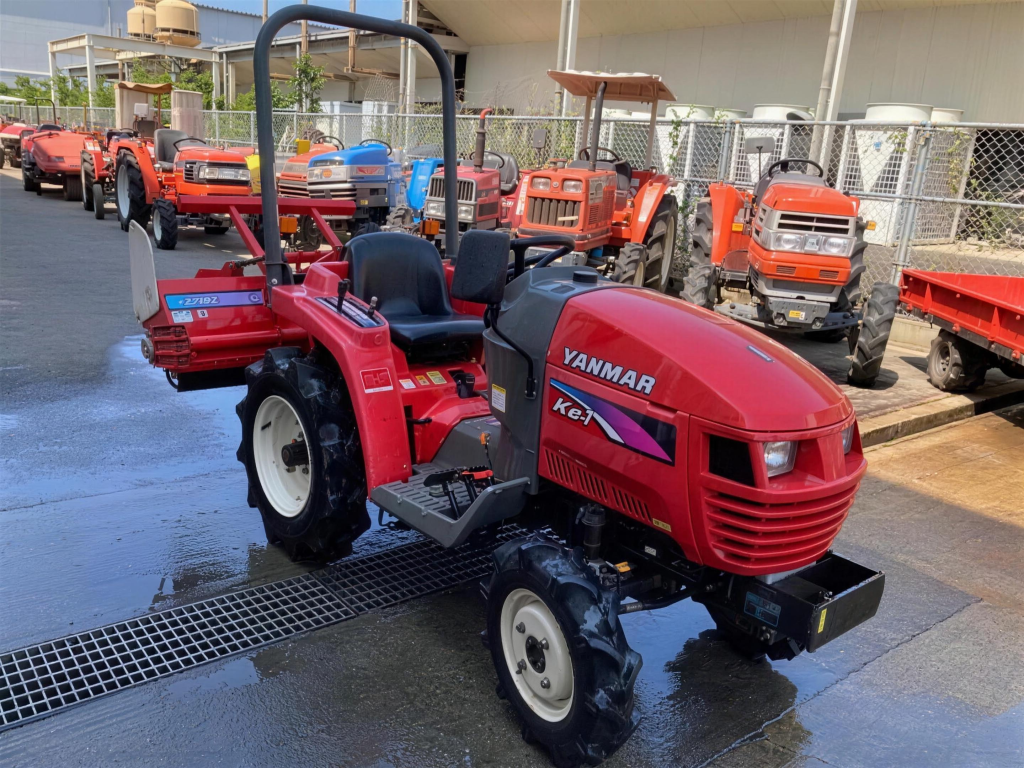
Buying a Yanmar Ke-1, Ke-1D, Ke-2D & Ke-3D: buying advice for the Ke series
The Yanmar Ke series is a modern generation of compact diesel tractors that you'll increasingly come across as Japanese imports in the Netherlands. In this buying guide you'll find out what to look out for when buying a Yanmar Ke-1, Ke-1D, Ke-2D or Ke-3D: the differences between models, indicative prices, and the points to check when viewing one.
Suitable for the entire series: Yanmar Ke-1, Ke-1D, Ke-2D and Ke-3D (approx. 2003–2006).
Yanmar Ke series: the four models at a glance
The series shares a single chassis and layout, but differs in engine and drivetrain. The Ke-1 is the 2WD base model; the D models have four-wheel drive.
| Model | Drivetrain | Engine | Displacement | Power | Weight |
|---|---|---|---|---|---|
| Ke-1 | 2WD | Yanmar 3TN63 (UK3M) | 600 cc | 12.5 hp / 2900 rpm | 490 kg |
| Ke-1D | 4WD | Yanmar 3TN63 (UK3S) | 600 cc | 12.5 hp / 2900 rpm | 495 kg |
| Ke-2D | 4WD | Yanmar 3TN66-UK3 | 658 cc | 14 hp / 2900 rpm | 500 kg |
| Ke-3D | 4WD | Yanmar 3TNE68-UK3 | 784 cc | 15 hp / 2900 rpm | 540 kg |
All four have a 3-cylinder water-cooled diesel engine with a Bosch injection pump, glow plug preheating via the ignition switch, and a 13-litre fuel tank. The Ke-3D also has a larger bore as well as a longer stroke (68 × 72.3 mm), making it the most powerful and torquiest of the series.
Yanmar Ke series: what makes these tractors special?
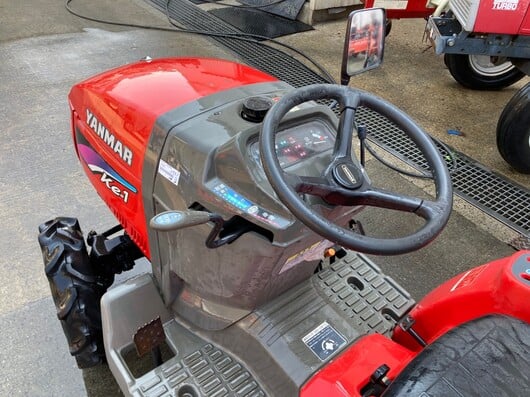
For its age class, the Ke series is remarkably modern in specification. You drive with a continuously variable transmission without having to use a clutch, which makes working with a rotary tiller on small plots very relaxed. The D models also have a reverse PTO (427 rpm reverse, alongside 569/900 rpm forward), the lift mechanism has automatic depth control, and the dashboard is complete with a tachometer, hour meter, fuel gauge, and warning lights for charge current, oil pressure, and coolant temperature. A safety frame (ROPS) with seatbelt was part of the standard equipment.
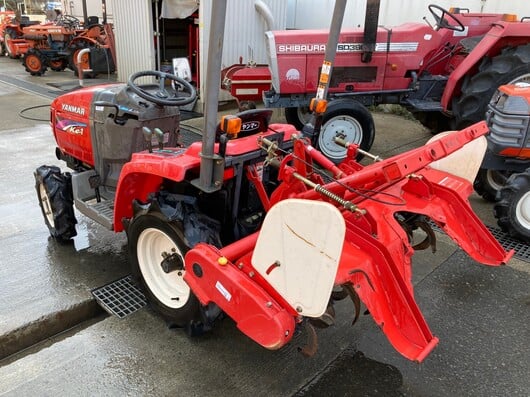
With 12.5 to 15 hp, these are typical one-hectare machines: tilling (standard rotary 110–120 cm), light soil cultivation, transport work, and mowing are all handled excellently. Don't expect heavy plowing work or a large flail mower from these — for that, it's better to look at a class higher.
Note: two generations with the same name
Important to know before you order parts or assess a listing: Yanmar also used the names Ke-2D and Ke-3D in the 1990s, for an older series with an 8-speed gearbox and a conventional plate clutch (engines 3TN66-UNK, 3TNA68-UNK and 3TNA72-UNK). Listings and auction sites regularly lump both generations together.
How to recognise the modern series: continuously variable driving without a clutch pedal, the large model decal ("Ke-1", "Ke-2D") with a purple accent on the side of the bonnet, grey side panels beneath the red bonnet, and the chassis number stamped on the frame beam at the front under the bonnet. Not sure? Check the engine code on the type plate: UK3 indicates this series, UNK the older one.
Buying a Yanmar Ke: indicative prices
The amounts below are indicative, based on recent sales results in Japan (last checked: July 2026). For a well-maintained machine in the Netherlands, expect roughly one and a half to two times the Japanese price level, due to transport, import, and dealer margin.
| Model | Price level Japan (approx.) | Note |
|---|---|---|
| Ke-1 / Ke-1D | € 1,000 – € 2,200 | Average around € 1,350 |
| Ke-2D | € 1,200 – € 3,100 | Well-maintained units with a tiller around € 1,400 – € 1,700 |
| Ke-3D | € 1,200 – € 2,500+ | Overhauled units with a tiller and warranty noticeably more expensive |
What mainly determines the price: the number of operating hours (under 500 hours is not uncommon for this series), whether a tiller is included, whether the safety frame is still present (sometimes removed for Japanese export), and whether the machine has been overhauled.
Yanmar Ke series: what to check when viewing
From owners' practical experience, one point clearly stands out: the front-wheel drive gears are a wear point with intensive use. Engage 4WD and make a short turn on a hard surface: crunching or rattling from the front axle is a reason to negotiate further or walk away from the purchase.
Also check:
- Cold start: let the engine preheat and start from cold. A healthy 3TN engine catches within a few seconds. Extended cranking indicates worn glow plugs, a weak battery (12V-27Ah), or loss of compression.
- Continuously variable transmission: drive both forward and reverse in both ranges. It should engage smoothly and without jolts; check the transmission oil level (11 litres, also serves as hydraulic oil).
- PTO and reverse setting: engage both PTO speeds and, on D models, also the reverse setting. Check for leaks around the PTO shaft while it's running.
- Lift mechanism: lift an implement and test the automatic depth control. The lift should hold without sagging.
- Hour meter and condition: compare the meter reading with the wear on the pedals, seat, and tyres. Original tyres: 4.50-10/7-14 (Ke-1), 4.50-10/7-16 (Ke-1D), 5-12/7-16 (Ke-2D), 5-12/8-16 (Ke-3D).
- Safety frame: check whether the ROPS frame is present and undamaged.
Parts for the Yanmar Ke series
Parts availability for this series runs almost entirely via the engine code: the 3TN63, 3TN66, and 3TNE68 engines have been used in countless machines, so wear parts are readily available. When ordering, always state your engine code and, where possible, the chassis number.
🔧 Parts tip from Shop4trac
- Glow plug Yanmar 3TN63 / 3TN66 / 3TNE68 (SKU-551216) — the number-one suspect for poor cold starting.
- Starter motor Yanmar 3TN63 / 3TN66 / 3TNE68, 12V 0.9 kW (SKU-129035) — a direct replacement for a clicking or sluggish starter.
- Water pump Yanmar 3TNE68 (SKU-40089) — for the Ke-3D, gasket included.
- Piston Yanmar 3TNE68 (VAR-0068) — for overhauling the Ke-3D engine.
Not sure about the fit? Send us a photo of the type plate — we'll figure it out for you.