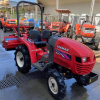





Kubota Aste A-155, A-175, and A-195 Maintenance Schedule – What, When, and How Much
Kubota Aste maintenance: complete schedule for the A-155, A-175, and A-195
The Kubota Aste is a tractor with an engine lifespan of 5,000+ hours without overhaul — provided you take maintenance seriously. That's the good and the bad news in one: well maintained, it will last decades; poorly maintained, it will wear itself out. This blog contains the complete Kubota maintenance schedule, translated into English with concrete parts suggestions.
All intervals and specifications in this guide come from the original Kubota Operator's Manual. Recommended fluids are the types prescribed by Kubota.

The maintenance schedule at a glance
The Kubota Aste works with an hour-based maintenance schedule. The hour meter on the dashboard is therefore not a gadget — it's your guide. Below is the complete overview:
| Interval | Action |
|---|---|
| Daily / before every start | Oil level, coolant, fuel, tire pressure, leak check |
| After the first 50 hours | Major break-in service — replace all oils and filters |
| Every 50 hours | Grease lubrication (grease nipples) |
| Every 100 hours | Replace engine oil + engine oil filter |
| Every 200 hours | Fuel filter element, blow out air filter, V-belt |
| Every 400 hours | Replace air filter, hydraulic filter, clean cooling system |
| Every 800 hours / annually | Replace transmission oil, front axle oil, coolant |
| Every 1,500 hours | Check / replace fuel injectors |
| Every 3,000 hours | Engine overhaul check |
Important: these intervals apply under normal use. Do you work often in dusty conditions (tilling dry soil), or under heavy load (flail mowing, plowing clay)? Then you should shorten the filter and oil intervals by 25–30%.
Daily check — 3 minutes before every start
This daily check literally takes 3 minutes and prevents 80% of all breakdown scenarios. Do it every morning:
- Engine oil level via dipstick — level should be between the two marks (tractor on level ground, engine cold)
- Coolant in the reservoir tank — not at the radiator cap (check with engine cold)
- Fuel level — tank capacity 17 L
- Transmission/hydraulic oil level via dipstick at the rear
- Tire pressure visual — front 1.2–2.0 kgf/cm², rear 1.6 kgf/cm²
- Leakage under the tractor — drops on the floor are a problem
- V-belt visual — no cracks, properly tensioned
- Air filter — tap the filter out briefly (do not wet it!)
The 50-hour break-in service (one-time)
Do you have an overhauled engine or a "new" secondhand Aste? Then there's a mandatory break-in service after the first 50 hours. Kubota is clear about this: without this service, microscopic metal particles get into the oil, which will cost you head and bearing wear in the long run.
This service includes:
- Replace engine oil (3.7 L)
- Replace engine oil filter
- Replace transmission oil (12 L standard / 14 L K version)
- Replace hydraulic filter
- Replace front axle oil (4 L)
- Check all bolts and nuts for tightening torque
- Check V-belt tension (deflection ~7 mm)
After this service, follow the regular schedule (100 / 200 / 400 hours).
Every 100 hours: engine oil and filter
This is by far the most important periodic service. Engine oil loses its lubricating properties due to temperature, contamination, and breakdown. After 100 hours it's "spent" — continuing to drive on it measurably shortens engine life.
Replacing engine oil — steps
- Tractor on level ground, run the engine warm (~10 min)
- Turn off engine, remove key
- Open the drain plug under the sump — collect oil in a container (3.7 L)
- Loosen the old oil filter with a filter wrench (gasket may stick)
- New filter: coat the gasket ring with clean oil, tighten by hand + ¾ turn extra
- Close the drain plug with a new copper ring
- Fill with new oil: 3.7 L Kubota D30 or diesel 10W-30 (API CD+)
- Start the engine, let it idle for 2 min, check level and top up if necessary
- Check for leaks around the filter and drain plug
Which oil filter?
Kubota OEM number 15241-3209-0. Fits the D905, D1005, and D1105 — so all three Aste models.
Every 200 hours: fuel filter and air filter
Fuel filter element
OEM element number 15231-4356-3, complete filter housing 15531-4301-0. Replace every 200 hours, or sooner if you notice the engine losing RPM at full throttle.
Note: after replacing the fuel filter, you need to bleed the fuel system:
- Install the new filter
- Loosen the bleed screw on the injection pump
- Operate the hand pump on the fuel supply until air-free diesel comes out
- Tighten the bleed screw
- Start — should fire up within 10 seconds
Doesn't start smoothly? Bleed again. A poorly bled fuel system can lead to injector damage.
Blowing out the air filter
Every 200 hours: blow out the air filter element with compressed air (max 2 bar, from the inside out). Never wash with water or submerge in oil — that ruins the filter.
When working in dusty conditions: blow it out more often, even outside the schedule.
V-belt
Deflection of the V-belt between the alternator and water pump should be ~7 mm at 6 kg of pushing force. A loose belt means the alternator doesn't charge + water pump turns slower = overheating. A too-tight belt causes premature wear of the water pump and alternator bearings.
Every 400 hours: bigger service
Replace air filter element
Blowing out works up to a certain point — but after ~400 hours the element is saturated and needs replacing. Tip: do this at the same time as an engine oil service so you have all the maintenance together at once.
Replace hydraulic filter
Kubota OEM number 67955-3771-0. This filter is located in the hydraulic/transmission oil tank (shared system). Replacement is as follows:
- Drain transmission oil (12 L/14 L)
- Remove old filter, install new one
- Fill with new oil (Kubota UDT or Super UDT)
- Run briefly, check level, top up
Cleaning the cooling system
Minerals, rust, and old coolant build up in the cooling system. Every 400 hours is a good time for a thorough flush:
- Drain coolant (collect the old — chemical waste)
- Add radiator flush + fill with water
- Run the engine warm for 10–30 min with the heater on (activates the flush agent)
- Drain + rinse with clean water
- Fresh coolant LLC 50/50 mixture (3.5 L + 0.6 L reservoir)
Adjusting valve clearance
Valve clearance: 0.145–0.185 mm (both intake and exhaust, engine cold). This is tool work best left to a mechanic if in doubt — valves set too tight can blow or burn the head gasket, valves set too loose cause ticking and loss of performance.
Every 800 hours (or annually): the annual service
Annually — or sooner if you've reached 800 hours — you face the major service. There's a lot to do here:
Replace transmission oil
12 L Kubota UDT or Super UDT (14 L for K version). With V-Shift (F) and BS versions, you really need the correct UDT quality — cheap alternatives cause shifting problems and foaming in the hydraulics.
Replace front axle oil
4 L Kubota UDT. The drain plug is located at the bottom of the front axle differential.
Replace coolant
Old coolant loses its corrosion inhibitors and anti-freeze properties. Fresh LLC 50/50 mixture:
- System + reservoir: 3.5 L + 0.6 L (total ~4.1 L)
- Take into account the -40°C anti-freeze specification for the Netherlands
Every 50 hours: greasing
Quick work, big effect. Using a grease gun, grease the following points:
- Front lift hinge points
- Upper and lower tie rod ends
- Front axle pivot points (upper and lower)
- PTO shaft universal joint (if using implements)
- Rear lower link hinges
Use EP-2 or EP-LiX lithium grease. Pump until you see fresh grease coming out at the edge — that means the old grease has been displaced.
Overview: fluids and quantities
| Component | Capacity | Prescribed type | Interval |
|---|---|---|---|
| Engine oil | 3.7 L | Kubota D30 / 10W-30 API CD+ | 100 hours |
| Transmission oil | 12 L (14 L for K) | Kubota UDT or Super UDT | 800 hours / annually |
| Front axle oil | 4 L | Kubota UDT | 800 hours / annually |
| Coolant | 3.5 + 0.6 L | LLC 50/50 mixture, -40°C | 800 hours / annually |
| Fuel | 17 L | Diesel | Refuel as needed |
| Grease | — | EP-2 or EP-LiX lithium grease | 50 hours |
Warning alarms — don't ignore them
The Aste has a few crucial warning lights. Ignoring them costs far more than the repair behind them:
| Light / signal | Cause | Action |
|---|---|---|
| Oil pressure light on | Engine oil pressure too low | Turn off engine immediately, check level, do not start if cause is unknown |
| Battery charge warning | Alternator not charging | Stop, check V-belt |
| Water temperature in red | Overheating | Let idle (don't shut off immediately), check coolant + fins |
| White exhaust smoke with warm engine | Head gasket or valve seal | Stop working, have a mechanic check it |
| RPM drops under load | Dirty fuel filter or injector | Replace filter, test injectors if problems persist |
Frequently asked questions
Do I have to use Kubota-branded oil?
For engine oil: no — any good 10W-30 diesel oil with API CD+ classification is sufficient. For transmission/hydraulics: preferably yes. Kubota UDT is specifically developed for the combined transmission/hydraulic systems of their tractors and prevents foaming. Cheap alternatives work in the short term but cause problems in the long run.
My Aste has 3,000 hours. Is an overhaul needed?
Not automatically. At 3,000 hours, Kubota's official recommendation is to perform a compression test to determine whether the engine is still running within specs. If the compression is fine, you can easily do another 1,000–2,000 hours. Only with clear power loss, blue exhaust smoke, or oil consumption is an overhaul in order.
What if I've skipped a maintenance interval?
Don't "talk yourself out of it" — do the next service as soon as possible. For example, if you've done 300 hours without an engine oil change, change it now and replace the filter. Damage usually occurs over a longer period, so catching up quickly prevents most of it.
Can you replace Kubota UDT with regular hydraulic oil?
Briefly, in emergencies, yes; as a replacement, no. The wet clutches and power steering of the Aste are designed for UDT's specific friction characteristics. Regular hydraulic oil causes shuddering clutches, sluggish lift action, and wear over time.
I have a small leak in the cooling system. Should I go straight to the garage?
Not necessarily. For hairline cracks in the radiator or gaskets, radiator leak stop is available — an additive that seals small leaks from the inside. This is a temporary but often long-lasting solution. For large leaks, replacement is of course necessary.
Keeping a maintenance log
Sounds boring, but it's the difference between a tractor you trust every day and one you're never quite sure about: keeping track of what you did and when.
Simplest form: a text file on your phone or a notebook in the shed. Note per service:
- Date
- Hour reading
- What was replaced / checked
- Which type/brand of oil or filter
- Peculiarities (small leaks, unusual noises)
This log is worth its weight in gold if you ever sell the tractor — a buyer will easily pay a few hundred euros more for an Aste with documented history than one without.
Summary: the bare minimum you can get away with
Only have one maintenance rule per year? Choose this one: engine oil + oil filter every 100 hours. That single service accounts for ~70% of engine lifespan. On top of that, once a year do filters + transmission oil + coolant, and the Aste will keep doing its job for decades.
And that's exactly what makes it — now already 25+ years old on the secondhand market — such a sought-after machine.