




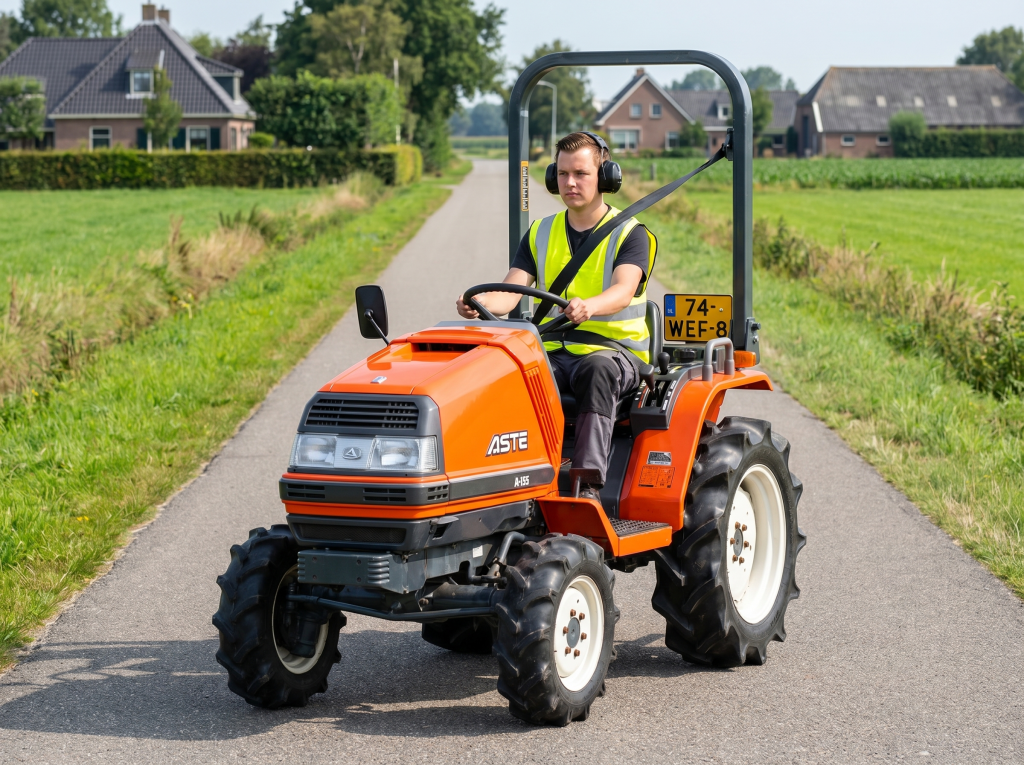
Working Safely with the Kubota Aste A-155, A-175 and A-195 – Rules and Regulations
Working Safely with the Kubota Aste: Rules, Regulations and Practice (A-155, A-175, A-195)
The Kubota Aste is a compact mini tractor — and that's exactly why it's tempting to be less strict about safety than with "real" agricultural vehicles. That's a mistake. It weighs nearly 700 kg, can reach 14 km/h, has a PTO shaft spinning at 1187 rpm, and a 3-point hitch that effortlessly holds 150 kg in the air. In short: things that can go wrong, do go wrong.
This blog covers all safety requirements for the A-155, A-175 and A-195: the Dutch legal obligations (license plate, driving licence, insurance), the ROPS bar, slopes, PTO safety, and working in confined spaces. Content is drawn partly from the original Kubota manual, and partly from current RDW and Dutch government regulations.
Legal requirements in the Netherlands (as of April 2026)
The Kubota Aste falls under agricultural vehicles in the Netherlands. Since 1 January 2025, a mandatory license plate requirement has applied to all agricultural vehicles, preceded by a registration requirement since 2021.
License plate requirement
According to the RDW, the license plate requirement applies to all agricultural vehicles that are wider than 130 cm or drive faster than 6 km/h. The Aste is 1050 mm (105 cm) wide — so under the 130 cm limit. But it drives at 12 to 14 km/h (so above the 6 km/h limit) and has a tow hitch for coupling trailers.
Conclusion for the Aste: because it drives faster than 6 km/h and has a tow hitch, it falls under the license plate requirement if you use it on public roads. The exemption for narrow vehicles only applies to the combination of "narrower than 130 cm, no tow hitch, and single-task vehicle" — and a multifunctional mini tractor does not meet that criteria.
What you need to arrange:
- Registration with the RDW (one-time, approx. €140 at an inspection station)
- Have a license plate made at an RDW-approved company
- Carry your registration certificate with you while driving on the road
Note: do you only drive on your own property and never on public roads? Then a license plate is technically not required. Registration and insurance, however, still are (see below).
T driving licence
Since 1 July 2015, a T driving licence has been mandatory for driving agricultural vehicles on public roads — regardless of the vehicle's size. This also applies to the Kubota Aste. You obtain the T driving licence through CBR exams; a category B car licence is not sufficient.
WAM insurance
The Motor Vehicle Liability Insurance Act (WAM) requires you to have your tractor insured with at least third-party liability insurance from the moment you register it. This applies even if you never use it on public roads. Since 2023, this has been actively enforced — an uninsured tractor results in a fine, even if it's parked in the shed.
MOT (APK) requirement
Good news: the Aste is exempt from the MOT (APK). The MOT requirement only applies to agricultural vehicles capable of driving faster than 40 km/h. The Aste reaches a maximum of 13.9 km/h and therefore falls well outside this requirement.
Summarized in one table
| Requirement | Mandatory for Aste? | Since when |
|---|---|---|
| RDW registration | Yes (when used on the road) | 1 January 2021 |
| License plate | Yes (when used on the road) | 1 January 2025 |
| T driving licence | Yes (when used on the road) | 1 July 2015 |
| WAM insurance | Yes (also when used on own property) | Always |
| MOT (APK) | No (tractor < 40 km/h) | — |
Regulations may change. For the current status, always consult rdw.nl or rijksoverheid.nl.
Safety bar (ROPS) and seatbelt
The Aste is equipped with a ROPS bar — the Roll-Over Protective Structure — on all standard versions (M, MA, BS, B, V-Shift F). This is the curved tubular frame behind the seat that keeps you from ending up under the tractor in the event of a rollover.
The K version (low-floor, for greenhouse work) has no ROPS. This is a deliberate choice for working under low ceilings — but it also means that with a K model, you should never work on slopes .
The strict rules
Kubota is very explicit in the manual about ROPS use. These rules aren't just advice — they're life-saving:
- ROPS raised during normal use. Always — unless you need to pass under a low obstacle (barn door, greenhouse).
- ROPS raised = seatbelt on. The seatbelt keeps you in the seat so the bar can do its job. Without a seatbelt, you'll be thrown out before the bar can protect you.
- ROPS folded down = seatbelt NOT worn. This is counterintuitive but essential: if the bar isn't active and you're held in the seat during a rollover, you'll end up with the tractor on top of you. Working with the bar folded down means: no seatbelt, and only in an environment where rollover is out of the question.
- Tighten the knob bolts properly after setting it up. Loose bolts mean the bar folds away on impact.
- Never modify or weld the ROPS. Bent or damaged means replace it, not repair it.
The Aste's ROPS is also certified — for example, the SF-A155 under ANZ number 92009, with a static load test of 1.21 kJ horizontal. This makes it legally recognized as safe, but only as long as it remains unmodified.
On public roads
Driving your Aste on the road requires extra attention — it's smaller and slower than regular road users, which makes you vulnerable.
Before you go on the road
- Coupling the brake pedals. The Aste has a separate brake pedal for each rear wheel. This is handy in the field but dangerous on the road: emergency braking with just one pedal causes the tractor to pull abruptly to one side. The locking plate couples them together.
- Differential lock OFF. Otherwise you won't be able to steer.
- Work lights off. Work lamps on your tiller or headlights aimed at the ground pose a blinding risk to oncoming traffic.
- Lighting on. Rear and front lights must work, as well as the turn signals.
- Do not carry a loose implement. A loose implement on the road is illegal. Transport it on a trailer, or attach it securely to the three-point hitch.
While driving
- Watch for traffic approaching from behind — you drive slowly, so overtaking traffic comes up quickly
- Signal clearly and indicate your direction
- No sharp turns at high speed; the Aste's short wheelbase makes it tip over quickly
- Do not disengage or shift to neutral on a slope — you won't be able to get it properly onto the engine brake again
Working on slopes
Statistically, slopes are where most mini tractor accidents happen. The Aste has a high centre of gravity and a compact wheelbase — two characteristics that promote tipping over.
The basic rules
- Approach straight on, not diagonally. When going up or down a slope, always drive straight on, never at an angle. Driving diagonally greatly increases the risk of tipping over.
- Brake pedals always coupled. Just like on the road — otherwise emergency braking on a slope can tip you over.
- Differential lock OFF. An active diff lock on a slope creates a spinning risk.
- Reduce your speed. Low range + 1st or 2nd gear. No quick gear changes while on the slope itself.
- Maximum 15° slope angle for using loading ramps on a trailer — and beyond that, you'll rarely want to seek out steeper slopes anyway.
If you get stuck
Do you get stuck in a ditch or on a slope? Drive out in reverse, never forwards. A tractor trying to drive forward out of a ditch places disproportionate weight on the rear axle and can flip backwards.
Double-speed turn (B/BS version)
The double-speed steering function is great for sharp turns in the field, but never use it at high speed. At higher speeds, the inside of the turn can spin so fast that the outside loses grip and you tip over.
PTO safety
The power take-off shaft is technically the most dangerous part of a tractor. A universal joint spinning at 1187 rpm can catch an arm, leg or much worse and crush it in milliseconds. Any task that involves being near a spinning PTO demands absolute discipline.
The strict rules
- Engine completely off before coupling or uncoupling implements. Not "idling but PTO in neutral" — genuinely off.
- Check the lock pin: the universal joint has a lock pin that must protrude 7 mm or more from the groove. Less than that means it's not properly secured.
- Install the check chain. This chain prevents the PTO shaft from rotating if the implement becomes detached.
- Always use the protective guard: if no implement is attached to the PTO, always fit the PTO shaft cap. During work, the protective guard (plastic sleeve) must surround the PTO shaft.
- Never come near a spinning PTO. No loose clothing, no scarves, no shoulder straps.
- No passengers on the implement. Sounds obvious, yet it still happens.
- PTO set to "Neutral" when starting and stopping. Otherwise an implement could unexpectedly start spinning.
Working in confined spaces: CO hazard
A diesel engine produces carbon monoxide (CO) — a colourless, odourless and deadly gas. In an enclosed space, this builds up extremely quickly. The Kubota manual is clear: never let the engine run in a confined space without ventilation.
Rules for sheds, barns and garages
- Driving in and out through a shed door: no problem, brief moment
- Engine checks in the shed: sliding door open or opposite hatch open
- Prolonged warming up: always outdoors, or with active exhaust extraction
- Decommissioned or stored tractors: let the engine cool down first, only then cover it
Battery and fuel
Two other weak points that are often underestimated:
- Battery electrolyte is diluted sulphuric acid. If you spill it: rinse immediately with plenty of water, and in case of eye contact, go straight to emergency care. Wear goggles and gloves during battery maintenance.
- When disconnecting: always disconnect the negative (minus) terminal cable first, otherwise you risk a short circuit between the key and the chassis.
- No open flames when refuelling or working on the battery. No cigarettes, no lighters, no sparking tools.
- Refuel with the engine switched off. Also no running engine near an open fuel tank.
Daily check before you start
Kubota's manual prescribes a brief pre-operation inspection. Performing this every morning prevents 80% of all work-stoppage scenarios:
- Engine oil level check via the dipstick (between the marks)
- Coolant level in the reservoir tank (with a cold engine — do not open the radiator!)
- Fuel level check — tank capacity 17 litres
- Tyre pressure: front 1.2–2.0 kgf/cm², rear 1.6 kgf/cm²
- Brakes and clutch: free play 20–30 mm
- Working lights and turn signals
- No leaks underneath the tractor
- Implements properly secured — drawbar pin fastened, lift up/down test
After finishing: parking safely
A parked tractor is just as much a potential source of accidents as one that's moving, especially with children or animals nearby.
- Choose flat ground — not a remote slope
- Lower the implement to the ground — not left raised by the hydraulic lift
- Gear in "Neutral" and V-Shift to N
- Parking brake engaged
- Remove the ignition key and take it with you (don't leave it in the lock)
- Fuel valve closed during longer periods of standstill
Keep it clean = limit fire risk
Especially important for the Aste: the exhaust runs close to the engine cover. Accumulated grass, hay or oil in that space is a genuine fire hazard. After a run through grass or grain: briefly blow out the exhaust area or wipe it with a cloth.
Personal protective equipment (PPE)
Not the most exciting topic, but relevant nonetheless:
- Sturdy shoes — no sandals or slippers
- Close-fitting clothing — no loose scarves, hoods or wide sleeves
- Safety glasses when tilling or shredding (flying stones)
- Hearing protection — the Aste produces 86 to 91 dB at the driver's ear. Up to half an hour a day poses no problem, but beyond that, hearing damage is cumulative
- Gloves during maintenance
- Helmet during forestry work or wherever falling branches are possible
Frequently asked questions
Does my Aste really need a license plate?
If you use it on public roads: yes, since 1 January 2025. If you drive exclusively on your own property and agricultural land not accessible to third parties, then a license plate is technically not required — but WAM insurance is.
Is a T driving licence also mandatory for the Aste?
Yes, for driving on public roads since 1 July 2015. On your own property, you're free to drive without one.
What if the ROPS was folded down and I forget to raise it again?
Then you must not wear a seatbelt. A folded-down ROPS with a seatbelt is statistically more dangerous than a folded-down ROPS without one. Raise it again as soon as possible and tighten the knob bolts before putting your seatbelt back on.
Can I let a child ride along on my Aste?
No. There is no safe position for a passenger on the Aste. No bench seat, no additional seatbelt attachment, and the ROPS only protects the driver. Accidents involving children on mini tractors almost always end badly.
My ROPS is bent after a minor incident. Can I bend it back?
No. A ROPS can only withstand load once — if it's deformed, its protective capacity has been used up. Replacement is the only correct solution, even if it costs a few hundred euros.
How much CO can I "safely" allow in a shed?
No amount is safe in the long term. CO builds up in your blood haemoglobin and, with calm air circulation, persists for hours. Rule: never let the engine run longer than 30 seconds in an enclosed space, not even for starting or warming up.
Summary: using the Aste safely
The Kubota Aste is a reliable, solidly built mini tractor. Its age doesn't make it more dangerous — modern tractors carry the same tipping and PTO risks. What makes it "safe" is your discipline: ROPS raised and seatbelt on, brake pedals coupled on the road, T driving licence and paperwork in order, and a daily check before you start.
If you use this blog as a checklist, you'll cover 95% of the risks. For the remaining 5%: common sense and attention — just like with anything bigger and faster than yourself.