



Yanmar RS-240 to RS-330 filters: oil, fuel and air filter
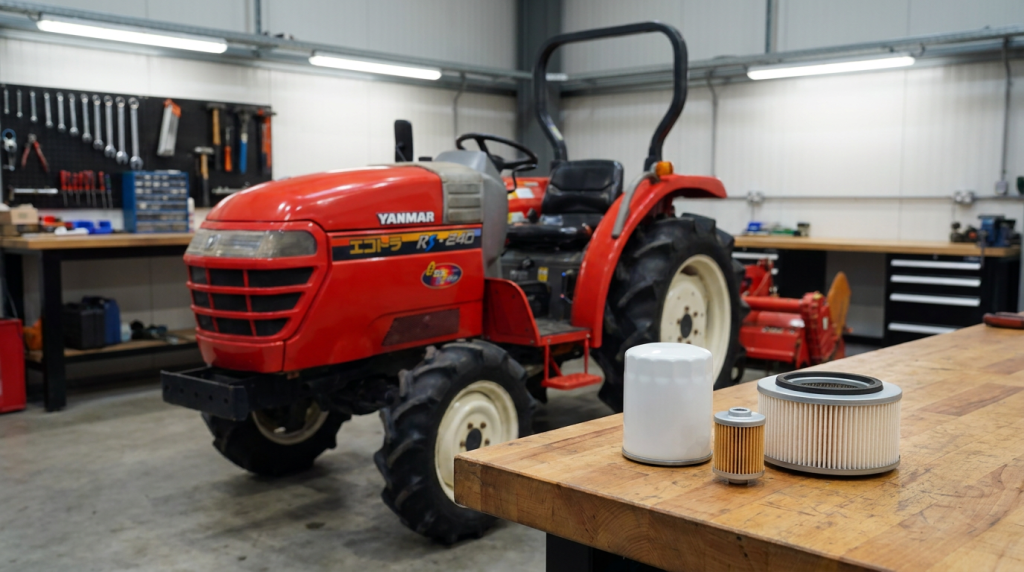
The filters of the Yanmar RS-240, RS-270, RS-300 and RS-330 are cheap, quick to replace and decisive for the lifespan of the engine and hydraulics. In this article we go through all four filters — engine oil filter, line filter (transmission), fuel filter and air filter — with the intervals from the manual and the correct procedure per filter.
Suitable for the entire series: Yanmar Forte Rice Special RS-240, RS-270, RS-300 and RS-330 (also known as RS24, RS27, RS30 and RS33), including the R, S, J, U, V and Q versions. The filters are the same for all four models.
Yanmar RS series: filter overview and intervals
| Filter | Type | Interval |
|---|---|---|
| Engine oil filter | Spin-on cartridge | Every 300 hours, or every 2–3 oil changes (first time: 50 hours) |
| Line filter (transmission/hydraulics) | Spin-on cartridge | Every 300 hours (first time: 50 hours) |
| Fuel filter (element in strainer) | Element in glass/plastic housing | Clean every 100 hours, replace element every 300 hours |
| Air filter element | Dry paper element | Clean every 100 hours (dusty: 50), replace every 1000 hours (dusty: 400), at least once a year |
Replacing the Yanmar RS series engine oil filter
The engine oil filter is a spin-on cartridge attached to the engine block. Procedure: first drain the engine oil, unscrew the cartridge counterclockwise with a filter wrench, lightly coat the rubber seal of the new filter with fresh oil and tighten it by hand plus a quarter turn. Fill the engine with 4.0 litres of fresh oil, start it, and wait until the oil pressure light goes out. Then check the level again. Never tighten the filter with a wrench — an overtightened cartridge deforms the seal and will start leaking.
Yanmar RS series line filter: the forgotten filter
The transmission oil of the RS series not only lubricates the gearbox, but also feeds the hydraulic pump and the power steering. The spin-on line filter filters this oil continuously. A clogged line filter shows up as a slow or jerky lift and heavier steering. Replace it with every transmission oil change (300 hours): unscrew the cartridge counterclockwise, grease the rubber seal of the new one, tighten by hand. Then let the engine idle and check the oil level — the new filter fills with about half a litre of oil.
Yanmar RS series fuel filter and water separation
The fuel filter is housed in a transparent housing (strainer) containing a red indicator ring. If water gets into the fuel, the red ring floats upward — the signal to empty the housing. Procedure: set the fuel tap to "C" (closed), unscrew the housing, remove water and dirt, check the element and replace it every 300 hours, reassemble the housing and turn the tap back to "O" (open). The fuel system will then largely bleed itself: tap open, throttle lever at maximum and let the starter motor run briefly. On a cab version, first turn the ignition to "on" for 10 to 15 seconds before starting.
Use winter diesel in the winter; the manual warns that regular diesel can gel below −10 °C and clog the filter. If the tractor is going to stand idle for a long time, fill the tank completely — this prevents condensation in the tank and thus water in the filter.
Cleaning and replacing the Yanmar RS series air filter
The dry paper element sits in a housing next to the radiator. To clean it, blow compressed air through it from the inside or gently tap it out — do not damage the paper folds. Replace visibly damaged, greasy or worn-through elements immediately: a clogged air filter costs power and causes black smoke, a leaking element lets dust scrape directly past the cylinders and piston rings. Also don't forget the radiator screen : slide the mesh up out of its guides (after loosening the air filter strap) and remove straw and dirt before and after each working day in straw or dust.