



Yanmar RS-240 to RS-330 controls and starting: how it works
Just bought a Yanmar RS-240, RS-270, RS-300 or RS-330 and everything is in Japanese? No worries: the controls on this series are logically laid out, and in this article we'll walk through everything — the dashboard, the levers, the starting procedure with automatic pre-glow, stopping, and the meaning of the indicator lights.
Suitable for the entire series: Yanmar Forte Rice Special RS-240, RS-270, RS-300 and RS-330 (also known as RS24, RS27, RS30 and RS33), including the R, S, J, U, V and Q versions.
Yanmar RS series: levers and pedals at a glance
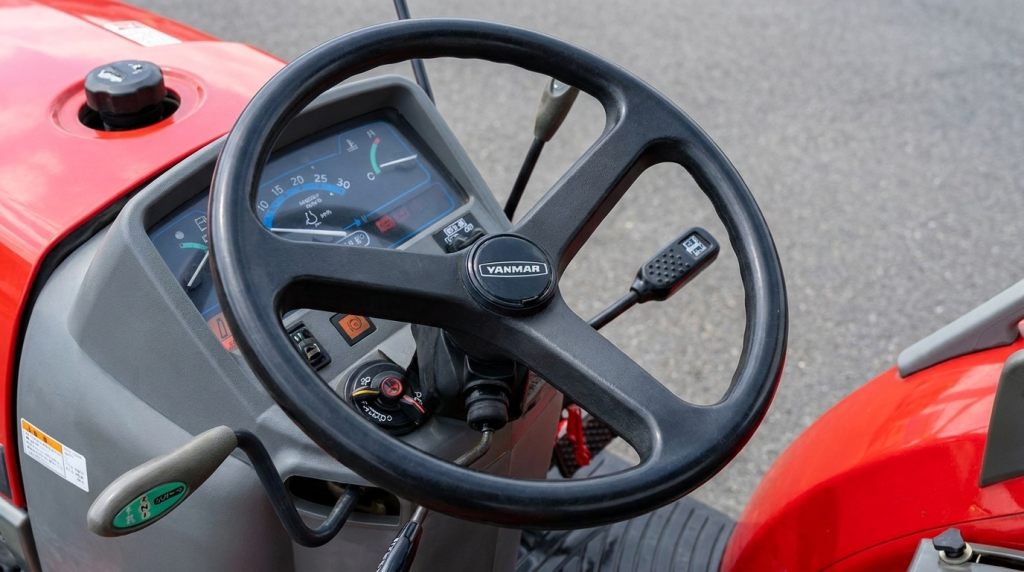
To the right of the seat you'll find the main gear lever (4 gears) and the lift lever (position control) with the dial for working depth; on the left are the range shift lever (3 ranges: creep/low/high) and the PTO lever (3 forward speeds + 1 reverse). To the lower left of the steering wheel is the shuttle lever (reverser) for forward/reverse — always shift this with the clutch pedal fully depressed and the tractor stationary. Also: clutch pedal on the left, two lockable brake pedals on the right, diff-lock pedal near your heel, and the throttle lever next to the steering wheel. Besides the lever, you can also operate the lift with the rocker switch on the fender: "up" raises the implement immediately (the "implement raised" light comes on), "down" lowers it to the set position.
Yanmar RS series dashboard: these lights you need to know
| Light / gauge | Meaning |
|---|---|
| Pre-glow light (予熱) | Lights up after ignition is turned "on"; goes out automatically as soon as the engine is ready to start |
| Oil pressure light | Should go out after starting; if it lights up during operation → stop immediately and check the oil level |
| Charge light | Lights up during operation → check the alternator or V-belt |
| "Implement raised" light | Stays on as long as the lift is in the upper position — starting is only possible when this light is off |
| Water temperature gauge | If it rises → check the radiator screen, coolant and V-belt |
| Hour meter + tachometer | Basis for your maintenance schedule (50/100/300 hours) |
Starting the Yanmar RS series: step by step
The RS series has automatic pre-glow — no manual thermostart like older Yanmars. The tractor determines the glow time itself based on coolant temperature: above 5°C about 1 second, below that around 3 seconds. With a warm engine, the light goes out almost immediately.
The starting procedure from the manual: open the fuel tap ("O"), put all levers — main gear, shuttle and PTO — in neutral, and lower the lift lever with the depth dial set to "deep": if the "implement raised" light is still on, briefly set the rocker switch to "lower" until it goes out. Pull the throttle lever slightly, turn the ignition to "on" and wait until the pre-glow light goes out. Then press the clutch pedal all the way down — otherwise the safety switch blocks the starter motor — and turn the key to "start". As soon as the engine is running, release the key immediately.
Two golden rules from the manual: never run the starter motor for more than 10 seconds at a time (if it doesn't start, wait at least 1 minute and try again), and never turn the ignition back to "start" while the engine is running. After starting, let the engine warm up for about 5 minutes at around 1500 rpm, without load — especially in cold weather, this pays off in terms of service life.
Stopping the Yanmar RS series
Move the throttle lever to idle, let it run down briefly and turn the ignition to "off" — the stop solenoid (fuel shut-off) stops the engine. When leaving the tractor, lower the implement to the ground, engage the parking brake (press and lock the pedal) and take the key with you. If the engine keeps running or stalls as soon as you turn on the ignition, the stop solenoid is suspect — more on that in the troubleshooting blog.
Driving: shuttle, ranges and diff-lock
For normal work, select the range (creep, low or high) and shift within the range using the main gear lever. The shuttle makes turning at the headland quick: engage the clutch, move the lever from F to R, and let the clutch out smoothly. If a rear wheel spins in wet ground, briefly press the diff-lock pedal — and release it again before steering into a turn. When driving on the road, always lock the two brake pedals together with the coupling plate, otherwise the tractor will pull sideways under hard braking.
Running in after an overhaul
Have you overhauled the engine or fitted a new clutch? Treat the first 50 hours as a running-in period: avoid full load and prolonged high revs, vary the load, and afterwards replace the engine oil and filter (the "first 50 hours" interval from the maintenance schedule).