



Yanmar AF-15 to AF-18 implements: what can you do with 15 to 18 hp?
The implements for the Yanmar AF-15, AF-16, AF-17 and AF-18 determine what you can do with this compact tractor. In this article you'll learn what 15 to 18 hp means in practice, how the three-point hitch, the PTO and the automatic tilling depth control work, and what to watch out for with the diff lock, creep gear and external hydraulics.
Suitable for the entire series: Yanmar Forte AF-15, AF-16, AF-17 and AF-18, including the OK-UFO, EG-UFO, creep (R), reverse PTO (B) and turf versions.
Yanmar AF series: what does 15–18 hp mean in practice?
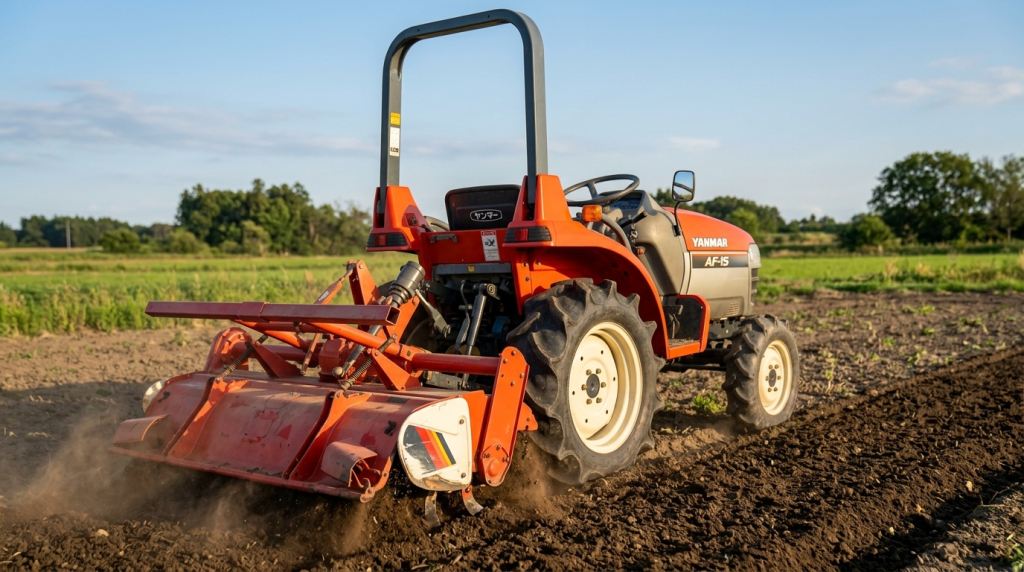
Important to understand: that 15–18 hp is the engine power — what's left at the PTO shaft or the drawbar is always less. For this class, that means in concrete terms: a rotary tiller of 1.3 to 1.4 metres (the factory combination was the RSA1404 at 1400 mm or the RCA1304 at 1300 mm), a single-furrow plough, a meadow harrow or drag, a rotary mower, a scarifier on the turf version, and towing a trailer in gear 8. The manual links the gear choice to the job: tilling in stages 2–4, harrowing and ploughing in stages 4–7, transport in stage 8, and trenching work in the creep gears. The manual explicitly prohibits heavy towing, earthmoving and front loader work in creep gear — the drivetrain isn't built for that.
Yanmar AF series three-point hitch and coupling
The hitch is a Japanese "special 3P" version with a top link of category JIS1 — smaller than the European cat. 1, so measure your implement beforehand. The inner width between the lower links is 465 mm without hitch and 565 mm with quick-hitch. For ploughs and subsoilers, set the stabiliser chains to 5–6 cm of lateral play; for tillers, harrows and mowers, set them play-free instead. Always couple on level ground, don't let anyone stand between the tractor and the implement, and for heavy implements mount the original ballast weights (5 × 30 kg) on the nose — never people or loose objects as ballast. If you work under a raised implement, first close the hydraulic shut-off valve completely.
Yanmar AF series PTO: speeds and reverse PTO
The PTO shaft (JIS 35 mm, clockwise) has three settings: 558, 805 and 1228 rpm at rated engine speed. The rev counter has a marking for the engine speed at which the PTO runs at exactly 540 rpm in position 1 — handy for implements that need to run at 540 rpm. Always use the speed specified by the implement manufacturer. The B version also has a reverse PTO (745 rpm reverse), but this is intended solely for hilling and freeing grass or straw wrapped around the original tiller — not for regular tilling in reverse direction. Always fit the PTO guard when the shaft is not in use.
Yanmar AF series tilling depth: position control, auto-rotary and mix
For working depth you have three systems. With the position control lever you set any implement to a fixed height — the correct method for ploughs, mowers and all non-rotary work. The auto-rotary lever keeps the tilling depth automatically constant, even on uneven ground: scale 1–3 for harrowing and shallow tilling, 4–7 for normal tilling, 8–10 for deep tilling. And with mix control you combine both on wet or uneven fields. The hydraulic stop/slow-return valve controls the lowering speed (clockwise = slower, fully closed = hitch locked), and the descent damper lets the tiller land gently just above the ground — switch off this damper for ploughing work. The backup function automatically raises the implement as soon as you put the shuttle in R; switch this off during transport, loading and orchard work. The OK-UFO version fully automates both depth and tilt via the control panel; the EG-UFO version automatically controls the tilt.
Yanmar AF series diff lock, creep gear and track width
The diff lock pedal rigidly couples both rear wheels — only use it in case of slip on soft ground, at reduced speed, and always release it before turning. Using the diff lock is prohibited in creep gear "C". The creep gear itself (from 0.14 km/h) is intended for trenchers, planters and fine tilling work on hard ground; when braking in creep gear, disengage the clutch first. The rear track width can be widened per model by swapping the wheels left/right (for example AF-18: from 860 to 980 mm) — do this for slope work or heavy towing, and retighten the wheel bolts to 11.9–15.1 kgm.
Yanmar AF series external hydraulics and power take-off
For a tipping trailer there's a single-acting connection on the lift cylinder head (R 3/8 thread): remove the plug, attach the hose, close the shut-off valve and operate with the position lever. Versions with front loader preparation have a double-acting connection under the left step (front port = pressure, rear port = return). Electrical implement? There's a 12V connection point at the front and rear, rated up to 10 A — connect the ground to the tractor chassis. Always stop the engine before (dis)connecting hydraulic lines.