



Winterizing & Storing the Kubota GL21
Suitable for the entire Kubota GL series (Grandel): GL19, GL21, GL23, GL25, GL25K, GL26, GL27, GL29, GL32 and GL33 (also GL23DJ and GL27DJ, and the Hinomoto NX series). The storage procedure comes directly from the original Kubota manual.
Is your Kubota GL21 going into the shed for a few months? It's precisely during storage that the most expensive problems arise: condensation in the tank, a seized clutch, and a flat, sulfated battery. The GL series manual contains a surprisingly complete storage procedure – you'll find it in full below, supplemented with practical tips.
Storing the Kubota GL21: the checklist from the manual
| Step | Action |
|---|---|
| 1 | Repair known defects before storage |
| 2 | Change the engine oil and let the engine run for 10–15 minutes at over 2,000 rpm so the fresh oil reaches everywhere |
| 3 | Go through the points of the maintenance schedule |
| 4 | Grease or oil rust-prone parts |
| 5 | Set the fuel valve to OFF |
| 6 | Fill the fuel tank completely – an empty tank condenses and rusts from the inside |
| 7 | Cooling system: if running water only – drain it; if running antifreeze – check level and frost protection |
| 8 | Press the clutch pedal down and lock it in the depressed position with the retaining clip |
| 9 | Check the drain plug under the clutch housing for water ingress |
| 10 | Inflate the tires slightly higher than normal |
| 11 | Remove the battery and store it somewhere cool and dry, or at least disconnect the negative terminal |
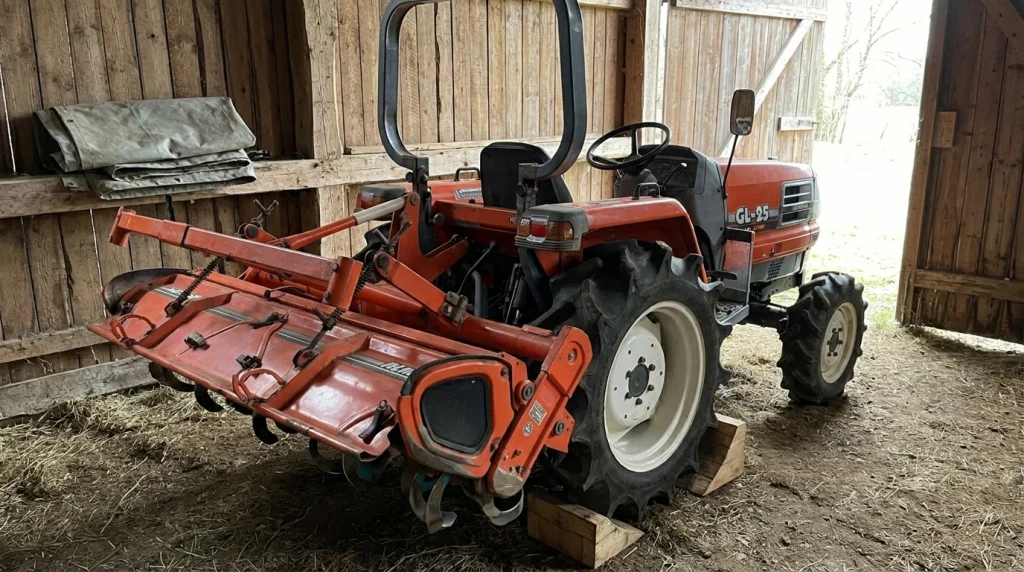
| 12 | Remove ballast weights and either detach implements or lower them to the ground |
| 13 | Place wheel chocks in front of and behind the rear wheels |
| 14 | Check wiring, battery cables, and fuel lines for damage |
| 15 | Fully recharge the battery every month during storage |
| 16 | Store in a dry place, not next to straw or other flammable material, and only cover once the engine and exhaust have completely cooled down |
Why the clutch must be locked
The most important GL-specific point: lock the depressed clutch pedal with the retaining clip. If the clutch plate stays pressed against the flywheel for months, it will rust to it, and you won't be able to free it in spring. With the lock engaged, the clutch stays disengaged. When putting the machine back into use, simply press the pedal fully down and the lock releases automatically.
Antifreeze and the cooling system
If you run antifreeze (mandatory in our climate), check the frost protection and its age before winter: coolant should be replaced every two years, as should the radiator hoses. If the tractor was running on water only – which sometimes happens with fresh imports from Japan – drain the system or fill it immediately with a good antifreeze mixture. A cracked block from frozen coolant is the most expensive storage accident there is.
Run it briefly every 1 to 2 months
The manual recommends running the engine for 10–15 minutes at over 2,000 rpm every one to two months during storage, so that oil reaches all lubrication points and condensation evaporates. Do this outside or with the doors open, with the battery connected, and preferably take it for a short drive so the transmission, brakes, and lift also get some movement. Just letting it idle briefly is actually bad practice: it leaves moisture trapped in the muffler and crankcase.
Starting up again after storage
In spring: reinstall the battery, set the fuel valve to ON, check the oil level and coolant, bring the tires up to normal pressure (front 1.6 / rear 1.0 kgf/cm²), and let it warm up gently the first time. If it starts poorly after its winter rest, start by checking the fuel filter and bleeding the system – see the blog on troubleshooting. A spring service with fresh filters is the perfect way to end the storage period.