



Mitsubishi MT14–MT20 won’t start or losing power? Troubleshooting
Mitsubishi MT14–MT20 won't start or losing power? Troubleshooting
Want to know why your Mitsubishi MT14, MT15, MT16, MT17, MT18 or MT20 won't start, is losing power or overheating? On this page you'll find the most common faults with their likely cause and solution — partly from the original troubleshooting chart, partly from the practical experience of MT owners.
Suitable for the entire series: Mitsubishi MT14, MT15, MT16, MT17, MT18 and MT20 (2WD and 4WD/D).
Mitsubishi MT won't start
If the engine won't start, go through these points:
- Battery flat or weak. Charge the battery or check it; the glow plugs draw a lot of current, so a weak battery will struggle to start a cold diesel.
- Fuel shortage or air in the system. Top up fuel and bleed the fuel system. Air in the lines is a classic cause of failing or irregular starting.
- Pre-glow not working. Worn glow plugs or a faulty glow relay. A broken glow timer can also keep the glow plugs switched on during operation, causing them to burn out.
- Stop solenoid stuck. The fuel solenoid valve (stop solenoid) can get stuck so no fuel gets through. A first check is to loosen an injector line slightly to see if fuel reaches the injectors.
- Fuse blown. Check the wiring and replace the fuse.
Mitsubishi MT runs irregularly or stalls
- Air in the fuel system → bleed it.
- Clogged or dirty fuel filter → clean or replace.
- Water or dirt in the injector → clean or replace.
- Fuel leak in the lines → check the clamps, replace the line, replace or renew the copper sealing washers.
- Sudden stalling usually points to a fuel shortage or a faulty injector; top up and bleed the system.
Mitsubishi MT loses power or produces smoke
- White smoke (not right after a cold start): clogged air filter (clean it), too much engine oil (check the level) or insufficient fuel supply.
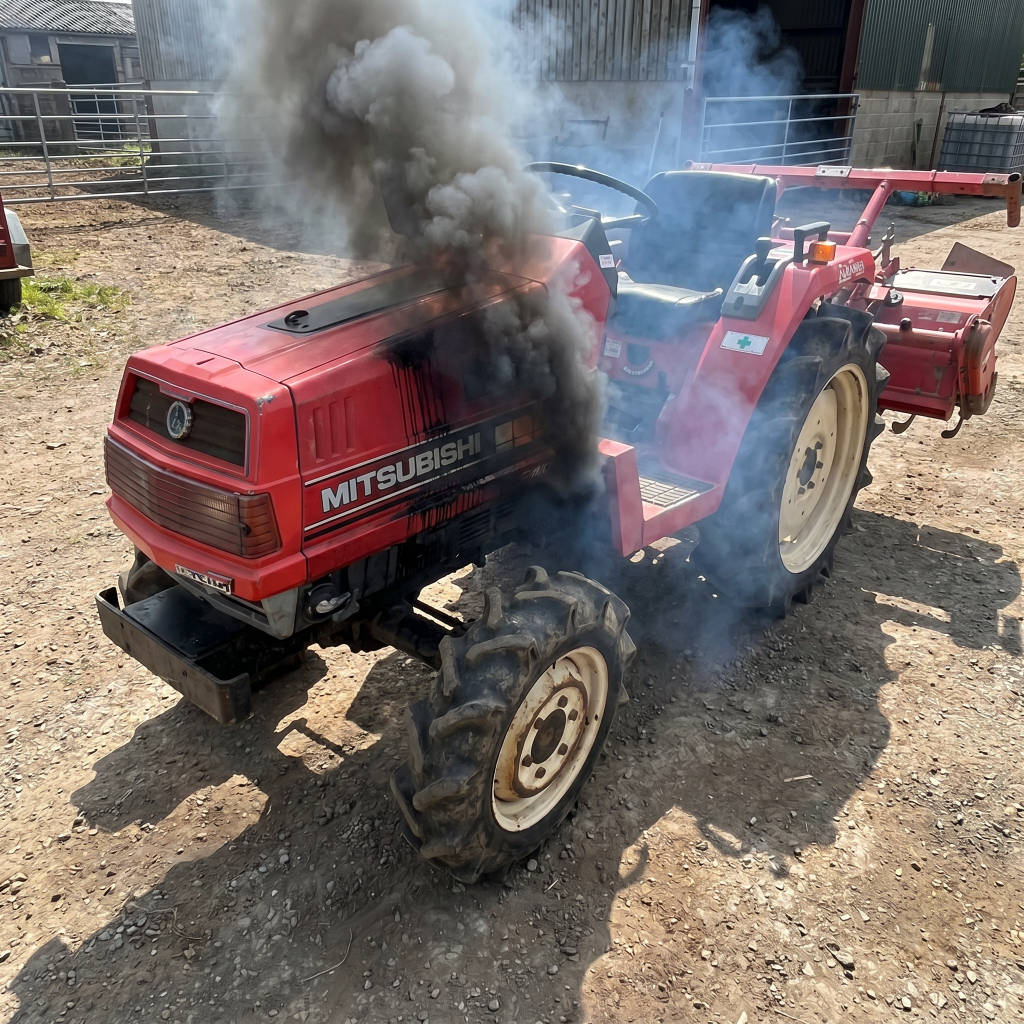
- Black smoke: too much fuel or a faulty injector — have the injection system checked at a workshop.
- Power loss: dirty injector or carbon build-up, poor compression, incorrect valve clearance or injection timing, dirty air filter.
Mitsubishi MT overheats
- Coolant shortage → top up.
- Loose or worn V-belt → tension it (deflection 10–13 mm) or replace it; a slipping belt also reduces water pump circulation.
- Clogged radiator screen → clean.
Model-specific points from practical experience
In addition to the general troubleshooting chart, there are a few complaints that recur more often on these particular MT models. They come from owners' experiences; use the stated dimensions and part numbers as a guideline and always verify them against your own serial and engine number.
- Engine stalls unexpectedly (MT18 and related models). A frequently reported complaint: the fuel stop solenoid "kicks in" during operation and cuts off the fuel, causing the engine to stall. Check the operation and wiring of the stop solenoid; replace if in doubt.
- Glow indicator light comes on, but the plugs don't heat up (MT14/MT15/MT16). From practical experience: the glow relay has two separate contacts — one for the indicator light and one for the glow voltage. So the light can be on while there's no voltage on the plugs. Measure whether there's actually voltage on the glow plugs during pre-glow (reference value 6–8 V); if not, replace the glow relay (reference MM431-282, verify against your own tractor).
- Cold start requires many attempts (MT15D and related). Owners report that after pre-glowing, the engine only fires up after cranking several times. Check battery condition, glow plugs and glow relay, and thoroughly bleed the fuel system.
- Won't start and smokes after a filter change or after running dry. If the fuel filter has been replaced or the tank has run empty, there's air in the system. A proven approach: with the starter motor cranking, loosen the injector lines one by one slightly until fuel sprays out, so all the air is removed.
- Rear lift raises slowly or reluctantly (MT18 and heavier versions). The most commonly reported cause is a dirty hydraulic filter or internal strainer. Replace the filter and clean the strainer before looking further; then refresh the hydraulic oil.
- Electric-hydraulic lift (MT20 versions). Some MT20's have an electrically operated lift that can become erratic over the years. Owners sometimes convert this to a conventional hydraulic control valve; have this assessed by a skilled workshop.
- Clutch doesn't fully disengage (4WD models). If the tractor keeps "creeping" while you depress the clutch, the pedal free play is often incorrect. Set the clutch pedal free play to 20–30 mm; also check for a dragging plate.
- Noisy or refusing to start (MT20 4×4). A clicking or grinding starter motor often points to the starter motor solenoid or poor ground/battery connections. First check the battery terminals and the ground cable.
Hydraulics work slowly, jerkily or not at all
In practice this is almost always traceable to contamination: a clogged internal strainer or blocked hydraulic filter, or air in the system. Replace the hydraulic filter, clean the strainer, bleed after repair and check whether the V-belt lets the hydraulic pump run at full pressure. Also check the hydraulic hoses for hairline cracks — a pinhole leak can spray out a surprising amount of oil under pressure.
Watch out for naming confusion and grey imports
Many MT tractors were imported as grey imports. As a result, a nameplate may differ from the actual model, and part numbers circulate that aren't always correct. Treat part numbers found elsewhere as a reference and always verify them against your own serial and engine number before ordering.