



Mitsubishi GS16-GS25 buying advice: which one suits you?
If you're looking for a compact 4WD mini tractor of Japanese make, the Mitsubishi GS16-GS25 is a series you should definitely know about. This buying guide helps you choose the right Mitsubishi GS16, GS18, GS20, GS21, GS23 or GS25, explains the differences between them, and warns you about a common naming confusion that catches out many buyers.
Suitable for the entire series: Mitsubishi GS16, GS18, GS20, GS21, GS21S, GS23, GS25 and GS25S — the four- to twenty-five-hp versions with the Mitsubishi S3L and S3L2 three-cylinder diesel engine.
Mitsubishi GS16-GS25: what are we talking about?
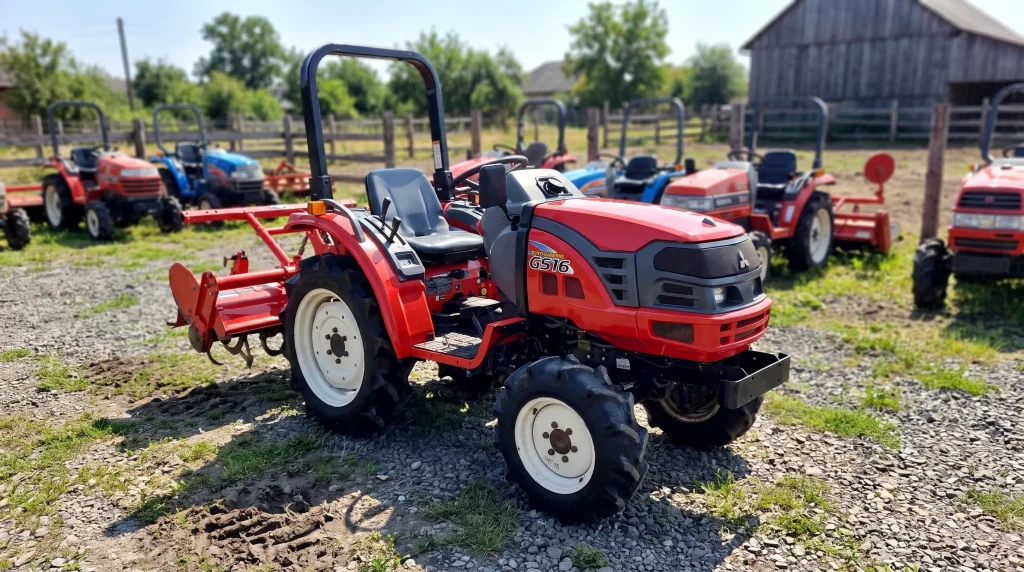
The GS16-GS25 is a series of compact four-wheel-drive tractors that Mitsubishi (三菱農機) introduced to the Japanese market around 2003-2005. These are angular, boxy machines with an eight-forward, eight-reverse mechanical gearbox, hydrostatic power steering, and a three-point hitch with position control. In Europe they turn up as grey imports: robust, straightforward, and easy to maintain yourself.
The series runs on two closely related engine blocks. The lighter models (GS16, GS18, GS20) have the S3L at 1,125 cc; the heavier ones (GS21, GS23, GS25) have the S3L2 at 1,318 cc. Both are water-cooled three-cylinder diesels known for their simplicity and long service life.
Mitsubishi GS16-GS25: watch out for the naming confusion
This is the most important tip in this entire guide. There are actually two Mitsubishi GS series that are easily mixed up:
- GS16-GS25 (this series): build years ~2003-2005, mechanical 8+8 gearbox, more angular bodywork. The nameplate reads, for example, "三菱GS16" or "三菱GS25".
- GS160-GS250: the successor from ~2006-2012, with a 12+12 gearbox and a more modern look. Confusingly, the nameplate on a GS160 also reads "三菱GS16".
So if in doubt, don't just look at the name, but also at the build year, the number of gears, and the appearance. Still unsure? Take a photo of the tractor and the nameplate before ordering parts. The good news: both series share the same S3L/S3L2 engine, so most engine parts and filters fit both. For the successor, we have a separate knowledge base article: Mitsubishi GS160-GS250 buying advice.
Mitsubishi GS16-GS25: the models at a glance
All models are 4WD. The horsepower number in the name corresponds to the engine power; the higher you go, the heavier the machine and the larger the tires.
| Model | Engine | Displacement | Power | Weight |
|---|---|---|---|---|
| GS16 | S3L-16A | 1,125 cc | 16 hp | 780-805 kg |
| GS18 | S3L-17A | 1,125 cc | 18 hp | 810 kg |
| GS20 | S3L-18A | 1,125 cc | 20 hp | 810 kg |
| GS21 / GS21S | S3L2-14A | 1,318 cc | 21 hp | 800-860 kg |
| GS23 | S3L2-15A | 1,318 cc | 23 hp | 870 kg |
| GS25 / GS25S | S3L2-16A | 1,318 cc | 25 hp | 870-880 kg |
The "S" versions (GS21S, GS25S) and the grade designations on the nameplate (M, SM, J) are equipment variants with small differences in tire size, track width, and height. For driving and maintenance this makes little difference; for exact dimensions, please refer to the complete specifications.
Mitsubishi GS16-GS25: which one should you choose?
GS16 to GS20 (S3L, 16-20 hp): ideal for garden, yard, and light groundwork, a small front loader job, and a tiller up to about 1.2 metres. Lighter, more agile (turning circle 1.8 m), and more economical. More than sufficient for most hobby and park users.
GS21 to GS25 (S3L2, 21-25 hp): the larger 1,318 cc engine delivers more torque and pulling power. These models have wider tires, a longer wheelbase (1,440-1,450 mm), and more weight — useful for heavier ground work, a larger tiller or flail mower, and working on slopes. Expect slightly higher fuel consumption and a larger turning circle (1.9 m).
Important to know: hp is not the same as pulling power. The stated power is the engine power; what remains at the power take-off (PTO) and the drawbar is lower. With 20-25 hp and 800 kg of own weight, you can pull a small plough, tiller, or mower just fine, but don't expect heavy ploughing like with a full-size agricultural tractor. More on this in the blog about hydraulics, PTO and implements.
Mitsubishi GS16-GS25: strengths and weaknesses
Strengths include the simple, reliable S3L/S3L2 engine, the good power steering, genuine 4WD, and the wide availability of wear parts. From owners' real-world experience, there are also some points to consider when buying:
- Cold starting and glow plugs. With grey imports, worn glow plugs or a weak battery are the most commonly reported starting complaint in winter. Easy to check and cheap to fix.
- Hydraulics and lift automation. The automatic depth/slope control (JAC/MAC) works with potentiometers and sensors that can start to falter after years of use. Check whether the lift moves up and down smoothly and evenly.
- Electrics and ground points. Corrosion on ground points and battery terminals causes erratic faults. Fifteen minutes of cleaning prevents a lot of trouble.
When viewing, always ask about the number of operating hours, have the tractor started cold, and test the lift, the PTO, and both brake pedals. An honest seller will gladly show you this.
Mitsubishi GS16-GS25: what does one cost?
The amounts below are indicative and heavily dependent on build year, operating hours, equipment (canopy, front loader), and condition.
| Market | Indicative price |
|---|---|
| Grey import Netherlands/EU (GS16-GS20) | approx. € 2,500 – € 4,500 |
| Grey import Netherlands/EU (GS21-GS25) | approx. € 3,500 – € 6,500 |
| Japan, private (auction) | approx. € 3,500 – € 5,000 |
| Japan, dealer-refurbished | higher, depending on refurbishment |
Product tip. Include your maintenance costs in your purchase budget right away. For a complete service, there's the Filter set Mitsubishi GS series (SKU-100164) with oil, fuel, and air filter in one. This set is put together based on the original part numbers from the GS manual and fits both the GS16-GS25 and the GS160-GS250 with S3L/S3L2 engine. If you've just bought a grey import, we recommend checking the glow plugs (SKU-55808) right away.