



Kubota GB110-GB200 hydraulics, PTO & implements
Kubota GB110-GB200 hydraulics, PTO & implements: what can you do with it?
The hydraulics of your Kubota GB is the heart of the machine: it lifts the implement, powers any power steering, and controls the automatic leveling. Here you can read how the system works, which PTO settings you have and which implements fit each model.
Suitable for the entire series: Kubota GB110, GB130, GB140, GB150, GB160, GB170, GB180 and GB200.
Kubota GB lift system: 2-point or 3-point
The main difference within the series lies in the implement coupling. The compact group (GB110 through GB170) has a Japanese 2-point coupling with position control: the implement — almost always a tiller — hangs from two lower arms with a specific coupling system. European cat. 1 implements don't simply fit on this; adapter frames exist for some models, but keep in mind that mounting options are limited. The GB110HP and the entire large group (GB160/GB180/GB200) have a genuine 3-point hitch according to JIS type O — comparable to cat. 0/1 — giving you far more implement choice. The lift is operated with the position lever next to the seat: the position of the lever directly determines the height of the implement. An adjustable lowering speed limiter (hydraulic lock) prevents the implement from dropping during transport — if your lift "no longer drops," this is often simply because it's turned closed.
Kubota GB Monroematic and Mecha-auto (M/A/MA versions)
Versions with the letter M have Monroematic: an electro-hydraulic automatic leveling system that keeps the tiller horizontal (水平制御), even when the tractor drives at an angle through a furrow, plus an angle adjustment (角度調節). The A version (Mecha-auto) has a mechanical lift automation. On the control panel you choose between keeping horizontal and manual angle adjustment. Maintenance point from the manual: the Monroematic cylinder hose must be replaced every two years. Known failure points from practice — a sensor rod coming loose, cable breakage and, more rarely, a defective control unit — are covered in the troubleshooting blog.
Kubota GB PTO: settings and use
| Model | PTO settings (rpm) | Engine speed |
|---|---|---|
| GB110 | 523 / 917 / 418 (reverse) | 3,000 |
| GB130 / GB140 | 554 / 972 / 443 (reverse) | 2,800 |
| GB150 / GB170 | 550 / 965 / 440 (reverse) | 2,500 |
| GB160 / GB180 / GB200 | 451 / 769 / 1,207 / 564 (reverse) | 2,600 |
The PTO shaft is a JIS 35 mm shaft. For connecting and disconnecting the PTO shaft, the rule is: engine off, PTO lever in neutral, and refit the shaft cap when no implement is attached. The reverse setting is intended for Japanese tillers with reversed rotation direction — never use it with a European implement without checking first.
Kubota GB implements: what fits?
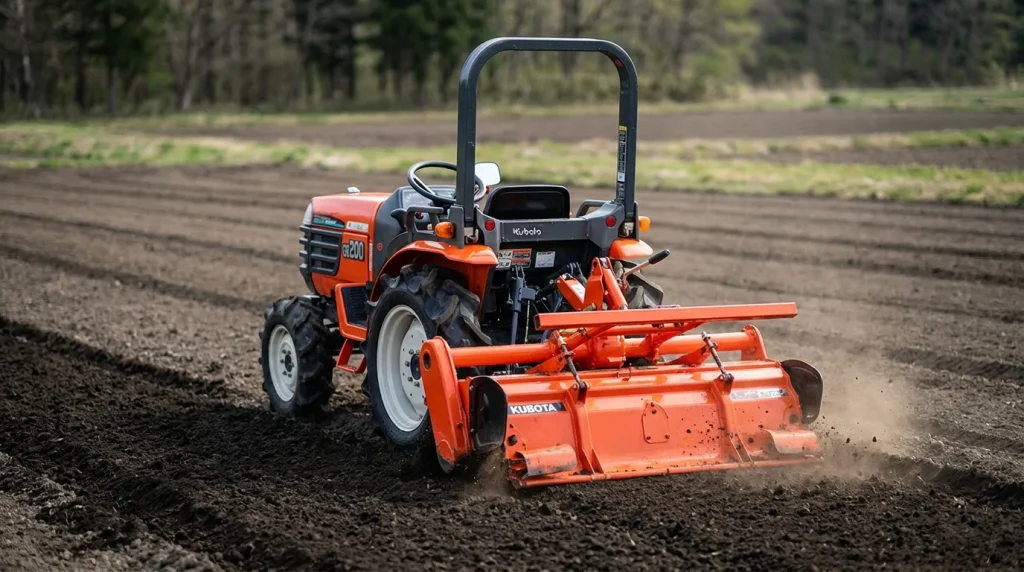
Kubota supplied factory side and center tillers in working widths from 1.20 to 1.60 meters (RSP/RKP series) plus several multi-tillers for ridge cultivation (RT series). Rule of thumb per model: GB110/GB130 up to approximately 1.2–1.3 meters, GB140–GB170 up to 1.4 meters and GB180/GB200 up to 1.6 meters. For the large group, a factory front loader and a hydraulic take-off point (urea pressure set) were also available. Always fit front weights with heavier mounted implements: the manual requires that at least 20% of the total weight remains on the front axle. Kubota supplied bumper weights of 25 and 40 kg for this purpose and a bracket that holds up to five 25 kg weights (125 kg total).
Kubota GB lift dropping or not rising?
The hydraulic pump is fed from the transmission oil. If the lift rises slowly or not at all, first check the oil level and the condition of the transmission oil, then the hydraulic filter and the suction strainer. Contaminated oil is the most common cause with this series — and the cheapest to fix. In our separate blog about hydraulic pump problems in Iseki and Kubota you can read how to recognize and test a worn pump.