



Iseki GEAS TG21-TG33 operation and starting
You start the Iseki GEAS TG using a fixed sequence on the ignition switch: preheating, turning on, and starting. Below is the step-by-step operation, plus what the dashboard lights mean and how the PTO switch works.
Suitable for the entire series: TG21, TG23, TG25 (+TG25N), TG27, TG29 (+TG29F-16), TG31 and TG33.
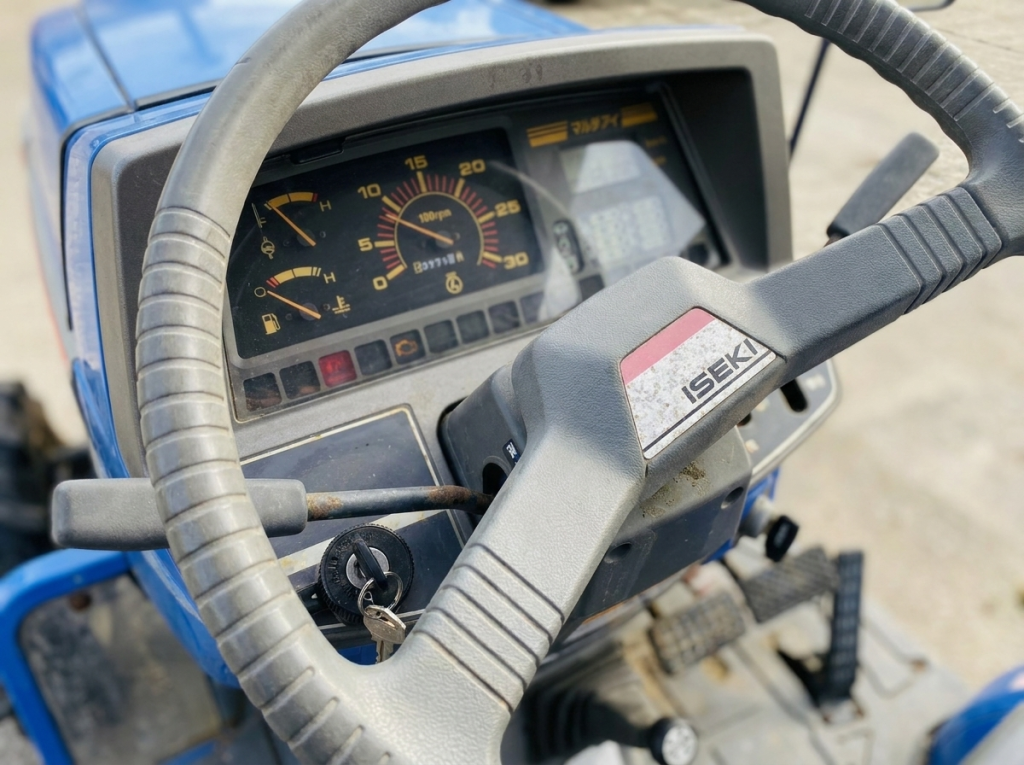
Ignition switch positions
| Position | Function |
|---|---|
| GLOW | Preheating: the engine compartment is preheated for reliable cold starting |
| OFF | Ignition off |
| ON | Ignition on, dashboard lighting and gauges active |
| START | Starter motor running — clutch pedal must be fully depressed |
When starting, fully depress the clutch: without the clutch pressed in, the safety switch won't activate the starter motor. Release the key after starting and it will automatically spring back to the ON position.
Preheating: how long?
The manual for this series does not specify a separate glow plug light or an exact preheating time in seconds — unlike later Iseki models with a digital glow indicator. In practice, this means: during cold or winter starts, hold the key on GLOW a few seconds longer than with a warm engine, and keep in mind that the engine will start up a bit more slowly at low temperatures — this is normal behavior for this type of mechanical preheating system and not a fault in itself.
Dashboard lights and indicators
| Light/indicator | Meaning |
|---|---|
| Battery charge light | Should go out as soon as the engine is running; if it stays on, the battery is not charging (see troubleshooting blog) |
| Engine oil pressure light | Lights up in case of a fault in the lubrication system — stop driving immediately and check the oil level |
| Water temperature gauge | Needle in the red zone = engine too hot — let it cool down at idle, don't switch off immediately |
| PTO indicator | Indicates that the power take-off is engaged |
| 4WD/Superfulturn indicator | Shows whether four-wheel drive or power steering assist on sharp turns is active |
| Parking brake indicator (S version) | Warns that the parking brake is still engaged |
PTO switch and main gear lever
The main switch turns the PTO shaft on or off. On the G version, there is also a PTO selector switch with AUTO, OFF, and MANUAL positions: in the AUTO position, the PTO shaft automatically stops as soon as the lift arms are fully raised. This is especially useful with a spreader or earth auger, as it protects the PTO shaft when you lift the implement, without you having to think separately about the PTO.
The main gear lever operates with 4 positions (super-low/low/medium/high) combined with the range gearbox, providing 16 forward and 16 reverse gears (the S version has 15 reverse gears).
Clutch lock lever
For longer periods of storage, it's advisable to use the clutch lock lever to keep the clutch disengaged. This prevents the clutch plate from rusting onto the flywheel — a common issue with tractors that stand idle for months (see also the blog on seasonal maintenance and storage).