



Buying a Yanmar Super Forte AF-22 to AF-33: experiences, strengths and weaknesses
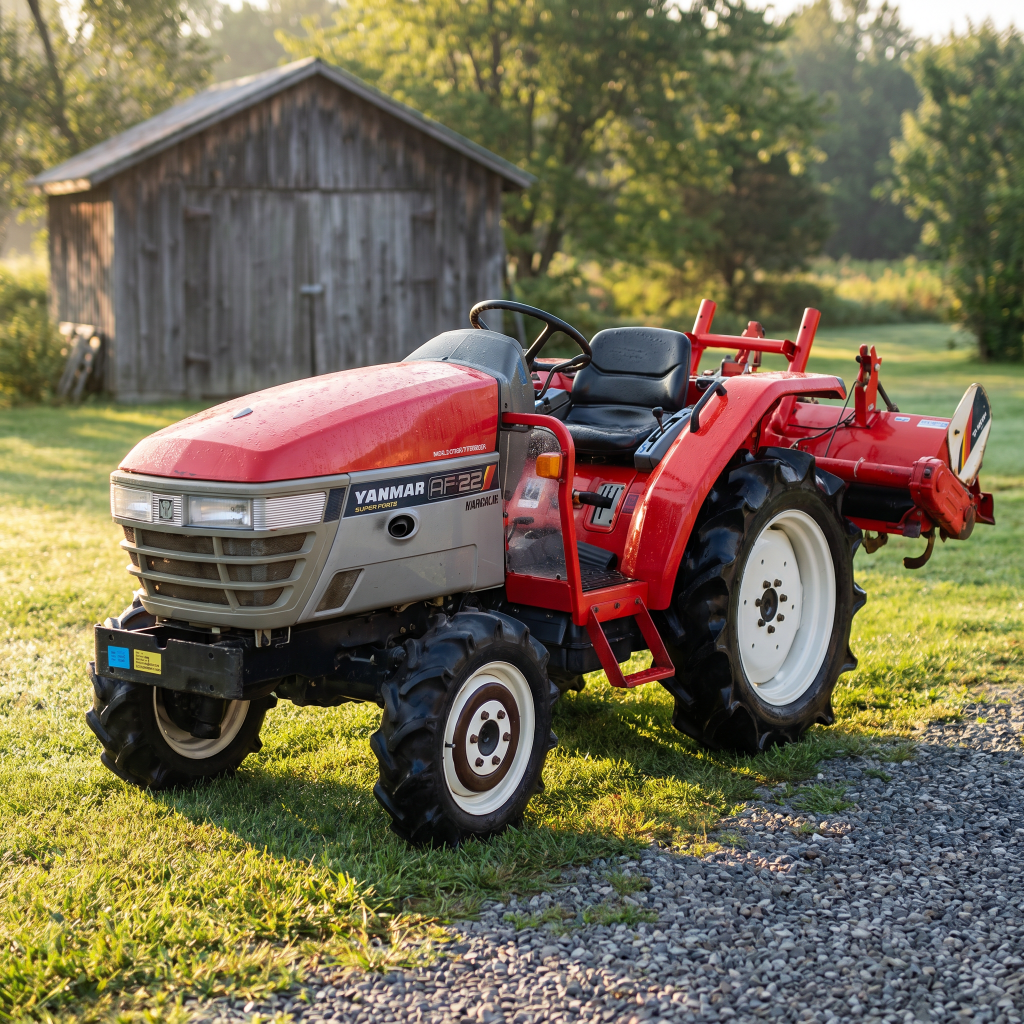
Considering buying a Yanmar Super Forte AF-22 to AF-33 ? Then it's important to know that this isn't a single model, but a whole series of compact 4WD diesel tractors (the MARK III generation) that differ considerably from one another in engine, weight, and size. In this buying guide, we compare the models side by side, explain the crucial engine difference, give a value indication, and tell you what to look out for when buying a used one.
Suitable for the entire series: Yanmar Super Forte MARK III AF-22, AF-24, AF-26, AF-28, AF-30, and AF-33. The number in the type name stands for the engine power in hp.
Yanmar Super Forte: one series, three size classes
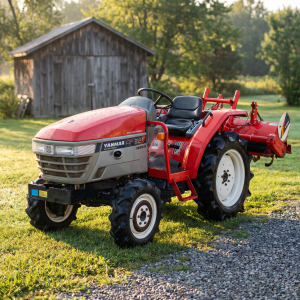
The Super Forte MARK III is a series of six models that can roughly be divided into three size classes. The higher the type number, the heavier and larger the tractor — and you notice this not only in the power output, but also in the weight, wheelbase, and tires. That makes quite a difference in what you can do with it and how stable it stands under a heavy tiller or flail mower.
| Model | Power | Engine | Weight (3P) | Size class |
|---|---|---|---|---|
| AF-22 | 22 hp | 3TNS82 (1425 cc) | 1165 kg | Small |
| AF-24 | 24 hp | 3TNS82 (1425 cc) | 1180 kg | Small |
| AF-26 | 26 hp | 3TNS84 (1496 cc) | 1225 kg | Medium |
| AF-28 | 28 hp | 3TNS84 (1496 cc) | 1255 kg | Medium |
| AF-30 | 30 hp | 3TNS84 (1496 cc) | 1380 kg | Large |
| AF-33 | 33 hp | 3TNS84 (1496 cc) | 1430 kg | Large |
All models feature four-wheel drive, full hydraulic power steering, a wet disc brake, and a three-point hitch with position control. So the basics are the same across all six; the difference lies in the engine and size.
The engine difference you really need to know
This is the most important point about this series. The six models run on two different three-cylinder diesel engines from the Yanmar 3TN family:
| Engine | Models | Bore × stroke | Displacement |
|---|---|---|---|
| 3TNS82 | AF-22, AF-24 | 82 × 90 mm | 1425 cc |
| 3TNS84 | AF-26, AF-28, AF-30, AF-33 | 84 × 90 mm | 1496 cc |
So the AF-22 and AF-24 have a smaller bore (82 mm) than the rest (84 mm). That may seem like a minor detail, but it has a practical consequence: engine gaskets — and especially the head gasket — are not interchangeable between the 82 mm and 84 mm engines. If you're ordering parts for the engine block, always check first which engine is in your tractor (the engine number is on the block). Within the 84 mm group (AF-26 to AF-33), everyone shares the same block; the difference between, say, an AF-30 and an AF-26 lies mainly in the tuning and RPM, not in the bore.
Good to know: the AF-30 and AF-33 get their extra power from a higher RPM (2800 rpm) than the AF-26 and AF-28 (2500 rpm), while sharing the same engine block.
Strengths
Owners particularly appreciate the Super Forte series for the combination of comfort and reliability that isn't a given in a tractor of this size. The full hydraulic power steering makes maneuvering effortless, even with a heavy tiller on the back. The wet disc brakes are low-maintenance and keep working well, even during wet and heavy tasks. The three-cylinder Yanmar diesels are known for being torquey and fuel-efficient, and the wide range of gears (main and range gearing with hydraulic shuttle and creep speeds) makes the tractor versatile — from precise tilling work to transport.
Since the series is 4WD with a rear diff lock, it has plenty of pulling power relative to its weight. For yard work, garden landscaping, flail mowing, and small-scale earthmoving, that's exactly what you want.
Weaknesses and points of attention
Let's be honest: these are machines from the 1990s, originally built for the Japanese market (grey import). This brings a few points of attention. The dashboard, warning stickers, and manual are often in Japanese, which can make operation tricky at first. When buying a used one, therefore pay attention to whether the instruments and indicator lights all still work.
From practical experience and owner feedback, the most common complaints about this type of tractor concern cooling and starting after long periods of inactivity: a dirty radiator or a worn V-belt leads to overheating, and old fuel or a clogged fuel filter makes starting difficult. The four-wheel drive also deserves attention — on some units, the 4WD no longer engages properly due to wear on the front axle coupling. None of these points is a design flaw — they are the usual consequences of aging and deferred maintenance. We discuss them in detail in our troubleshooting blog.
A second point of attention is naming confusion. Over the years, Yanmar has made several AF series; an AF-26 (Super Forte MARK III) is different from, say, an AF-326. If in doubt, check the type plate and the engine number to make sure you order the correct parts.
What to look out for with a used AF series?
When viewing a tractor, be sure to check these points: does it start smoothly (possibly after warming up the thermo-start in cold weather) and does it idle steadily? Is there no excessive blue or black smoke at full throttle? Does the hydraulics respond promptly and does the lift hold its position? Does the four-wheel drive work and does the diff lock engage — turn it on and feel whether the front axle really pulls along? Does the clutch feel non-slipping and does the brake pedal have the correct play? Finally, check the coolant and engine oil for contamination or mixing with water — that tells you a lot about how well the tractor has been maintained.
What is a Yanmar Super Forte AF worth?
A fixed price cannot be given — the value depends heavily on the model, the operating hours, the overall condition, and whether implements are included. As an indication, based on the used market for comparable Japanese grey-import compact tractors (not a formal valuation), the guide prices roughly increase with the size class:
| Size class | Models | Indicative guide price |
|---|---|---|
| Small | AF-22, AF-24 | ± €3,500 – €6,000 |
| Medium | AF-26, AF-28 | ± €5,000 – €8,000 |
| Large | AF-30, AF-33 | ± €6,500 – €10,000+ |
Within each class, the condition is mainly what determines the final price: a unit with many hours, questionable 4WD, or worn tires will be at the lower end, while a well-maintained tractor with low hours and an included rotary tiller will be at the higher end or even above it. The biggest price determinants are the number of operating hours, whether the four-wheel drive and hydraulics work properly, the condition of the tires and bodywork, demonstrably recent maintenance (fresh oil, filters, cooling), and the included implements. A tractor with maintenance history and working 4WD is almost always worth the extra cost compared to a cheap but unknown unit. (Amounts are indicative and may vary by time and region — last checked June 2026.)