



Buying a Kubota 05 series: what to look out for (D905 to V1505)
Do you want to buy a Kubota 05 series engine, or does your tractor, wheel loader or mini excavator already have one and are you torn between rebuilding or replacing it? Then this guide will help you make a well-informed choice. The 05 series is one of the most widely used diesel families in compact machines, and precisely because these engines last so long, you often come across them second-hand — with big differences in condition. Below you'll find out how the series is structured, how to tell a good one from a worn-out one, and when a rebuild kit or complete cylinder head is more cost-effective than a whole new engine.
Suitable for the entire series: D905, D1005, D1105, D1305, V1205, V1305 and V1505 — including the turbo versions (-T / -TE) and the emissions variants (-E, -E2B, -E3B, -E4B) and generator set versions (-BG).
Kubota 05 series: what exactly is it?
The 05 series is a family of compact, water-cooled four-stroke diesel engines with indirect injection (Kubota's so-called E-TVCS combustion chamber system). You'll find them in mini tractors, wheel loaders (Giant, Schäffer, Avant), mini excavators, scissor lifts, forklifts, generator sets and sweepers. The series ranges from the small 0.9-litre three-cylinder to the 1.5-litre four-cylinder, with power outputs of roughly 20 to 33 hp (without turbo) and considerably more with turbo.
The type designation reveals a lot. The letter indicates the number of cylinders: a D is a three-cylinder, a V a four-cylinder. The number refers to the displacement — so a D1105 is a three-cylinder of 1.1 litres, and a V1505 is a four-cylinder of 1.5 litres. Suffixes such as -T (turbo), -E3B (emissions version) or -BG (generator set) indicate the version and year of manufacture — and these partly determine which parts fit.
Kubota 05 series models at a glance
The table below compares the seven base models. The power figures are the standard intermittent ratings at 3000 rpm; actual power depends on the application and speed control.
| Model | Cylinders | Bore × stroke | Displacement | Power (intermittent @3000) |
|---|---|---|---|---|
| D905 | 3 | 72 × 73.6 mm | 898 cm³ | 14.9 kW / 20 hp |
| D1005 | 3 | 76 × 73.6 mm | 1001 cm³ | 16.8 kW / 22.5 hp |
| D1105 | 3 | 78 × 78.4 mm | 1123 cm³ | 18.7 kW / 25 hp |
| D1305 | 3 | — | 1261 cm³ | 21.0 kW / 28 hp |
| V1205 | 4 | 72 × 73.6 mm | 1198 cm³ | 20.1 kW / 27 hp |
| V1305 | 4 | 76 × 73.6 mm | 1335 cm³ | 22.4 kW / 30 hp |
| V1505 | 4 | 78 × 78.4 mm | 1498 cm³ | 25.0 kW / 33.5 hp |
Important to know: even though these engines look very similar, they are not simply interchangeable. The bore differs per model, and so do the pistons, liners and — very importantly — the head gasket. A head gasket or gasket set for a D905 therefore won't fit a D1105, and one for a V1305 won't fit a V1505. Always order parts based on the exact engine model.
Kubota 05 series new, used or exchange engine?
Roughly speaking, you have three routes if your engine needs replacing:
A new or used complete engine. The most convenient option, but also the most expensive (new) or the least certain (used without history). Never buy a used engine blindly — see the checklist further below.
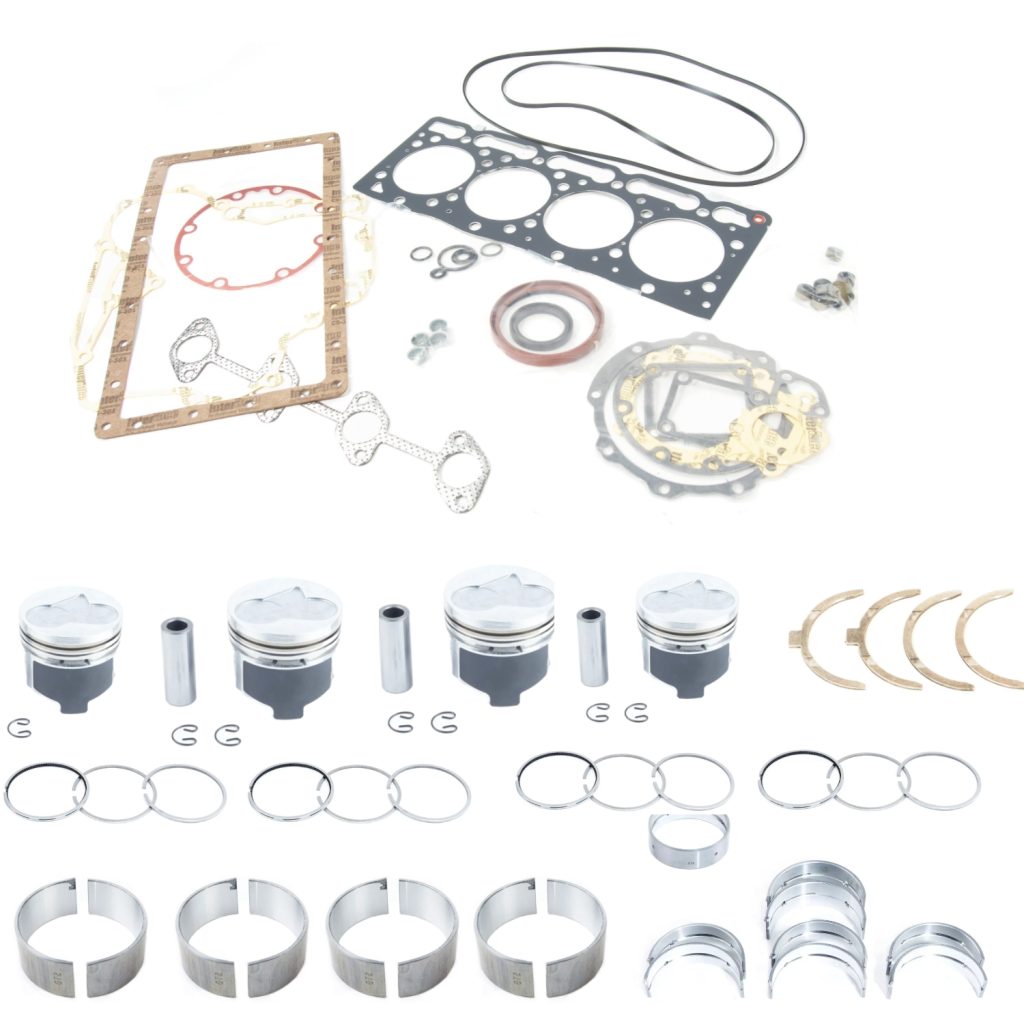
Rebuilding it yourself. If the block and crankshaft are still in good condition, rebuilding is often by far the most cost-effective option. With a rebuild kit (pistons/piston rings, bearings, complete gasket set) and possibly a new or reconditioned cylinder head, you can bring the engine back to top condition for a fraction of the price of a new one. For the most popular models — V1505 and D1105/D1305 — complete rebuild kits and cylinder heads are simply in stock.
Replacing only the cylinder head. Many complaints (white smoke, coolant loss, poor compression) are caused by a warped or cracked head after overheating. If the bottom end of the engine is still healthy, you can solve this with a complete, pre-assembled cylinder head — valves, springs and seals are already fitted, so you don't need to transfer anything over.
Tip from our workshop: not sure whether to rebuild or replace? First do a compression test and a cooling system pressure test. If compression is still even and the problem is at the top of the engine, a complete cylinder head is usually the smartest investment.
- Complete cylinder head V1505 (incl. head gasket + glow plugs): view the V1505 cylinder head
- Complete cylinder head D1105 (incl. gasket set + thermostat): view the D1105 cylinder head
- Full rebuild kit V1505: view the V1505 rebuild kit
- Full rebuild kit D1105 / D1305: view the D1105/D1305 rebuild kit
Buying a used Kubota 05 series engine: the checklist
If you're buying a used engine, or a machine with an 05 series engine in it, go through these points. In ten minutes they'll tell you more than any sales listing ever could.
Operating hours and maintenance history. Hours mean little without context. An engine with 6,000 hours that always got timely oil and filter changes is often healthier than a neglected one with only 2,000 hours. Ask for receipts or a logbook.
Cold start and smoke behaviour. Have the engine started from cold. Lots of white smoke that doesn't clear once the engine warms up points to coolant entering the combustion chamber (head gasket or cracked head) or poor injectors. Blue smoke means oil consumption (piston rings or valve guides), and black smoke under load points to late injection timing, worn injectors or a clogged air filter.
Check the oil and coolant. Milky oil or a low coolant level with no visible leak is a red flag — usually the head gasket. Also check whether there's oil in the coolant. Note: the 05 series has dry liners, so coolant in the oil almost always comes from the head or gasket, not from a "cracked liner".
Signs of overheating. Overheating is by far the biggest killer of these engines. Discoloured metal around the head, traces of previous head gasket repairs, or a clogged cooling grille are warning signs.
Oil pressure. Does the oil pressure warning light stay on for a moment at idle after warming up, or does the pressure build up slowly? That can indicate worn bearings or a contaminated pickup screen.
The exact engine model and serial number. Note the full type from the nameplate (including any suffix such as -E3B or -T) as well as the serial number. You'll need them to order the correct parts — grey imports and standalone industrial engines come in many sub-versions with different injectors, glow plugs and gaskets.
Kubota 05 series: how much can you do with it?
A common question is what you can realistically do with such an engine. Don't rely purely on the maximum hp figure: the usable power at the PTO or hydraulics is lower than the gross engine output. A three-cylinder (D905–D1305) of 20 to 28 hp is fine for a light mini tractor, a small wheel loader or a generator set. The four-cylinders (V1205–V1505) run smoother and have more low-end torque — better suited to heavier earthmoving, a front loader or continuous hydraulic work. If you really want power in a compact block, the turbo version (for example V1505-T) is the solution; just keep in mind that a turbo requires extra attention to clean air and oil.
Parts and rebuilding: what you can stock up on
The great thing about the 05 series is that virtually all wear parts are available separately, so you can keep a healthy engine running for a long time. These are the most requested parts for maintenance and rebuilds:
- Complete and bare cylinder heads, head gaskets and gasket sets
- Complete rebuild kits and more affordable in-frame rebuild kits
- Pistons, connecting rod bearings and bushings
- Water pump, thermostat and cooling fan
- Injectors, feed pump and fuel filter
- Filter sets (air, fuel and oil filter in one)
- Starter motor and alternator
In the upcoming blogs in this series, we'll dive deeper into each topic — from the exact torque settings to the maintenance schedule and troubleshooting common faults.