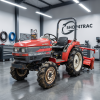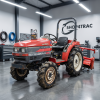





Buying a Kubota B1-14, B1-15, B1-16 or B1-17: which Bulltra suits you?
If you want to buy a Kubota B1-14, B1-15, B1-16 or B1-17, you're buying one of the most beloved Japanese mini tractors from the 1980s. These four Bulltra models look virtually identical, but the real difference lies under the hood — and that determines which one best suits your work.
Suitable for the entire series: B1-14, B1-15, B1-16 and B1-17, including the Zen-noh rebadges ZB1-14 through ZB1-17.
Kubota B1-14 through B1-17: one machine, two engine families
The four models share virtually the same chassis, the same transmission, the same fluid capacities and the same three-point hitch. The number after the B1 says something about the engine power, and this splits the tractors into two pairs. It's no coincidence that Kubota issued two separate manuals back then: one for the B1-14 and B1-15, and one for the B1-16 and B1-17. Each pair shares the same engine block.
| Model | Engine | Bore × stroke | Maximum power | Drive |
|---|---|---|---|---|
| B1-14 | Kubota D850, 3-cylinder diesel | 72 × 70 mm | 14.5 hp | 2WD or 4WD |
| B1-15 | Kubota D850, 3-cylinder diesel | 72 × 70 mm | 15.5 hp | 2WD or 4WD |
| B1-16 | Kubota D950, 3-cylinder diesel | 75 × 70 mm | 16.5 hp | 2WD or 4WD |
| B1-17 | Kubota D950, 3-cylinder diesel | 75 × 70 mm | 17.5 hp | 2WD or 4WD |
The stroke is the same across all four (70 mm); only the bore differs. The B1-14 and B1-15 have the slightly smaller D850 (72 mm bore, 855 cc), while the B1-16 and B1-17 have the larger D950 (75 mm bore, 927 cc). Maximum power ranges from 14.5 hp for the B1-14 to 17.5 hp for the B1-17, each at 2600 rpm — these figures and all the capacities further on in the series come directly from the original manuals.
 Kubota B1-14 through B1-17: what can you do with 14 to 17 hp?
These are genuine garden and hobby farm tractors. With 14 to 17 hp at the crankshaft, you have enough power for a rotary tiller, a flail mower, a ridging plough or a small tipper on the yard and in the vegetable garden. Important to know: the PTO power (what remains at the power take-off) is always somewhat lower than the engine power, because the transmission absorbs part of it. For light tillage and mowing work, the difference between a B1-14 and a B1-17 makes little practical difference; if you do heavier tilling or often push your implements to their limits, you will notice the extra torque of the D950.
The rule of thumb: if you're mainly buying the tractor for a tiller and some transport, a well-maintained B1-14 or B1-15 is more than sufficient. If you want a margin and the ability to handle somewhat heavier implements, choose the B1-16 or B1-17.
Kubota B1-14 through B1-17: 2WD, D or DB?
Each model is available in three drive variants, and this is at least as important as the engine type when buying:
- Two-wheel drive (2WD) — simple and light, fine on flat and dry terrain.
- D version (4WD) — four-wheel drive with driven front axle; much more grip on wet ground and slopes.
- DB version (4WD with dual-speed steering) — four-wheel drive with a front axle that turns faster in corners, allowing you to make shorter, tighter turns at the headland.
There are also standard, M and MA hydraulic versions (the Monro-Matic position and draft control), and a rotor in side-drive or center-drive configuration. Which one you have is reflected in the controls and in the parts that fit.
Kubota B1-14 through B1-17: what should you look out for when buying?
Let's be honest: these are machines around forty years old, so condition matters more than the model. Look for a smooth, white-smoke-free cold start (see our starting guide), a cooling system without oil in the water, a clutch that engages properly, and a lift that holds its load. Also check that the correct nameplate matches the machine — with grey imports and Zen-noh rebadges, naming confusion does occur. If you're unsure about the exact engine type, check the bore or the casting number on the block: that determines whether you need D850 or D950 parts.