



Yanmar Super Forte AF-22 to AF-33 maintenance schedule and adjustment values
With the right maintenance schedule for the Yanmar Super Forte AF-22 to AF-33 you'll keep this tractor reliable for decades. Below you'll find all the maintenance intervals from the original Yanmar manual, plus the adjustment values for the V-belt, clutch, brake and steering that you won't find in a regular service.
Suitable for the entire series: Yanmar Super Forte MARK III AF-22, AF-24, AF-26, AF-28, AF-30 and AF-33. The schedule is the same for all models.
Yanmar AF series: running-in (first 50 hours)
The first 50 operating hours are decisive for the engine's service life. Yanmar specifies that during this period you should avoid sudden starts or braking maneuvers, not load the tractor more heavily or run it at higher revs than necessary, and always let the engine warm up properly first. Drive carefully on rough terrain. Important: after those first 50 hours, carry out a complete inspection and change the engine oil — this flushes out the break-in particles.
Maintenance schedule by operating hours
The basic principle: check every 50 operating hours. If you don't reach those hours within a year, perform the check at least once a year. Below are the most important recurring tasks.
| Maintenance point | Interval |
|---|---|
| Change engine oil | 1st time at 50 hours, then periodically according to schedule |
| Replace engine oil element (oil filter) | According to schedule (together with oil change) |
| Check/change transmission oil | According to schedule |
| Check/change front axle oil | According to schedule |
| Drain fuel water / fuel filter element | Periodically according to schedule |
| Clean/replace air filter element | Periodic (more often in dusty conditions) |
| Clean radiator screen and cooling system | Check regularly |
| Check battery (fluid / recharge) | Periodic |
| V-belt (fan belt) tension | 1st check at 50 hours, then periodically |
| Retighten bolts and nuts | Periodic |
| Grease all lubrication points | Periodic |
| Valve clearance, injection timing, injectors | Periodic workshop check |
Parts you should replace preventively on time
A few rubber parts also age without much operating time. Yanmar recommends replacing the radiator hoses, the hydraulic rubber hoses and the fuel lines every two years, regardless of the hour count. The rubber hose of the power steering also falls under this two-year interval. On a tractor of this age, this is the kind of maintenance that prevents costly downtime.
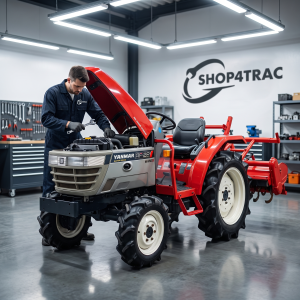
Adjustment values for the Yanmar AF series
Besides changing and replacing, there are a few things you need to adjust periodically. These are the exact values from the manual — handy to have on hand.
| Adjustment point | Value | How |
|---|---|---|
| V-belt (fan belt) deflection | 10–15 mm | Press the middle of the belt with your finger; tension by shifting the alternator |
| Clutch pedal play | 15–25 mm | Adjust with the adjusting screw (tensioning screw) |
| Brake pedal play | 30–40 mm | Adjust left and right equally, so both brakes engage simultaneously |
| Steering wheel play | 20–50 mm | If there's more play, have the steering checked |
| Front wheel toe-in | 4–8 mm | Measurement A (rear) minus measurement B (front); adjust via the tie rod |
A V-belt that's too loose is a common cause of overheating and a draining battery, because it no longer properly drives both the fan and the alternator. So always check the deflection as standard at every service.