


Yanmar F195–FX265 Hydraulics, PTO and Implements
The hydraulics of the Yanmar F195 through FX265 are surprisingly complete for tractors of this age: position control, automatic depth control and, on the U version, even an electronic lift automatic. This lets you get the most out of the lift, the PTO and your implements.
Suitable for the entire series: F195(D), FX195(D), F215(D), FX215(D), F235(D), FX235(D), F255(D), FX255(D), F265(D) and FX265(D).
Yanmar F195–FX265 lift control: three systems
You'll get to know the lift fastest via the three controls next to the seat:
- Position control keeps the implement at a fixed, self-selected height — for plowing and all work without a rotary tiller.
- Auto-rotary keeps the tilling depth constant on uneven ground. Scale 1–4 for shallow work, 4–8 for normal tilling, 9–10 for deep tilling; above setting 10 the automatic function is disabled.
- Mix-control combines both and only limits the lowering side — useful on wet or bumpy plots.
You raise and lower during work using the lift switch (one-touch); the lift-up light on the dashboard stays on as long as the implement is raised. Note: if the position lever is in the highest position, the implement won't lower via the switch. And as long as the ignition is ON, the lift will also lower with the engine off — keep children away from the tractor.
You adjust the lowering speed with the stop/slow-return valve: counterclockwise is faster, clockwise slower, and fully closed blocks the hydraulics — mandatory when working underneath a raised implement. The non-UFO versions also have a lowering cushion that slows the implement just above the ground; for plowing work this can be disabled with the damper lever behind the right-hand cover.
Yanmar F195–FX265 backup automatic
With the backup switch enabled (light on), the implement lifts automatically as soon as you put the main gear lever into reverse — including a warning buzzer. Disable the automatic function when loading onto a trailer, when crossing dikes, in the orchard or greenhouse, and with implements not attached to the three-point hitch.
Yanmar FX265 and the other U versions: OK-UFO explained
The OK-UFO automatic (U version) electronically controls three things at once: the tilling depth, the tilt of the implement relative to the ground, and the position of the rotary hood. One press of the OK button activates everything simultaneously, including the lowering cushion. You set the depth with a rotary knob (scale: up to 3 for shallow work, 3–5 for normal tilling, from 4 towards deep), the tilt automatic keeps the tiller level relative to the ground surface regardless of how tilted the tractor is, and the lift-height knob limits the maximum lift height. On the road, turn off the automatic function (dashboard lights off) so the implement can't unexpectedly lower.
Good to know with a used machine: a flashing dashboard light indicates a sensor fault, and the tilt zero position can be calibrated with the fine-adjustment screw — raise the implement 5–10 cm above flat ground and adjust until it hangs horizontally. Never point the pressure washer at the control box, solenoid valves or sensors when washing.
Yanmar F195–FX265 PTO
| Model | Settings | Speeds at 2500 rpm |
|---|---|---|
| F/FX195(D) | 3 | 571 / 785 / 1209 rpm |
| F/FX215(D) through F/FX265(D) | 4 | 574 / 698 / 958 / 1293 rpm |
The PTO shaft is 35 mm (JIS size); so always check the connection of the intermediate shaft with a European implement. Only engage the PTO with the clutch fully depressed and read the working speed on the PTO scale of the tachometer. The lift is a three-point JIS type 0 (F/FX195) or type 1 (F/FX215 and larger) with position control.
What can you do with 19 to 26 hp?
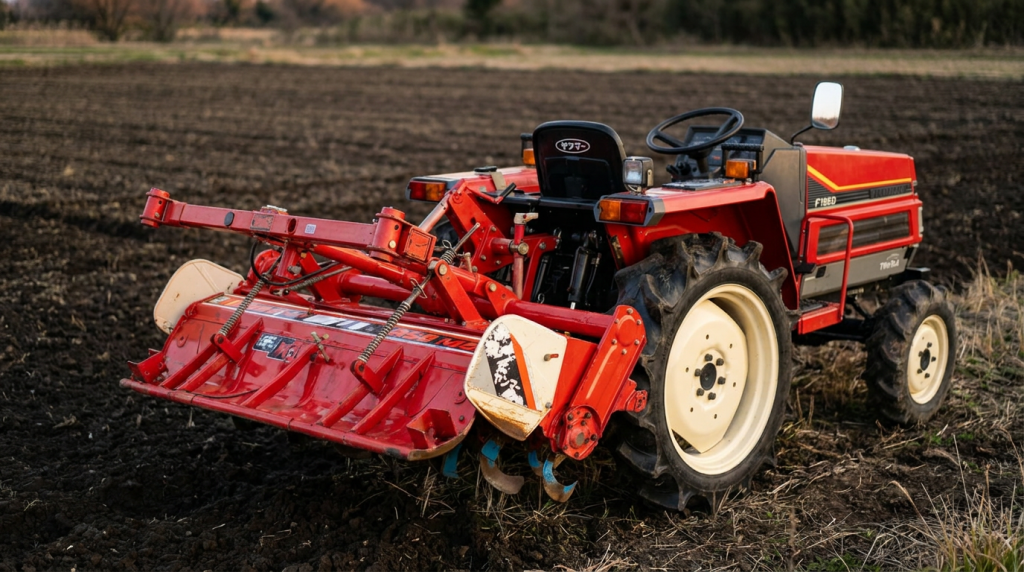
The PTO power has never been officially published; as a rough guide, count on 85–90% of the engine power. In practice this means: the F/FX195 effortlessly runs a 1.30 m rotary tiller (the factory-standard RSB-1302), the mid-range models handle 1.40–1.50 m, and the F/FX255 and 265, with their extra weight and 1.50 m tiller, are also suitable for single-furrow plowing and serious transport work. The gear selection from the manual: group 1 for tilling (driving speed 1–2, PTO shaft in position 1–3), group 2 for plowing and harrowing, group 3 for transport. When tilling, allow around 2.6 m of headland all around, and for heavy mounted implements, fit the ballast weights (4 × 25 kg wheel weights and 2 × 20 kg front weights) for balance.
External hydraulics are also available: a single-acting outlet on the cylinder head (for example for a tipping trailer, operated via the position lever with the stop valve closed) and a double-acting outlet at the right-hand step for a front loader — the switching lever is located under the seat.
💡 Product tip: a slow or whining lift almost always starts with the shared transmission/hydraulic oil. If you have issues, first replace the hydraulic filter (fits the entire series) and change the oil — see the fluids guide for the correct specifications.