



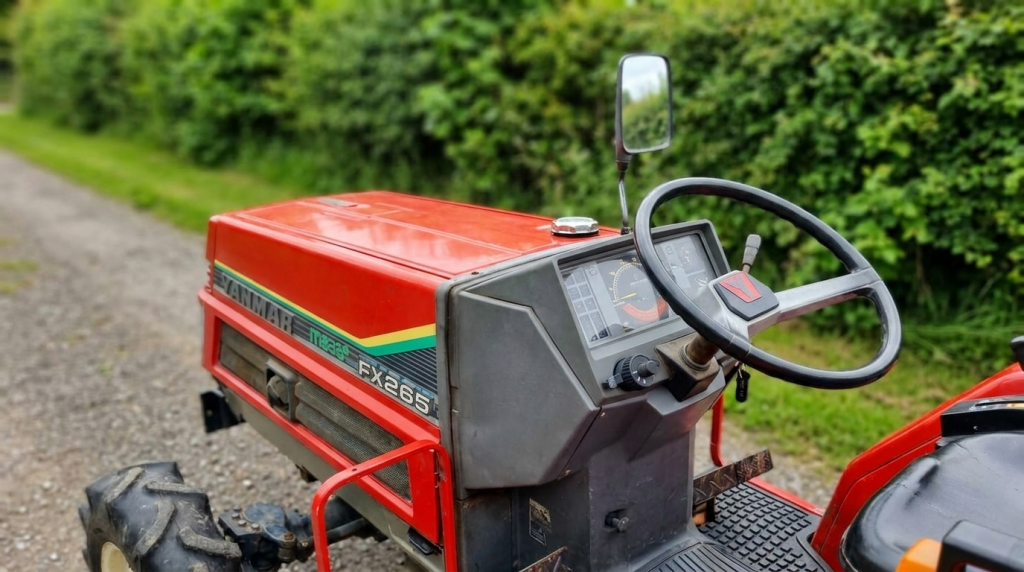
Yanmar F195–FX265 Faults: Causes and Solutions
Is your Yanmar F195 not starting, is the powershift on your FX235 shifting oddly, or has the lift stopped working? Below is the complete fault diagnosis for the New Super Forte series: first the tables from the factory manual, followed by the well-known practical issues from owners' experiences.
Suitable for the entire series: F195(D), FX195(D), F215(D), FX215(D), F235(D), FX235(D), F255(D), FX255(D), F265(D) and FX265(D).
Yanmar F195–FX265: engine won't start
| Symptom | Check | Solution |
|---|---|---|
| Starter motor doesn't turn | Clutch pedal (start safety switch!), battery, battery terminals, main fuse | Fully depress the pedal; charge the battery, clean and grease the terminals, replace the fuse |
| Starter motor turns, engine doesn't start | Fuel level, air in the system, fuel tap position | Refuel and bleed the system; set the tap to "O" |
| Only turns over with the decompression lever pulled | Battery voltage | Charge or replace the battery |
| Engine runs unevenly | Air or water in the fuel, clogged fuel filter or injector | Bleed the system, drain water, replace the filter or injector |
| No power | Air filter, compression, valve clearance, injection timing | Clean the filter; have compression and adjustment checked by a workshop |
Yanmar F195–FX265: warning lights while driving
| Light | Cause | Action |
|---|---|---|
| Oil pressure | Oil level too low, wrong viscosity, faulty pressure switch or oil pump | Stop immediately; top up oil, otherwise consult a workshop |
| Charging current | Faulty voltage regulator or slipping V-belt | Tension the belt (10–15 mm deflection); test the regulator or alternator |
| Radiator water level | Coolant in the expansion tank below minimum | Top up; if it recurs, check the system for leaks |
| Engine overheating | Clogged radiator screen, loose V-belt, insufficient coolant, or overload | Clean the screen, tension the belt, top up coolant, reduce the load |
Yanmar F195–FX265 hydraulic faults
If the implement doesn't lift, check the following in order: is the stop/slow-return valve open, is the transmission oil level correct, is the hydraulic filter clogged, and is the pump drawing in air through a porous line or O-ring? If the implement doesn't lower while the lift lever is set to "lower," the position lever is usually in the top position — move it toward "free." If the implement doesn't lift when reversing (backup automatic), check the reverse switch and the buzzer fuse under the seat.
Yanmar FX series: powershift issues from real-world experience
Owners' real-world experience highlights two recurring powershift problems. The first: the lever no longer engages fully, especially in reverse. This is often caused by simple wear in the shift rods and bushings, causing the lever to hit the end of the quadrant before the valve has fully shifted — replacing the pins and bushings resolves this. The second is more serious: the transmission "binds" (as if two gears engage at once), or the tractor creeps backward while in a forward gear. This points to worn sealing rings on the powershift shaft, causing pressurized oil to engage the wrong clutch pack; the tractor will need to be split to fix this. A handy diagnostic tip if the tractor suddenly stops driving: if the PTO shaft still turns, the problem lies in the powershift; if the PTO shaft also stops, it's the main clutch.
Yanmar F195–FX265: electrical issues from real-world experience
A classic issue with this series is a blown 5A fuse combined with a charge light that stays on: in almost all reported cases, the voltage regulator or alternator turned out to be faulty. The fuse box is located on the firewall on the clutch side. Additionally, the fuel shutoff works electrically: a stop solenoid receiving insufficient voltage (for example, due to a worn wiring harness) can prevent the engine from starting or cause it to stall unexpectedly — first measure whether full battery voltage reaches the solenoid before replacing it (part number for reference: 119233-77932; verify against the serial number). And since dashboards on grey-import units are often swapped, when troubleshooting electrical issues, trust the nameplate rather than the printing on the tachometer.
Yanmar F195–FX265: glow system
If the engine starts poorly when cold but runs fine once warm, first test the thermostart/glow system (the indicator light should come on when the ignition is switched on below 5°C) and replace the glow plugs if necessary. Never use starting spray on an engine with a pre-glow system — this can cause damage. If cold starting remains poor with a properly functioning glow system, loss of compression is the likely cause.
💡 Product tip: the most requested parts for these faults: hydraulic filter, voltage regulator F/FX series, alternator, glow plugs and the starter motor (incl. F195).