



Mitsubishi S3L & S4L: Fuel, Injection and Starting
A Mitsubishi S3L or S4L that starts poorly or won't start is almost always related to fuel, air in the system, preheating, or compression. In this article we go through the complete fuel and starting system — including injection data, injection timing, testing the injectors, bleeding, adjusting idle speed, and measuring compression — all with the values and procedures from the workshop manual.
Suitable for the entire series: Mitsubishi S3L, S3L2, S4L and S4L2 — used, among others, in Vetus, Solé, Caterpillar, Pel-Job, Weidemann, Mahindra, Solis, TYM and Farmtrac.
How the fuel system of the Mitsubishi S3L & S4L works
The fuel flows from the tank via the fuel filter with drain cock to the injection pump. On engines with a feed pump, the diesel is actively drawn in. The injection pump forces the fuel under high pressure through the injection lines to the injectors, which spray the atomized diesel into the swirl chamber. Excess fuel returns via the leak-off pipe. Because this is an indirect-injection engine with a swirl chamber, cold starting relies heavily on properly functioning glow plugs.
Mitsubishi S3L & S4L injection data
| Parameter | Value |
|---|---|
| Combustion system | Swirl chamber (indirect injection) |
| Injection timing | 17° before TDC (BTDC) |
| Injector type | Throttle nozzle (Bosch), spray angle 15° |
| Injector opening pressure | 14.22–15.00 MPa (145–153 kgf/cm²) |
| Injection pump | Bosch M-type (DENSO), plunger Ø5.5 mm, cam lift 15 mm |
| Governor | Centrifugal flyweight type |
| Idle (low) | 1000 ± 25 rpm |
| High idle (max. no-load) | 2700 rpm |
| Glow plug resistance | 0.55 Ω |
| Firing order | 3-cylinder 1-3-2 · 4-cylinder 1-3-4-2 |
| Fuel | Diesel (JIS K2204 Special 1–3) |
| Fuel filter | Paper element cartridge, separate type with cock |
Checking and adjusting Mitsubishi S3L & S4L injectors
Worn or poorly atomizing injectors cause hard starting, white smoke, and loss of power. You can check them using an injector tester:
- Mount the injector on the tester and pump the handle to bleed out air.
- Then pump at approximately one stroke per second and watch the needle. The needle should rise gradually and vibrate during injection.
- The pressure at which the needle starts to vibrate is the opening pressure; this should be 14.22–15.00 MPa .
- If the pressure deviates, adjust it using the shim under the spring. A 0.1 mm change in shim thickness gives approximately a 1.0 MPa pressure difference; shims are available in ten thicknesses from 1.25 to 1.70 mm, in steps of 0.05 mm.
- Also check the spray pattern: a good injector atomizes finely and evenly. A poor spray or dripping means it needs cleaning or replacing.
Tighten the injector holder to 49.0–58.8 N·m, and the injector lock nut to 34.3–39.2 N·m.
Checking and adjusting Mitsubishi S3L & S4L injection timing
The injection timing should be set to 17° before top dead center . You check this using the classic "spill timing" method:
- Close the fuel cock. Disconnect the No. 1 injection line at both ends.
- Remove the delivery valve holder from No. 1, take out the delivery valve and spring, and reinstall the delivery valve holder (empty).
- Connect the No. 1 injection line only at the pump side so you can see the fuel coming out. Set the throttle lever to low speed and open the fuel cock.
- Slowly turn the crankshaft clockwise. Fuel will flow from the line; the injection timing is exactly the moment the fuel stops flowing.
- At that moment, the IT mark on the crankshaft pulley should align with the corresponding mark on the gear case — this is 17° BTDC.
Adjustment is done with shims under the injection pump housing. A thickness change of 0.1 mm shifts the timing by approximately 1°. A thicker shim retards the injection timing, a thinner one advances it. Shims are available in 0.2 / 0.3 / 0.4 and 0.8 mm; the deviation must stay within ± 1.5° of the standard. Apply sealant to both sides of the shim to prevent oil leakage, and re-check the timing after adjusting.
If you don't want to remove the delivery valve (to keep out dirt), you can loosen the line at the injector side and slowly rotate until fuel wells up from the end of the pipe; then allow for approximately 1° margin relative to the spec.
Mitsubishi S3L & S4L preheating and cold starting
The glow plugs are energized as soon as you turn the key to the glow position. Indicative preheating times:
| System | Glow plug | Preheating time |
|---|---|---|
| 12 V | 10.5 V – 9.7 A | ± 30 seconds |
| 24 V | 22.5 V – 5 A | ± 25 seconds |
A healthy glow plug has a resistance of approximately 0.55 Ω — if you measure significantly higher or infinite, it's defective. Tighten the glow plug to 14.7–19.6 N·m, no more, as the element is fragile. If the engine doesn't stop when you turn the key, or fails to start at all, the stop solenoid is often the culprit. There are ETR versions (energize to run) and ETS versions (energize to stop); the clearance between the solenoid plunger and the control rod should be 0.15–0.20 mm.
Bleeding the Mitsubishi S3L & S4L fuel system
After a filter change, running the tank dry, or working on the lines, you need to bleed the system — otherwise it won't start. The method depends on the filter type.
Filter with drain cock (push-button type)
- Open the cock and press the priming pump button several times; the fuel will flow into the filter on its own. If the engine has a feed pump, turn the key to ON.
- Keep pumping until no more air bubbles come out with the fuel.
- The air in the injection lines and injectors will bleed out automatically while cranking the engine.
Cartridge filter
- Turn the key to ON (on engines with a feed pump); the fuel will flow into the filter.
- First loosen bleed screw 1 and tighten it once no more air bubbles appear.
- Then loosen bleed screw 2 and tighten it once the fuel is free of air bubbles.
Adjusting Mitsubishi S3L & S4L idle speed
Only adjust the idle speed once the engine is warm (coolant 60 °C or higher) and once valve clearance, injection timing, and injectors are all in order.
- Low idle: loosen the lock nut on the idle bolt and turn the bolt in or out to reach 1000 ± 25 rpm; then lock the nut.
- High idle: loosen the lock nut on the high-speed bolt and adjust to 2700 rpm (no load); lock the nut.
Measuring Mitsubishi S3L & S4L compression
If the engine starts poorly or lacks power without an obvious fuel-related cause, measure the compression. With a compression ratio of 22.0 : 1, good compression is essential.
- Set the throttle lever to STOP and remove all glow plugs.
- Fit a compression gauge with the correct adapter to the cylinder being tested.
- Crank the engine with the starter motor and read the value once the needle stabilizes. Measure ALL cylinders — don't assume the rest based on one.
| Compression (at 290 rpm) | Value |
|---|---|
| Standard | 2.9 MPa (30 kgf/cm², 421 psi) or higher |
| Limit | 2.6 MPa (27 kgf/cm², 377 psi) |
| Allowable difference between cylinders | 0.29 MPa (3.0 kgf/cm², 42 psi) or less |
If you're at or below the limit, or if the cylinders vary too much, an overhaul is needed.
Replacing the Mitsubishi S3L & S4L fuel filter
According to the manual, replace the fuel filter every 500 operating hours, and sooner if water or sediment is present. For the type with a selector cock, close the cock, loosen the ring nut, replace the element and O-ring, and then open the cock again; for the cartridge type, replace the entire filter unit. Bleed the system after every replacement.
Mitsubishi S3L & S4L fuel and starting system torque specifications
| Component | Thread × pitch | N·m | kgf·m |
|---|---|---|---|
| Injector holder | M20×1.5 | 49.0–58.8 | 5.0–6.0 |
| Injector lock nut | M16×0.75 | 34.3–39.2 | 3.5–4.0 |
| Injection line nut | M12×1.5 | 24.5–34.3 | 2.5–3.5 |
| Leak-off pipe nut | M12×1.5 | 20.6–24.5 | 2.1–2.5 |
| Delivery valve holder | — | 39.2–49.0 | 4.0–5.0 |
| Injection pump banjo bolt | M14×1.5 | 19.6–24.5 | 2.0–2.5 |
| Injection pump bleed plug | M8×1.25 | 9.81–13.7 | 1.0–1.4 |
| Glow plug | M10×1.25 | 14.7–19.6 | 1.5–2.0 |
| Stop solenoid mounting nut | M30×1.5 | 39.2–49.0 | 4.0–5.0 |
| Starter motor terminal B | M8×1.25 | 9.81–11.8 | 1.0–1.2 |
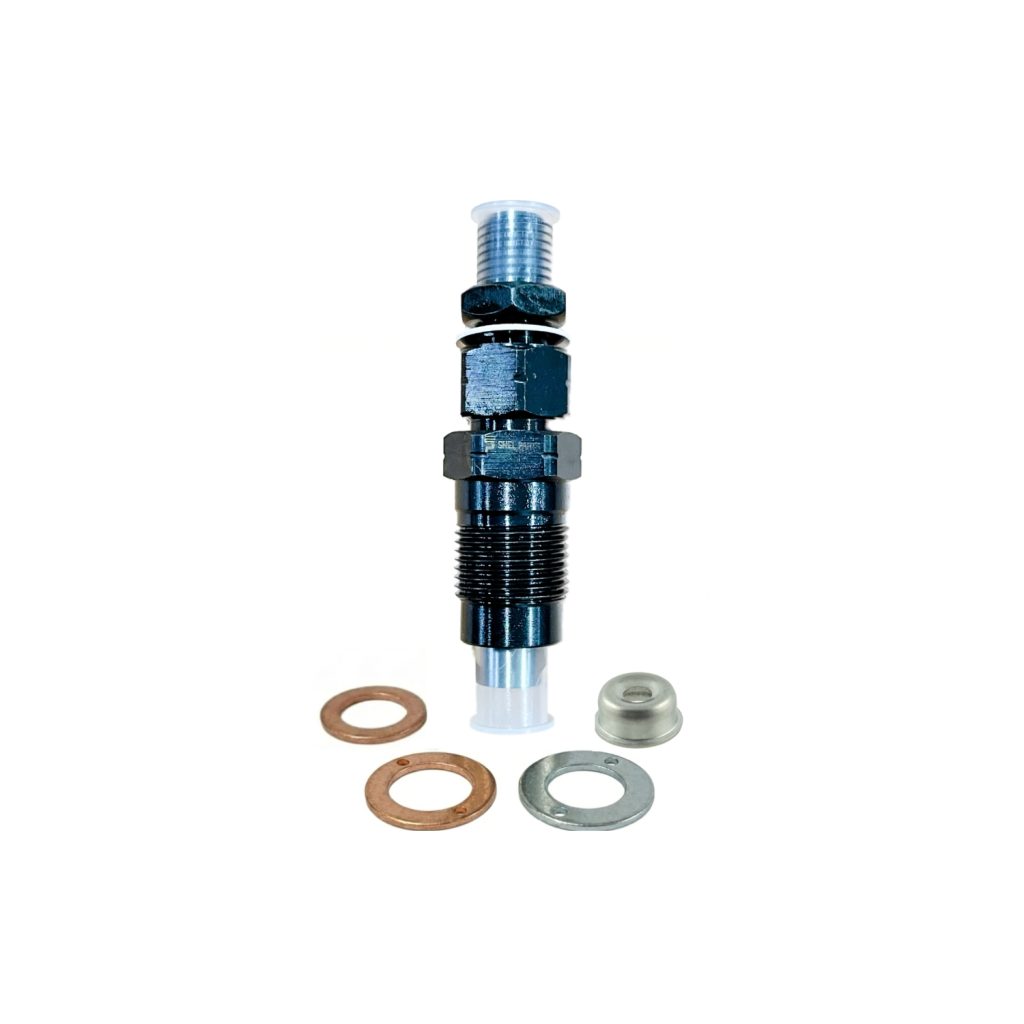
Fuel parts in stock: complete injector (SKU-47022-s), individual injector nozzle (SKU-47009-s), fuel feed pump (SKU-56003) or the SKU-56011 version, and a fresh filter set with fuel filter.
Is the no-start issue electrical? Check out the starter motor S4L (SKU-1290015) or S3L (SKU-1290016), the alternator (SKU-120020) and the voltage regulator (SKU-128009).
Frequently Asked Questions
What is the injection timing of the Mitsubishi S3L/S4L?
17° before top dead center (BTDC). You adjust it using shims under the injection pump: a 0.1 mm thickness difference shifts the timing by about 1°, a thicker shim retards it and a thinner one advances it.
What is the opening pressure of the injectors?
14.22–15.00 MPa (145–153 kgf/cm²). You adjust it using the shim under the spring: 0.1 mm thickness gives approximately a 1.0 MPa difference.
How much compression should a Mitsubishi S3L/S4L have?
At 290 rpm, at least 2.9 MPa (30 kgf/cm²); the limit is 2.6 MPa (27 kgf/cm²). The difference between cylinders may not exceed 0.29 MPa.
My Mitsubishi starts poorly when cold — what now?
Check the glow plugs (resistance ± 0.55 Ω) and the preheating time (± 30 s at 12 V, ± 25 s at 24 V), check for air in the fuel system, and if white smoke persists, have the injectors and injection timing checked. If that doesn't help, measure the compression.
How do I adjust the idle speed?
With a warm engine (60 °C or higher): set low idle to 1000 ± 25 rpm using the idle bolt, and high idle to 2700 rpm using the high-speed bolt — locking the nut each time.
{
"@context":"https://schema.org","@type":"FAQPage","mainEntity":[
{"@type":"Question","name":"What is the injection timing of the Mitsubishi S3L/S4L?","acceptedAnswer":{"@type":"Answer","text":"17° before top dead center (BTDC). You adjust it using shims under the injection pump: a 0.1 mm thickness difference shifts the timing by about 1 degree, a thicker shim retards it and a thinner one advances it."}},
{"@type":"Question","name":"What is the opening pressure of the injectors on a Mitsubishi S3L/S4L?","acceptedAnswer":{"@type":"Answer","text":"14.22 to 15.00 MPa (145 to 153 kgf/cm²). You adjust it using the shim under the spring: 0.1 mm thickness gives approximately a 1.0 MPa difference."}},
{"@type":"Question","name":"How much compression should a Mitsubishi S3L/S4L have?","acceptedAnswer":{"@type":"Answer","text":"At 290 rpm, at least 2.9 MPa (30 kgf/cm²); the limit is 2.6 MPa (27 kgf/cm²). The difference between cylinders may not exceed 0.29 MPa."}},
{"@type":"Question","name":"My Mitsubishi starts poorly when cold — what now?","acceptedAnswer":{"@type":"Answer","text":"Check the glow plugs (resistance approximately 0.55 ohm) and the preheating time (approximately 30 s at 12 V, 25 s at 24 V), check for air in the fuel system, and if white smoke persists, have the injectors and injection timing checked. If that doesn't help, measure the compression."}},
{"@type":"Question","name":"How do I adjust the idle speed?","acceptedAnswer":{"@type":"Answer","text":"With a warm engine (60 °C or higher): set low idle to 1000 ± 25 rpm using the idle bolt, and high idle to 2700 rpm using the high-speed bolt, locking the nut each time."}}
]
}
{
"@context":"https://schema.org","@type":"HowTo","name":"Checking injection timing on a Mitsubishi S3L or S4L",
"step":[
{"@type":"HowToStep","name":"Prepare","text":"Close the fuel cock and disconnect the No. 1 injection line at both ends."},
{"@type":"HowToStep","name":"Remove delivery valve","text":"Remove the delivery valve holder from No. 1, take out the delivery valve and spring, and reinstall the holder empty."},
{"@type":"HowToStep","name":"Set up","text":"Connect the line only at the pump side, set the throttle lever to low, and open the fuel cock."},
{"@type":"HowToStep","name":"Turn","text":"Slowly turn the crankshaft clockwise; the injection timing is the moment the fuel stops flowing."},
{"@type":"HowToStep","name":"Read","text":"At that moment, the IT mark on the crankshaft pulley should align with the corresponding mark on the gear case (17° BTDC). Adjust as needed with shims under the pump."}
]
}
{
"@context":"https://schema.org","@type":"HowTo","name":"Bleeding the fuel system on a Mitsubishi S3L or S4L",
"step":[
{"@type":"HowToStep","name":"Supply fuel","text":"Open the cock and pump with the priming pump, or if there is a feed pump, turn the key to ON; the fuel will flow into the filter."},
{"@type":"HowToStep","name":"Bleed the filter","text":"Keep pumping or loosen the bleed screws (first screw 1, then screw 2) until no more air bubbles appear, then tighten them."},
{"@type":"HowToStep","name":"Lines and injectors","text":"The remaining air in the injection lines and injectors bleeds out while cranking the engine."},
{"@type":"HowToStep","name":"Start","text":"Preheat and start the engine; let it idle briefly to purge the last of the air."}
]
}