



Kubota B1-14 through B1-17: troubleshooting
The Kubota B1-14, B1-15, B1-16 and B1-17 are reliable workhorses, but after forty years logical wear-related issues tend to show up. Below are the most common problems with the B1 series and the D850 and D950 engines, along with the likely cause and solution for each — based on the manual and on owners' real-world experience.
Suitable for the whole series: B1-14, B1-15, B1-16 and B1-17, including the Zen-noh rebadges ZB1-14 through ZB1-17.
Kubota B1-14 through B1-17: engine won't start or starts hard
By far most starting complaints are fuel- or preheat-related. Work through it systematically:
- Weak or no glow plug preheat — a worn glow coil is a classic culprit. Check whether the pilot light comes on and whether the coil actually gets hot; if in doubt, replace the glow plug.
- Air or dirt in the fuel system — if the tractor has been sitting for a long time, air often gets into the line or the fuel filter becomes contaminated. Replace the filter and bleed the system; if the system has run completely dry, you'll need to bleed it all the way to the injection pump.
- Worn injectors — a poorly atomizing injector causes hard starting, white smoke and loss of power. Have them tested if in doubt. A complete injector fits both the D850 and D950; only the injector nozzle or the seal kit are also available separately.
- No fuel supply — if the injection pump isn't getting diesel, the feed pump may be worn. Also check the fuel filter and bleed the system.
- Fuel shut-off stuck — the B1 series stops mechanically via the engine stop knob. Make sure the rod returns smoothly to the running position; a stuck or misadjusted stop will prevent the engine from starting, or from stopping.
- Dead or weak battery — cold weather drops battery voltage. Use the decompression lever to make the engine easier to turn over (see our starting guide), and stick to the correct preheat time: about 5 seconds above 0 °C, about 10 seconds below.
Kubota B1-14 through B1-17: head gasket leaking or blown
On the D850 and D950, a blown head gasket is almost never the original problem — it's usually the result of overheating. The heat warps the cylinder head, and then the gasket can no longer hold combustion pressure. Typical symptoms include oil in the coolant or vice versa, white smoke, bubbles in the radiator and rising temperature. Approach:
- Fix the cause first. Always resolve what made the engine run too hot first (see below), otherwise the new gasket will fail again.
- Have the head inspected. When disassembling, have the cylinder head checked for flatness and cracks. A slightly warped head can be machined flat; a cracked head needs to be replaced. If the gasket blows again after correct torquing, the head is almost certainly warped. If it can no longer be saved, there's a complete cylinder head for the D850 and D950 available. When reassembling, replace the cylinder head bolts if they've stretched.
- Choose the correct gasket. Order the head gasket D850 (B1-14/15) or the head gasket D950 (B1-16/17). If you're replacing several gaskets at once, the complete gasket set covers the whole engine.
- Watch for a commonly overlooked detail. When replacing the head gasket, the O-ring for the oil feed to the valve actuation (rear left of the engine block) should also be replaced. It's usually not included by default in a standalone head gasket, so order it separately or choose a complete gasket set.
Kubota B1-14 through B1-17: engine runs too hot
Overheating almost always has an identifiable cause in the cooling system — and it's worth fixing quickly, since heat is the main cause of head gasket damage:
- Loose or worn V-belt — a slipping belt makes the water pump turn too slowly. Adjust it to about 7 mm of deflection or replace it.
- Clogged radiator — chaff and dust between the fins block airflow. Clean the radiator (per the schedule, also internally roughly every 500 hours).
- Faulty water pump or thermostat — a leaking or stiff water pump and a stuck thermostat cause overheating. Both can be replaced as separate parts.
- Too little or old coolant — top up to between FULL and LOW and replace the coolant every 2 years.
Kubota B1-14 through B1-17: clutch problems
At this age, the clutch is a well-known trouble spot, with three common complaints:
- Clutch stuck to the flywheel. If the tractor has been sitting for a long time, the clutch plate can rust onto the flywheel, especially if moisture has gotten into the clutch housing. The clutch then won't release, even with the pedal fully depressed. You can often free it carefully by starting in a higher gear with the clutch pedal depressed (and locked), letting the plate break loose. Prevention is better: when storing the tractor, leave the clutch pedal depressed and locked, and use the drain plug at the bottom of the clutch housing to release moisture.
- Worn splines. A scraping or rattling noise when releasing the clutch often points to worn splines between the clutch plate and the shaft — the hub then partially spins on the shaft. This requires splitting the tractor and fitting a new clutch kit; the clutch plate for the B1-14/15 and the one for the B1-16/17 differ, so order by model.
- Sheared roll pin. The drive shaft is secured to the clutch/coupling with a roll pin. If that pin shears, the engine runs but the tractor doesn't move, or moves erratically. Replacing the pin is the job; check the cause (play, wear) at the same time.
Always adjust the pedal free play correctly first before investigating further; an improperly adjusted clutch wears out faster.
Kubota B1-14 through B1-17: lift works slowly or weakly
The three-point hitch shares its oil with the transmission. For a slow or weak lift, first check the oil level and then the hydraulic filter. Low or contaminated transmission/hydraulic oil and a clogged filter are the most common causes. Replace the oil and swap out the strainer and filter; this resolves the issue in most cases.
Kubota B1-14 through B1-17: reading the smoke
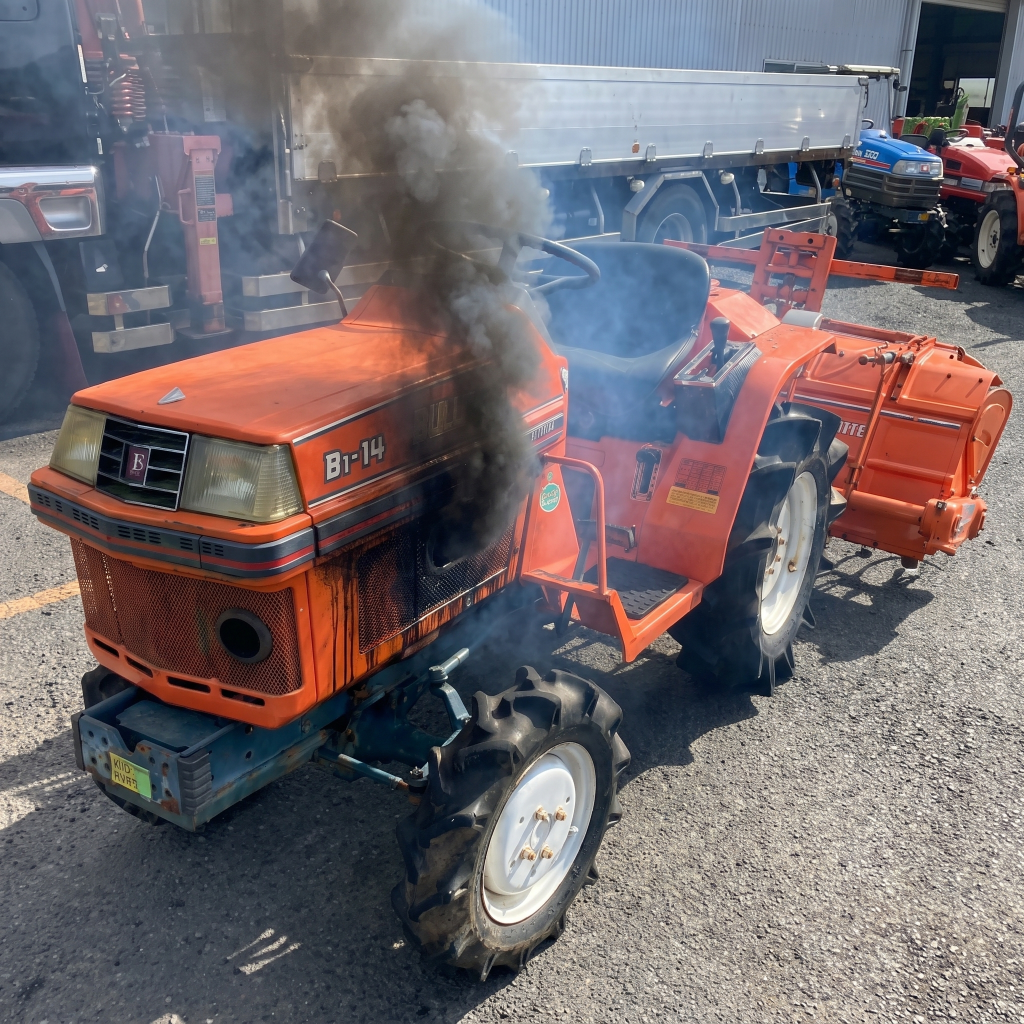
- Black smoke — incomplete combustion, usually a clogged air filter or overloading. Clean or replace the air filter and shift into a lower gear.
- White smoke — unburned diesel from a cold or poorly preheated engine, or worn injectors. Check the preheat first, then the injectors.
- Blue smoke — oil burning, a sign of engine wear. Keep an eye on the oil level and plan an overhaul in due course with the engine overhaul kit D850 (B1-14/15) or the engine overhaul kit D950 (B1-16/17).
Kubota B1-14 through B1-17: front axle and steering (4WD)
On the D and DB versions (4WD), play can develop over the years in the front axle and the ball joints of the drive shaft — a known wear point that causes some wobbling and clicking. Check the joints and tie rod ends for play and replace worn parts; this restores steering responsiveness.
Kubota B1-14 through B1-17: watch out for naming confusion
Many B1 tractors are grey imports or Zen-noh rebadges. A model plate doesn't always tell the whole story. Therefore, order engine parts based on the actual engine type: the B1-14 and B1-15 have the D850, the B1-16 and B1-17 have the D950. If in doubt, check the bore or the casting number on the block. Use part numbers found online for reference only — verify them against your serial and engine number before ordering.