




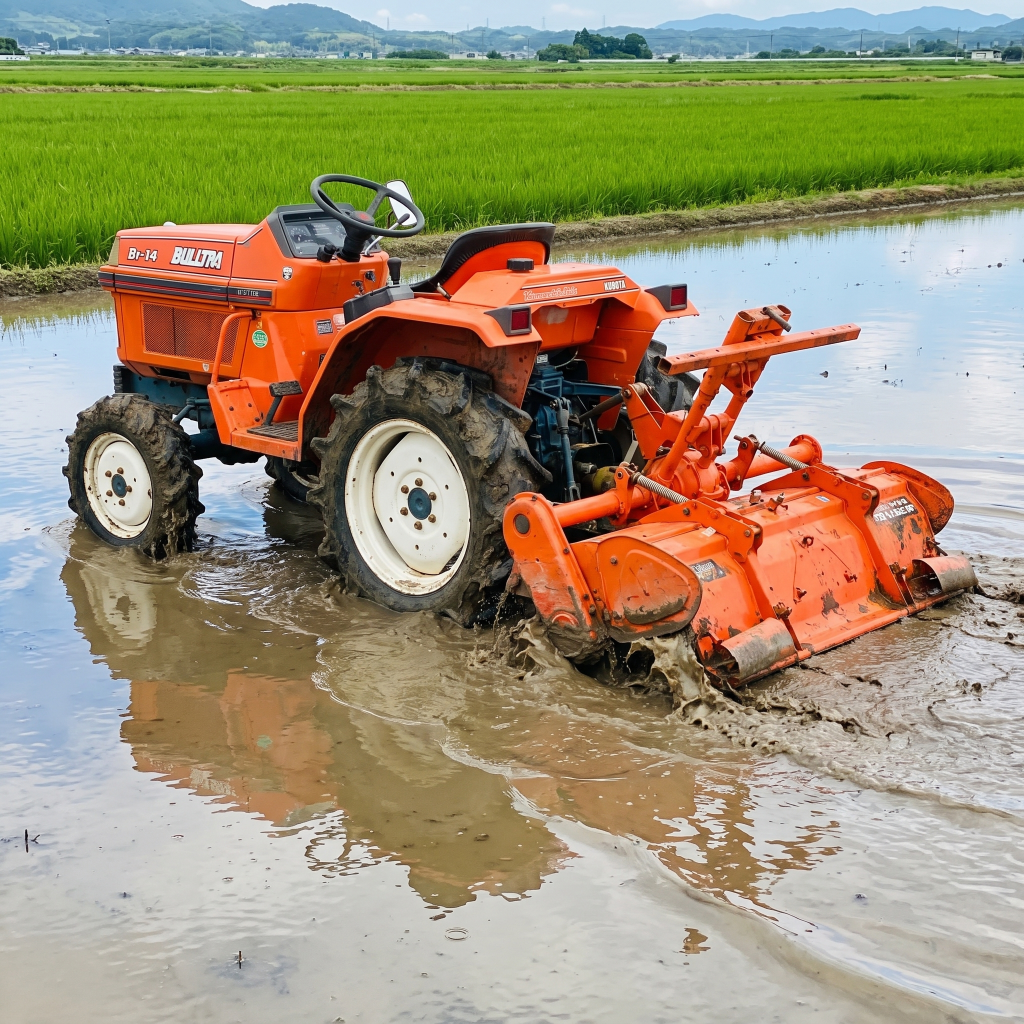
Kubota B1-14 to B1-17: hydraulics, PTO and implements
The hydraulics and PTO of the Kubota B1-14, B1-15, B1-16 and B1-17 are what make these mini tractors so versatile. With the three-point hitch, the PTO and the included rotary tiller, you can handle most garden and yard work. Below you'll find out how the system works and what you can realistically do with 14 to 17 hp.
Suitable for the whole series: B1-14, B1-15, B1-16 and B1-17, including the Zen-noh rebadges ZB1-14 through ZB1-17.
Kubota B1-14 to B1-17: the three-point hitch
The hitch is fed from the same oil bath as the transmission (12 liters). The standard version has a simple lift control; the M and MA versions feature the Monro-Matic system, which lets you control not just height but also position and (on the MA) draft control. With draft control, the tractor keeps the tilling depth constant as the soil gets heavier or lighter — handy on uneven ground. If your hitch lifts slowly or weakly, it's almost always due to low or contaminated transmission/hydraulic oil, or a clogged hydraulic filter.
Kubota B1-14 to B1-17: the PTO
The rear PTO is switchable and runs at 540, 860 or 1000 rpm depending on the setting (indicative). The 540 setting is used for most standard implements; the higher speeds are useful for tillers that need to spin faster. Always disengage the PTO before attaching or detaching an implement, and put the lever in neutral when starting the engine.
Kubota B1-14 to B1-17: what can you do with 14 to 17 hp?
Honest expectation management helps. With this class of engine, you have enough power for:
- Rotary tilling — the standard rotary tiller (side-drive or center-drive) is the implement this tractor was built for. On loose or previously worked soil it tills nicely; in heavy, unbroken clay you'll need to drive slower and work shallower.
- Flail mowing and grass — a light flail mower or sickle bar suits this power range well.
- Plowing and hilling — a single-bottom plow or hilling plow is achievable, especially with the 4WD version for extra grip.
- Transport — a small tipping trailer or transport box around the yard is no problem.
Do keep in mind the difference between engine power and PTO power: less remains at the PTO shaft than the 14 to 17 hp at the crankshaft. For heavy, continuous tilling work, the D950 in the B1-16 and B1-17 offers a bit more margin than the D850 in the B1-14 and B1-15.
Kubota B1-14 to B1-17: tilling pitch (side-drive and center-drive)
The tilling pitch — the distance between two blade strikes — determines how fine your soil ends up. It depends on your driving speed and the rotor speed. The manual gives these values for the B1-14 and B1-15 (in cm):
| Driving speed | Rotor setting 1 | Rotor setting 2 | Rotor setting 3 |
|---|---|---|---|
| 1st gear | 9.9–10.9 | 5.8–6.2 | 3.8–4.1 |
| 2nd gear | 16.9–19.3 | 9.9–10.9 | 6.6–7.2 |
| 3rd gear | 25.6–29.1 | 15.0–16.5 | 10.0–11.0 |
If you want fine soil, drive slower and choose a higher rotor speed (smaller pitch). For coarse breaking up, do the opposite. The values for the B1-15 are slightly higher than for the B1-14, because the B1-15 drives a touch faster.