



Iseki TK maintenance schedule & adjustment values: TK21–TK33, TK532 & TK538
The Iseki TK maintenance schedule on one page: below you'll find all maintenance intervals and adjustment values for the TK series, taken directly from the original Iseki manuals. With this schedule you'll keep your TK21 through TK538 in top condition and prevent most breakdowns before they occur.
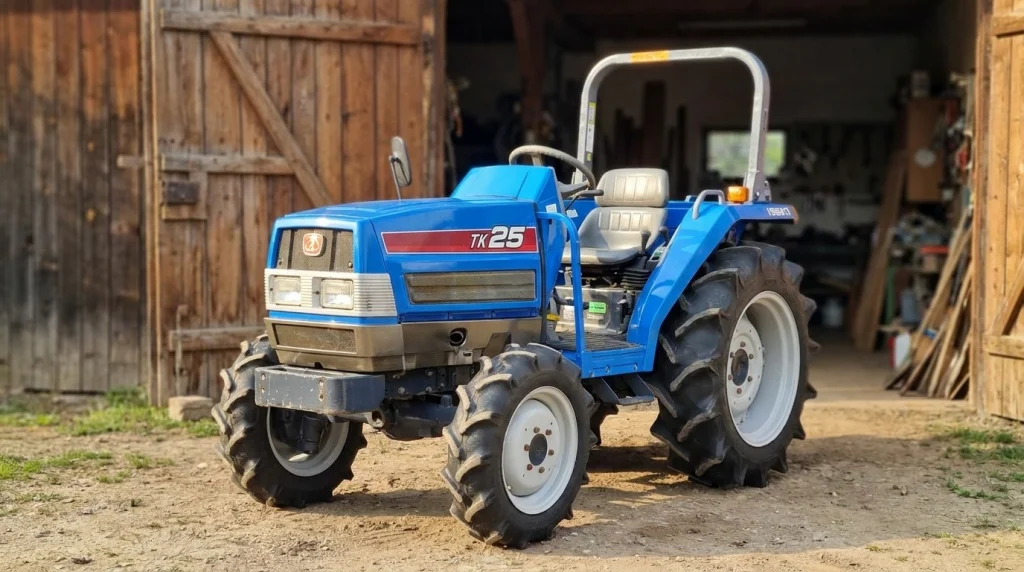
Suitable for the entire series: Iseki TK21, TK25, TK29, TK33 (Japanese) and Iseki TK527, TK532, TK538 (European).
Safety first: before every service, place the tractor on level ground, switch off the engine, engage the handbrake, lock the hydraulics (lowering speed knob closed) and let the engine cool down first. Always support an attached implement before working underneath it.
Iseki TK maintenance schedule: the intervals
The Japanese and European manuals use slightly different intervals. We show both; when in doubt, use the shorter interval — especially with heavy, dusty or wet work, Iseki also recommends shorter intervals.
| Component | Action | Japanese series | European series |
|---|---|---|---|
| Engine oil | Check level | Daily | Daily |
| Engine oil | Change | First 50 hrs, then every 100 hrs | First 50 hrs, then every 150 hrs |
| Engine oil filter | Replace | First 50 hrs, then every 300 hrs | Along with the oil (150 hrs) |
| Air filter | Clean / replace | Clean every 100 hrs; replace after 5x cleaning or 600 hrs | Inspect/clean every 50 hrs |
| Fuel filter | Clean / element | Clean every 100 hrs; element every 300 hrs | Sight glass daily; element every 300 hrs + bleed |
| Coolant | Check level / replace | Daily / once a year | Daily / once a year (drain, flush, refill) |
| Radiator & screen | Remove debris | Daily | Daily |
| Fan belt | Check tension | Daily | Daily |
| Transmission oil | Check level / change | Daily / first 50 hrs, then every 300 hrs | Daily / first 50 hrs, then every 200 hrs (incl. filter and screen) |
| Hydraulic filter | Replace | First 50 hrs, then every 300 hrs | First 50 hrs, then every 200 hrs |
| Front axle oil (4WD) | Change | First 50 hrs; check every 100 hrs; change every 600 hrs | Check level daily; change every 200 hrs |
| Power steering oil | Change (+ filter) | First 50 hrs, then every 300 hrs | First 50 hrs, then every 300 hrs |
| Grease nipples | Grease | Every 50 hrs (daily in wet soil) | Every 50 hrs |
| Battery | Fluid level / terminals | Every 100 hrs | Every 50 hrs |
| Clutch and brake pedal | Check free play | Daily | Daily |
| Tire pressure & wheel bolts | Check | Daily; adjust pressure every 300 hrs | Daily |
| Steering play & toe-in | Check / adjust | Every 300 hrs | Every 300 hrs (alignment) |
| Front axle play (longitudinal) | Check / adjust | — | Every 200 hrs |
| Clutch housing | Remove drain plug, check for leaks | Once a year | Once a year |
| Electrical wiring & hoses | Inspect | Hoses every 100 hrs; wiring once a year | Daily visual check |
Which oil and how many liters are needed per point can be found in Iseki TK engine oil & fluids. The correct filters per model are listed in Iseki TK filters & filter set.
Iseki TK adjustment values: clutch, brake, steering and belt
These are the factory values used to adjust the controls. All adjustments are done with locknuts and turnbuckles and can be performed with standard tools.
| Adjustment point | Value | Note |
|---|---|---|
| Clutch pedal free play | 20–30 mm | Incorrectly adjusted: slipping or poor disengagement |
| Brake pedal free play | 30–40 mm | Equal on left and right, otherwise the tractor pulls to one side when braking |
| Fan belt deflection | 10–12 mm | With finger pressure in the middle of the belt; too loose = overheating and poor charging |
| Steering wheel play | 30–60 mm | Measured at the outer edge of the steering wheel |
| Front wheel toe-in | 2–6 mm | Rear measurement minus front measurement; adjust via the tie rod |
| Front axle longitudinal play | 0.1–0.3 mm | Adjust if the front axle suspension rattles |
| Valve clearance (cold) | 0.35 mm | Intake and exhaust; job for advanced users |
Iseki TK greasing: don't skip these nipples
The manual lists the following grease points (every 50 hours, universal lithium grease): the central front axle pivot, the clutch shaft, the brake arms, the steering tie rod balls and tie rod ends, and the right lift rod turnbuckle. If you work a lot in wet or muddy conditions, grease daily — moisture pushes the grease out of the pivot points.
Iseki TK annual checks
Once a year, for example when winterizing: replace the coolant (with antifreeze/LLC), briefly remove the drain plug at the bottom of the clutch housing to check for oil or moisture leakage past the crankshaft or input shaft seal, inspect the electrical wiring for chafing, and test the battery. This way you'll catch a developing leak before the clutch gets flooded.
Product tip: everything for the major service
- Filter set Iseki TK21 – TK33 | TK527 – TK538 (SKU-10081) — oil, air and fuel filter complete in one go.
- Glow plug Iseki TK / E3CD (SKU-55001) — if in doubt, replace all three at once.
- Radiator cap (SKU-3240) — a weakened spring in the cap causes gradual coolant loss.
- Water pump Iseki TK (SKU-320) — replace immediately if leaking from the weep hole.