



Buying an Iseki TK21–TK33 & TK527–TK538: complete buying advice
Thinking about buying an Iseki TK? Then you'll quickly run into two branches of the same family: the Japanese Iseki TK21, TK25, TK29 and TK33, and the European Iseki TK527, TK532 and TK538. In this buying advice, we explain exactly how the series is structured, what the differences are between the Japanese and European versions, what to look out for when buying, and how parts availability works. This blog is the start of a complete knowledge base about the TK series, based on the original Iseki manuals of both branches.
Suitable for the entire series: Iseki TK21, TK25, TK29, TK33 (Japanese) and Iseki TK527, TK532, TK538 (European). We separately mention the larger 4-cylinder sister model TK546 where relevant.
Iseki TK series in short
The Iseki TK series is a family of compact tractors from the 1990s with power outputs ranging from 21 to 38 hp. All models share the same base technology: a water-cooled 3-cylinder Iseki diesel engine from the E3 family, a transmission with 16 forward and 16 reverse gears (4 main gears × 4 ranges), four-wheel drive, power steering, wet disc brakes, and a category 1 three-point linkage with position control. The PTO is a 35 mm hex-spline shaft on all models, with multiple speeds. These are solid, easy-to-maintain tractors that are popular for yard work, horticulture, riding stables, and hobby farming.
Iseki TK: Japanese or European? How the series is structured
This is the point that causes a lot of confusion, so let's lay it out completely. Iseki built the TK series in two versions:
- The Japanese series: TK21, TK25, TK29 and TK33. These models (type codes TK21F, TK25F, TK29F and TK33F) were supplied to the Japanese home market and almost always enter Europe as used imports. The official manual covers exactly these four models. In-between models such as a "TK23", "TK27" or "TK31" do not exist.
- The European series: TK527, TK532 and TK538. These models (TK527F, TK532F and TK538F) were officially built by Iseki for the European and overseas market and sold here through the dealer network. The TK532 and TK538 were only supplied outside Japan, which explains why you encounter them in Europe far more often than the Japanese numbers.
Technology and engines run almost one-to-one parallel between both branches:
| Japanese model | European counterpart | Engine | Displacement | Power |
|---|---|---|---|---|
| TK21 | — | E3CE | 1429 cc | 21 hp |
| TK25 | TK527 | E3CF | 1463 cc | 25 hp / 27 hp |
| TK29 / TK33 | TK532 | E3CD | 1498 cc | 29–33 hp / 32 hp |
| — | TK538 | E3CD-TB (turbo) | 1498 cc | 38 hp |
| — | TK546 (sister model) | E4CG (4-cylinder) | 2197 cc | 46 hp |
The main practical differences between the Japanese and European versions:
- Engine variants. The European TK538 is the only model with a turbo on the well-known E3CD block. Among other things, this means different injectors and a larger clutch (240 mm instead of 225 mm). The TK546 falls outside the core series: it has a genuinely different, 2.2-litre 4-cylinder engine.
- Type approval and equipment. European models were supplied with European lighting, a ROPS bar, and instructions in English; Japanese imports often still have Japanese stickers and sometimes narrower (paddy-field) tyre sizes. Japanese models also have factory variants with a cab, narrow track (T), and larger or flat tyres (06/04/09 versions).
- Transmission options. In Europe, the TK532/TK538 was also supplied with power shuttle (electro-hydraulic reverser), and the TK538FH even with hydrostatic transmission (HST, 3 ranges). The Japanese series has the mechanical shuttle.
- Lift options. On the European series, top-link-sensed draft control was available as an accessory; the base, in both branches, is the same position control.
- Maintenance instructions. Notably, the Japanese manual specifies an engine oil change every 100 hours, while the European manual states every 150 hours. We recommend following the stricter schedule; all intervals can be found in the Iseki TK maintenance schedule.
- Parts. Good news: because the engines and drivetrain are shared, many parts fit both branches. For example, one filter set covers the entire series (see further below).
By the way, did you know that a lot of the technology in this class also runs around under Massey Ferguson colours? Iseki built compact tractors for Massey Ferguson during the same period, using the same E3 engines. You can read which models are equivalent in Iseki & Massey Ferguson models – which models are equivalent to each other?
Iseki TK by model: which one suits you?
| Model | Power | Weight | Length | Turning circle | Typical use |
|---|---|---|---|---|---|
| TK21 | 21 hp | 1135 kg | 2880 mm | 1.9 m | Light tillage, mowing, yard work |
| TK25 | 25 hp | 1190 kg | 2990 mm | 2.1 m | All-round, tiller up to ±1.3 m |
| TK527 | 27 hp | 1125 kg | 2935 mm | 2.1 m | All-round, European version |
| TK29 | 29 hp | 1270 kg | 2990 mm | 2.2 m | Heavier tiller work, transport |
| TK532 | 32 hp | 1170 kg | 3050 mm | 2.1 m | All-round with more reserve power |
| TK33 | 33 hp | 1285 kg | 3070 mm | 2.2 m | Top model of the Japanese series |
| TK538 | 38 hp | 1180–1215 kg | 3070 mm | 2.1 m | Turbo top model, also available as HST |
All figures and the full tables per model can be found in Iseki TK specifications.
Iseki TK538: why this model is so popular
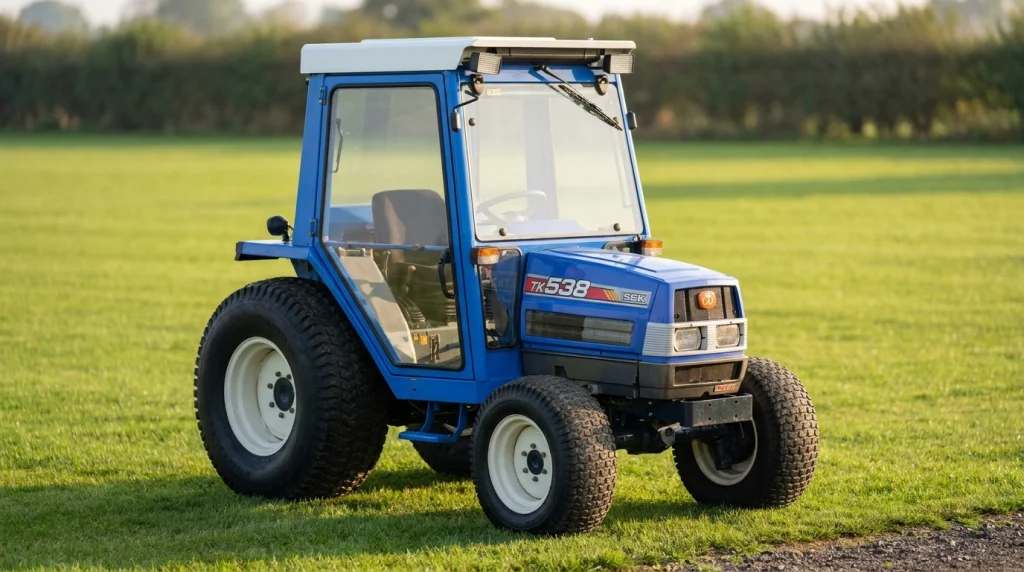
The TK538 is by far the most popular of the series in Europe. That makes sense: it's the most powerful 3-cylinder (38 hp from the turbocharged E3CD-TB), it was officially supplied here (so with European documentation and lighting), and it was available as a mechanical shuttle, power shuttle, and even hydrostatic (TK538FH). When buying, do note that the turbo version has its own parts: the injectors differ from the naturally aspirated E3CD, and the clutch is one size larger at 240 mm. A gasket or piston set "for E3CD" is therefore not automatically a correct fit for the turbo — order using engine code E3CD-T and check the serial number.
Iseki TK546: the odd one out
The TK546 belongs to the European TK family by name, but is technically different: a 2.2-litre 4-cylinder E4CG engine producing 46 hp, a 260 mm clutch, a larger fuel tank (48 litres), and considerably more weight. Parts from the 3-cylinder models generally do not fit. We therefore don't include the TK546 fully in this series, but mention it where useful.
Buying an Iseki TK: what to look out for
- Cold start and glow plugs. Have the engine started cold. Long pre-glow times, a lot of white smoke, or firing on only two cylinders indicate worn glow plugs or a weak pre-glow system — not a disaster, but negotiating room.
- Hydraulics and lift. Let the lift lower and raise with a load at an engine speed of 1000–1500 rpm. A lift that raises slowly or not at all often has a contaminated suction filter or a leaking suction line; in practice this is the most common "fault" — and usually easy to fix.
- Clutch. Check the pedal free play (20–30 mm) and test for slipping under load. Clutch parts are available, but pay attention to the size differences per model (225/240 mm).
- Cooling. Look for signs of leakage at the water pump and check that the fan belt is properly tensioned (10–12 mm deflection). Overheating due to a worn water pump is a regularly reported issue with this engine family.
- Front axle. Oil leakage at the steering knuckles of the driven front axle indicates worn seals — a known wear point on this generation of Iseki tractors. Parts are available, but it is labour-intensive work.
- Electrical. Check that the charge and oil pressure warning lights come on with the ignition and go out after starting, and that the starter motor engages immediately and forcefully. Slow starter motors are often caused by transition resistance in earth cables and the ignition switch.
- Tyres and track. Japanese imports sometimes have (worn) paddy-field tyres or different sizes. Check the size and pressure using the table in our specifications blog.
- Documentation and identification plate. Note the full type number and serial number from the identification plate (for example TK25F-06 or TK538F). Version variants determine which parts fit.
Iseki TK parts: excellent availability
Wear and maintenance parts are readily available for the entire TK series. A selection from our range:
Product tip: what you should have on the shelf as a TK owner
- Filter set Iseki TK21 – TK33 | TK527 – TK538 (SKU-10081) — oil, air, and fuel filter for the complete series in one set.
- Water pump Iseki TK (SKU-320) — the go-to preventive replacement for cooling issues.
- Glow plug Iseki TK / E3CD (SKU-55001) — for a smooth cold start.
- Front axle seal, vertical, TK21 – TK538 (SKU-96065) — a known wear point of the driven front axle.
- Clutch plate Iseki TA | TK (SKU-3018418-2) — for TK21/TK25; see the clutch section in the troubleshooting blog for the correct size per model.