



Iseki TK engine oil & fluids: all fill quantities per model
Which engine oil should you use for your Iseki TK, and exactly how many litres go into the engine, the transmission, the front axle, and the power steering? Below are all fill quantities and oil types for the Iseki TK series, taken directly from the original manuals — including the important difference between the oil recommendations for the Japanese and European versions.
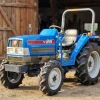
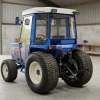
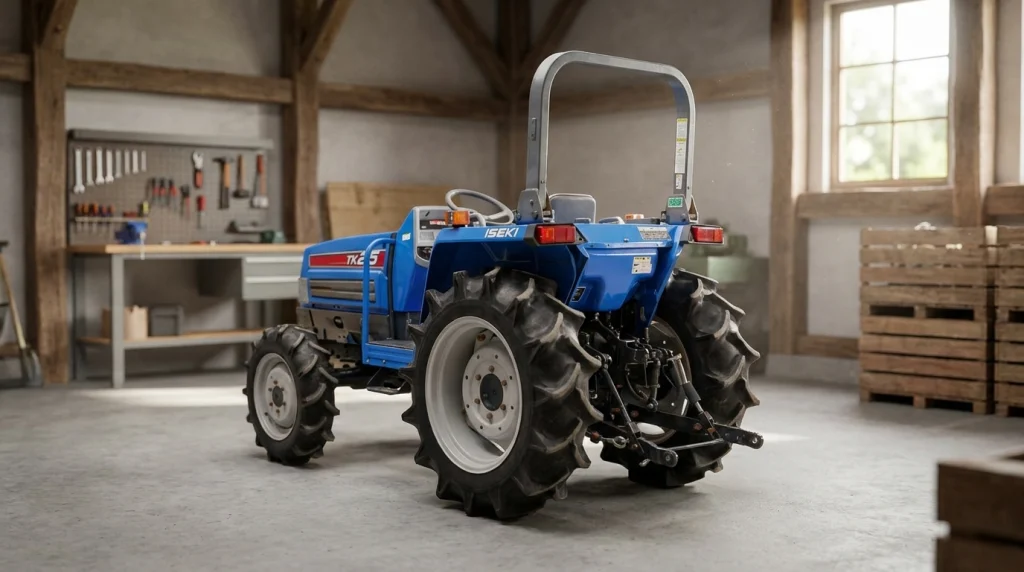
Suitable for the entire series: Iseki TK21, TK25, TK29, TK33 (Japanese) and Iseki TK527, TK532, TK538 (European).
Iseki TK fill quantities per model
| Fill point | TK21 | TK25 / TK527 | TK29 / TK532* | TK33 / TK538* |
|---|---|---|---|---|
| Engine oil (incl. filter) | 5.0 L | 5.0 L (EU: 4.7 L) | 5.0 L (EU: 4.7 L) | 5.0 L (EU: 4.7 L) |
| Transmission/hydraulics | 21.0 L | 23.0 L | 23.0 L (TK532: 25.0 L) | 25.0 L (TK538FH: 31.0 L) |
| Front axle (4WD) | 4.0 L | 4.0 L | 4.0 L | 4.0 L |
| Power steering | 1.1 L | 1.1 L | 1.1 L | 1.1 L |
| Cooling system | 6.2 L | 6.2 L (EU: 6.5 L) | 6.5 L | 6.5 L |
| Fuel tank (diesel) | 21 L | 30 L | 30 L | 30 L |
* The Japanese and European manuals give virtually identical values; where they differ, the EU value is listed alongside. The small difference in engine oil (5.0 versus 4.7 litres) is due to the measuring method — always fill to the top mark on the dipstick, not "to the litre".
Iseki TK engine oil: which specification?
For the naturally aspirated engines (E3CE, E3CF, E3CD), the manual specifies a diesel engine oil of at least API CC quality; by today's standards, a modern 15W-40 diesel oil (API CD or higher) is simply used, which comfortably exceeds that requirement. Choose the viscosity based on the season: 15W-40 works fine year-round in the Dutch climate, while 10W-30 is a good alternative during severe frost. For the TK538 with turbo, an additional requirement applies: the European manual explicitly specifies turbo diesel-quality oil for turbocharged engines (for example, 15W-40 API CD/CE or higher). Turbo oil can also be used in naturally aspirated engines — but not the other way around.
Change the engine oil while warm: it then flows easily and carries the dirt out with it. For intervals, see the Iseki TK maintenance schedule.
Iseki TK transmission and hydraulic oil: one system, take note!
On the TK series, the hydraulics (lift, steering pump drive) share the oil bath with the transmission and differential. So the oil lubricates the gears as well as operating the lift. This is where the two manuals notably differ:
- Japanese manual: Iseki hypoid gear oil #80 or Iseki multi-deluxe oil #80 (a JIS #80 transmission oil, comparable to SAE 80W GL-4).
- European manual: a universal tractor transmission oil (UTTO), such as the well-known tractor hydraulic oils from major oil brands; cold climate 10W-30 type, moderate/warm climate the thicker variants.
Both specifications are correct for their own market; in practice, a modern UTTO (e.g., 10W-30 GL-4 with wet-brake additives) is the sensible choice for both branches, as it serves the gears as well as the hydraulics and wet brakes. Do not mix oil types: if you switch to UTTO, do a full change including the hydraulic filter and suction strainer. Incidentally, cold, thick oil is the reason the manual specifies warming up first: the hydraulic pump draws thick oil poorly and may start whining or suffer damage.
Iseki TK front axle oil
The driven front axle has its own oil bath of 4.0 litres. The Japanese manual specifies the same #80 gear oil as the transmission; the European manual specifies the same UTTO. Check the level via the mark on the axle and change according to schedule — front axle oil is often forgotten, and milky (watery) oil is an early warning sign of seal wear.
Iseki TK power steering oil
The power steering reservoir (1.1 litres) requires a thin hydraulic/ATF oil: the Japanese manual specifies an ISO VG32 hydraulic oil, while the European manual specifies ATF (Dexron type) or a 10W engine oil. A standard ATF Dexron II/III is a good choice. The system has its own small filter to replace at the 300-hour service.
Iseki TK coolant
Fill the cooling system (6.2–6.5 litres) with a mixture of water and long-life antifreeze (LLC/G11 type), and replace annually. Water alone invites rust in the block and a frozen-and-cracked engine in winter. Check the level daily at the expansion tank and keep the radiator and front screen free of chaff and debris. More winter tips in Iseki TK winterising & storage.
Iseki TK fuel
Ordinary (white or red, where permitted) diesel oil EN590. The manual recommends a winter diesel grade for extreme cold — in the Netherlands, the pump handles this automatically during the heating season. Preferably fill up fully after work to limit condensation in the tank, and let the fuel filter's sediment bowl do its job.
Iseki TK grease
For all grease nipples (front axle pivot, coupling shaft, brake arms, steering ball joints, lift rod turnbuckle), universal lithium grease (EP2) is sufficient. Apply a few pumps with the grease gun every 50 hours, and more often for wet work.
Product tip: changing oil = replacing filters
- Filter set Iseki TK21 – TK33 | TK527 – TK538 (SKU-10081) — oil, air, and fuel filter for the entire series.
- Engine oil filter Iseki (SKU-002/6) — available separately if you're only changing the oil.
- Radiator cap (SKU-3240) — replace when aged; a leaking cap causes the system to boil.