



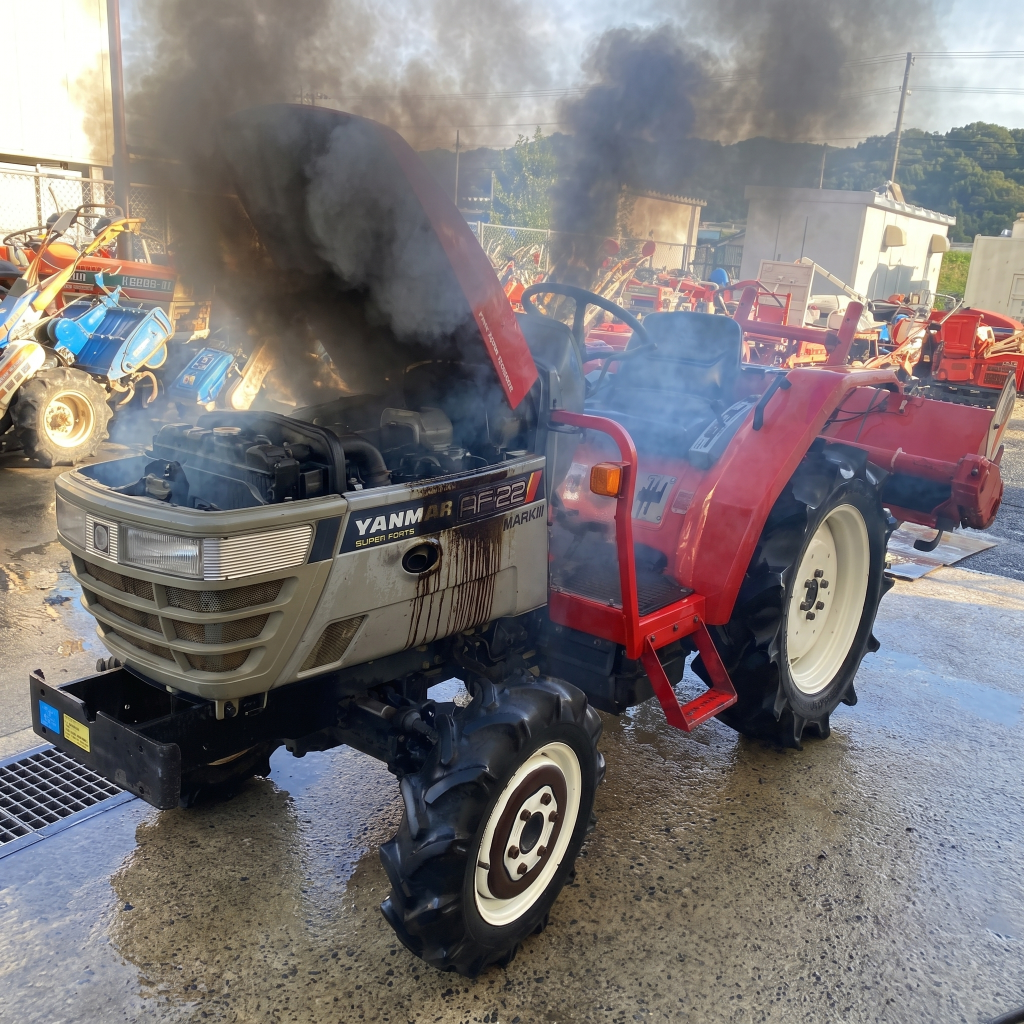
Yanmar Super Forte AF-22 to AF-33 won’t start or losing power? Troubleshooting
Yanmar Super Forte AF-22 to AF-33 won't start or losing power? Troubleshooting
Is your Yanmar Super Forte AF-22 to AF-33 not starting, losing power, or running hot? Most faults with this tractor are easy to fix yourself. Below you'll find the likely causes per symptom — based on the fault tables from the Yanmar manual, supplemented with known practical experiences from owners.
Suitable for the entire series: Yanmar Super Forte MARK III AF-22, AF-24, AF-26, AF-28, AF-30 and AF-33.
The starter motor doesn't turn
If there's no movement when you try to start, it's rarely the engine itself. First check whether the clutch pedal is fully depressed — that's a starting requirement. Then check the battery (sufficiently charged, clean and tight battery terminals) and check whether a fuse has blown. If it's still silent, the key switch or the starter motor itself may be faulty; that's a job for the workshop.
| Possible cause | Solution |
|---|---|
| Clutch not fully depressed | Press the pedal all the way down when starting |
| Battery flat or terminals loose/dirty | Charge or replace the battery, clean and tighten the terminals |
| Fuse blown | Replace the fuse with one of the correct rating |
| Key switch or starter motor faulty | Have it checked at the workshop |
The starter motor does turn, but the engine won't start
If the starter motor turns but the diesel won't start, the problem is almost always in the fuel supply. This is by far the most common complaint after a period of standstill.
| Possible cause | Solution |
|---|---|
| No or insufficient fuel | Refuel; check that the fuel tap is open ("0") |
| Air in the fuel system | Bleed the system |
| Old or clouded (winter) diesel | Drain the old fuel, refuel with fresh diesel |
| Clogged fuel filter | Replace the filter element |
| Thermo-start not waited out (cold weather) | Turn the key to ON, wait until the thermo-start light goes out |
The engine runs unevenly
If the engine stutters or runs roughly, check for water or air in the fuel, a clogged fuel filter, or an injector that isn't atomising properly. Drain any water from the fuel; then refuel with fresh diesel. If the problem persists, the injectors or injection timing need attention — that's workshop work.
The engine overheats
Overheating is a classic issue with older compact tractors and is almost always due to cooling or lubrication. Check these points:
| Possible cause | Solution |
|---|---|
| Insufficient coolant | Top up coolant; check for leaks |
| V-belt loose or worn | Tension the belt (10–15 mm deflection) or replace it |
| Radiator screen or fins clogged | Clean the radiator and screen |
| Insufficient engine oil | Top up oil to the correct level |
The engine lacks power
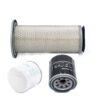
If the tractor doesn't pull well or drops back under load, first check the air filter (clogged = power loss and black smoke). Other causes include too low compression, an incorrectly adjusted valve clearance, deviating injection timing, or a poorly atomising injector. The last three should be checked at the workshop.
Four-wheel drive doesn't engage
A complaint that occurs more often specifically with these compact 4WD Yanmars: the four-wheel drive stops working, even though the lever does move. From practical experience and owner feedback, a few typical causes emerge, almost all located in the drive to the front axle:
| Possible cause | Explanation |
|---|---|
| Worn splines on the sliding coupling | The coupling between the transmission and the front axle differential can wear on the spline, causing it to lose grip |
| Sheared or broken pin | If the pin shears, the coupling spins loosely on the spline; the teeth on the pinion are harder than those in the coupling |
| Ball coupling at the front axle | Some couplings contain small balls that can pop out of place, preventing the drive from engaging |
How to locate the fault: place the tractor safely on axle stands, engage four-wheel drive, start the engine and put it in gear so the wheels turn. Feel under the tractor at the protected drive shaft to see if it's turning. If the shaft isn't turning, the problem is inside the tractor (coupling/spline/pin); if the shaft is turning but the front wheels aren't, the problem is in the front axle itself. Repair usually means replacing the coupling and pin and inspecting the splines.
A warning light comes on while driving
If the oil light comes on while working, stop immediately: check the oil level and top up; if the oil is too thin or too old, change it. If the charge lightcomes on, it's usually because the V-belt is loose or worn, or there's an issue with the alternator or regulator. If the coolant lightcomes on, check the coolant level in the sub-tank.
Note on grey imports: naming confusion
Many AF tractors are grey imports. Be aware that a nameplate sometimes doesn't fully match the actual model, and that part numbers found elsewhere may not always fit your specific unit. Therefore, always verify parts against your own engine and chassis number before ordering — especially for engine parts, where the difference between the 82 mm and 84 mm engine is decisive.