




Yanmar F210H & F250H Lift, PTO and Implements: What Can You Do with 21 hp?
Yanmar F210H/F250H lift, PTO and implements: what can you do with 21 hp?
The hydraulic lift and the power take-off make the Yanmar F210H and F250H true working tractors. In this guide we explain how the position control, the lowering speed valve and the PTO work — straight from the original manual (ON03-00616) — and what you can and can't realistically do with 21 hp.
Applies to the Yanmar Forte F210H and F250H; the lift system of the gear-shift versions works largely the same way.
Yanmar F210H/F250H lift system and position control
You operate the lift in two ways: with the position control lever (stepless, the lift follows the lever position — ideal for tilling at a fixed working depth) and with the lift switch, which raises the implement in one movement, for example at the headland. As soon as the lift is in the top position, the "implement raised" light on the dashboard comes on. If you set the switch to "lower," the implement descends to the position set with the position control lever — and no further. A handy detail from the manual: if the position control lever is in the highest position, the lift switch does not respond to "lower."
Yanmar F210H/F250H setting the lowering speed
Under the seat is the oil stop/lowering speed valve. Turning it counterclockwise = faster lowering, clockwise = slower; fully closed clockwise blocks the oil supply and the implement stays suspended. This lets you match the lowering speed to the implement: lower a heavy tiller gently, while a light weeder harrow can drop more quickly. Two warnings from the manual: do not close the valve when transporting on the road (instead, raise the position control lever and lock it with the stopper), and never operate the lift while the valve is fully closed — this can cause hydraulic damage.
Yanmar F210H/F250H power take-off (PTO)
The PTO is a 35 mm JIS shaft (dimensions comparable to 1 3/8") and rotates clockwise, with three forward speeds: 553, 727 and 1,210 rpm. Notable is the reversible PTO speed of 667 rpm — allowing a suitable tiller to rotate in reverse. Operate the PTO lever only with the clutch depressed and at low engine speed. When working with a tiller, use drive group 1 and control the travel speed with the HST while keeping the PTO at rated speed.
Yanmar F210H/F250H 3-point hitch and implements
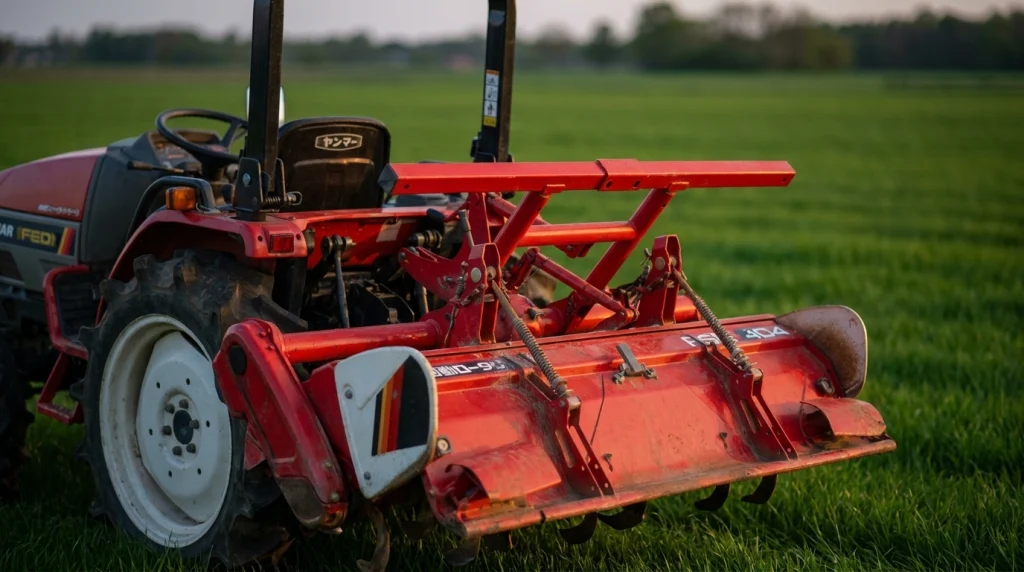
The three-point hitch is built to the Japanese JIS 0 standard, which in practice is comparable to Category 1 but with tighter dimensions — when using European implements, check the diameter of the mounting pins and the width between the lift arms. Yanmar supplied these models as standard with the RSK150M and RSK160M rotary tillers (working width 150–160 cm) and the RCK1304. Realistic combinations at 21 hp and around 900 kg unladen weight: a tiller up to roughly 150–160 cm, a flail mower or pasture topper of similar width, a rear-loading auger or tipping trailer on flat terrain, a snow blade or sweeper. For towed work, weight is the key factor: keep trailers modest and use the manual's warning as a guideline — low center of gravity, drive straight up and down slopes.
With heavier mounted implements, pay attention to front ballast: the manual prescribes front weights once the front axle load becomes too light to steer safely.
Parts tip: if you notice the lift becoming sluggish or "jerky," first replace the hydraulic filter for the F210/F250 (SKU-250002) and check the transmission oil level — the lift, HST and power steering share the same oil. More on this in our oil and fluids guide.