



Yanmar F210H & F250H Manual: Operation, Starting and Driving
Yanmar F210H/F250H manual: operation, starting and driving
The original manual for the Yanmar F210H and F250H is in Japanese — which makes operation a guessing game for many owners. In this guide, we translate the key chapters from that manual (ON03-00616) into English: the correct starting procedure, stopping, HST operation and the running-in period.
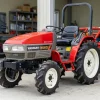
Applies to the Yanmar Forte F210H and F250H with hydrostatic transmission (HST).
Starting the Yanmar F210H/F250H: the correct procedure
This is what the manual prescribes:
- Set the fuel valve to "O" (open).
- Set the range lever and the PTO lever to neutral.
- Set the position control lever (lift) to its lowest position. Never start while the lift warning light on the dashboard is on — otherwise the lift may rise unexpectedly.
- Move the throttle lever to its highest position.
- Turn the key to the preheat position and wait until the glow plug indicator light goes out. With a warm engine it goes out almost immediately.
- Fully depress the clutch pedal — otherwise the safety switch will block the starter motor — and turn the key to "start".
- Release the key as soon as the engine is running.
- Let the engine warm up unloaded for about 5 minutes at approximately 1,500 rpm. Below 0 °C: at least 10 minutes.
Important: never engage the starter motor for more than 10 seconds at a time. If the engine doesn't start within that time, wait at least one minute before trying again. And never turn the ignition to the start position while the engine is already running.
Stopping the Yanmar F210H/F250H
Move the throttle lever to its lowest position (idle), let it idle down briefly, then turn the key to "off". Apply the parking brake — it works via the brake pedal with the locking lever. When warming up or standing still with the engine running, the parking brake should always be engaged.
Driving the Yanmar F210H/F250H with the HST
Use the range lever to select the correct range: 1 for milling and fine work (0–3.3 km/h), 2 for tillage (0–6.7 km/h), 3 for transport (0–14.2 km/h). Within the range, speed is infinitely variable. The manual warns: on public roads, always couple both brake pedals together using the coupling plate — separate pedals mean one-sided braking at high speed. Drive up steep slopes in reverse and down them forwards, keeping the implement low for a low centre of gravity. Enter and exit fields at right angles to the edge.
Yanmar F210H/F250H dashboard and warning lights
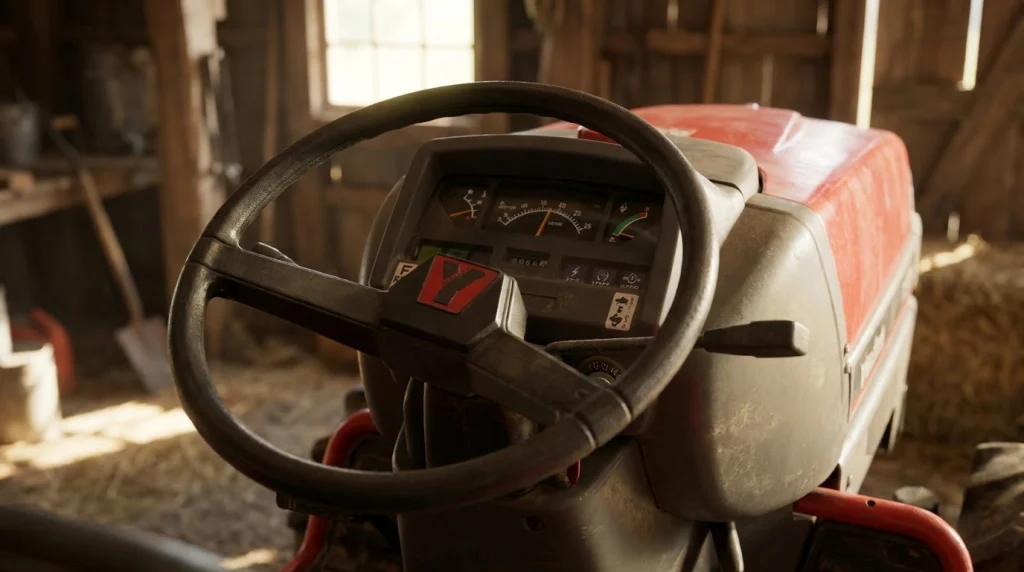
The dashboard has an hour meter, temperature gauge and fuel gauge (F250H), along with warning lights for oil pressure, charging current, glow plug, indicators, lift raised ("implement up"), brake pedal coupling and the reverse/headland automatic system. If the oil pressure light comes on during operation: stop immediately and check the oil level. If the charging current light stays on, check the V-belt first.
Yanmar F210H/F250H running-in period (first 50 hours)
According to Yanmar, the first 50 hours determine the lifespan of the machine. Avoid abrupt acceleration and braking, don't overload the engine unnecessarily, only work once the engine is up to temperature, and drive gently on rough terrain. After 50 hours comes the major running-in service: oil, filters and transmission oil — see our maintenance schedule for the F210H/F250H.
Parts tip: is the ignition switch worn out or the key lost? The ignition switch with preheat position for the F210/F250 (SKU-IGS8) comes with two keys and is ready to install immediately. If the battery no longer charges properly, take a look at the 12V/20A alternator (SKU-120006).