




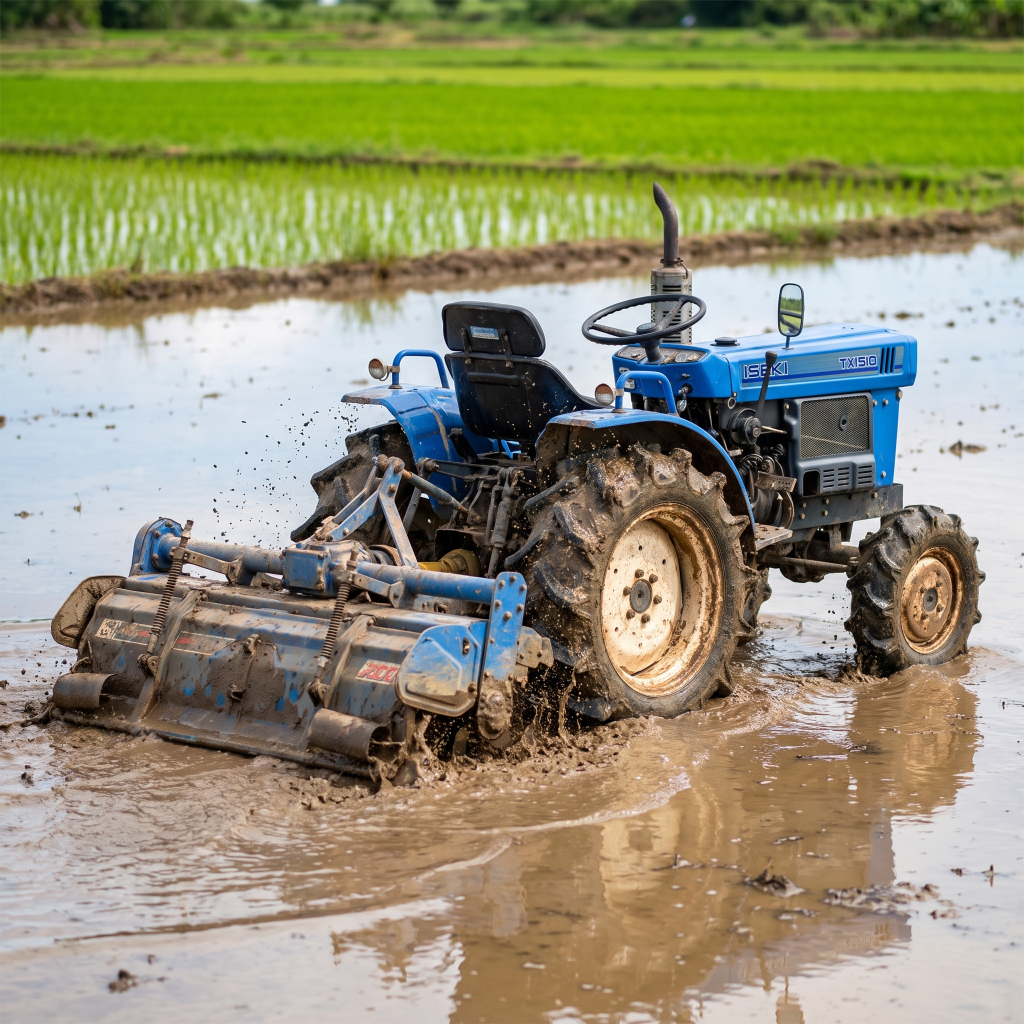
Iseki TX1410 & TX1510 hydraulics, PTO & implements
Iseki TX1410 & TX1510 hydraulics, PTO & implements
The hydraulics and PTO turn your Iseki TX1410 or TX1510 into a genuine workhorse. In this blog we explain how the three-point linkage, position control and lowering speed work, which PTO speeds are available, and what you can realistically drive with 14 to 15 hp worth of implements.
Suitable for the whole series: TX1410, TX1410F (4WD), TX1510 and TX1510F (4WD).
The three-point linkage and position control
The TX1410/TX1510 has a hydraulic three-point linkage in JIS category 0 with position control. Operation is intuitive: pull the lift lever back and the implement rises; push it forward and the implement lowers under its own weight. Within the range of the position control, the lever position directly determines the implement height — which then stays constant. This lets you, for example, keep a tiller at a fixed working depth.
The "raise" stop and lift arm play
If you hear a "beeping" sound when moving the lift lever all the way to the raised position, or if the play in the lift arm has disappeared completely, the "raise" stop needs to be adjusted. The correct lift arm play is 3–9 mm. This is a simple but important adjustment: too little play puts unnecessary strain on the system.
Setting the lowering speed
The lowering speed lever controls how quickly the implement drops. Turn the lever left and the implement lowers faster; turn it right and it lowers more slowly, and at the far end the hydraulics are locked — the implement then stays in place, even if you move the lift lever. The manual gives a guideline per job:
| Job | Lowering speed |
|---|---|
| Tilling (rotary) | Lower slowly — approx. 2 seconds |
| Ploughing | Lower quickly — 0.5 to 1 second |
| Driving away, changing blades, inspecting the implement | Lock |
Always lock the lift when driving away and when servicing the implement — this prevents the implement from unexpectedly dropping.
The PTO

The PTO has three speeds, the same for both models: 454, 724 and 1185 rpm. This lets you match the implement to the job — a lower speed for heavier, slower work, a higher speed for, for example, a mower or tiller that requires more revs. The tiller is attached via the 2-point system; towed implements via a fixed pin.
What can you drive with 14 to 15 hp?
Important to know: engine power (14 hp for the TX1410, 14.8 hp for the TX1510) is not the same as the power available at the PTO or as drawbar pull — some is lost in the drivetrain. So expect a light, agile tractor rather than a powerhouse. In practice, that's more than enough for:
- a light rotary tiller for a vegetable garden, nursery or small plot;
- a flail mower or rotary mower for grass and verge maintenance;
- a light plough on not-too-heavy soil;
- transport with a trailer or tipper;
- light loading and moving work with a front loader or pallet forks, within the lift capacity.
The four-wheel-drive TX1410F and TX1510F with differential lock have noticeably more grip and pulling power. On heavy, wet or sloping ground, you'll clearly get more out of the same horsepower with these than with the 2WD version.
These tractors have the Mitsubishi K3 engine. More about the engine: Mitsubishi K3A–K3F engine: specifications and torque values.