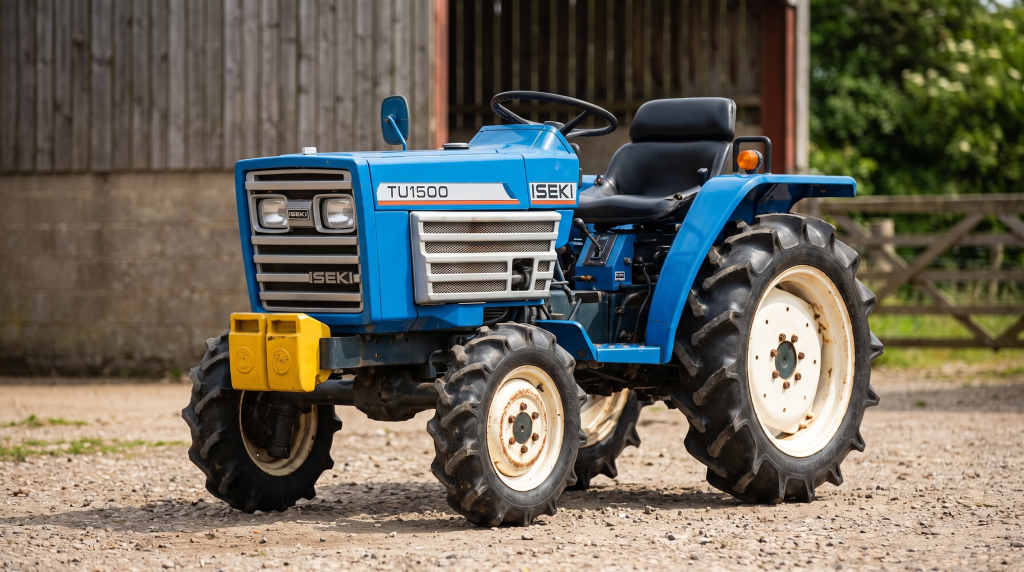
Iseki TU1400-TU1601: troubleshooting faults
The overview below combines the official fault table from the Iseki factory manual with commonly reported real-world experiences from owners of these and similar Mitsubishi K3 engines. It applies to the entire series: the engine, fuel system, and clutch/brake are identical between the 00 and 01 generations.
Suitable for the entire series: Iseki TU1400, TU1400F, TU1500, TU1500F, TU1600, TU1600F, TU1401, TU1401F, TU1501, TU1501F, TU1601, TU1601F.
Engine doesn't start or starts poorly
| Symptom |
Possible cause |
Solution |
| Engine turns over but doesn't start |
Fuel tap closed, or air in the fuel system |
Check the tap; bleed the system via the bleed screws until bubble-free diesel comes out |
| Difficult to start, especially when cold |
Contaminated fuel filter or water/dirt in the tank (often after long periods of inactivity) |
Replace the fuel filter, drain the tank, and refill with fresh diesel |
| Won't start, even with starting fluid |
Compression too low |
Have a compression test performed; possible worn cylinder/valves |
| Difficult cold starting, even with fresh diesel |
Worn or faulty glow plugs |
Test and replace glow plugs — often the first suspect in older Japanese tractors |
| Starts well warm, not cold |
Wear in the injection pump or lift pump |
Have the fuel system inspected by a specialist |
Engine stalls or runs irregularly
| Symptom |
Possible cause |
Solution |
| Stalls at idle |
Contaminated fuel filter, incorrectly adjusted idle speed |
Replace the filter, have the idle speed adjusted |
| Engine "hesitates" under load |
Air leak in the fuel line, blocked tank vent |
Check lines and connections for leaks |
Overheating
| Symptom |
Possible cause |
Solution |
| Temperature rises under load |
Coolant level too low, radiator clogged with grass/dust |
Top up the level, blow out/clean the radiator |
| Overheating despite a full cooling system |
V-belt slipping or loose/torn |
Check deflection (10-12 mm) and replace the belt if necessary |
| Moisture/drips at the water pump shaft |
Worn water pump shaft seal (weep hole leakage) |
Replace the water pump as soon as this occurs — the bearing is usually still fine at this point |
| Grinding/scraping noise at the water pump |
Worn water pump bearing |
Replace the water pump immediately to prevent consequential damage |
| Stays hot despite a new pump/belt |
Thermostat stays closed, poor circulation |
Have the thermostat tested/replaced |
Smoke from the exhaust
| Color |
Meaning |
| White |
Often harmless on cold start (condensation), but persistent white smoke indicates coolant being burned (head gasket or crack in the head) |
| Black |
Mixture too rich — contaminated air filter or incorrect injection |
| Blue |
Engine oil being burned — worn piston rings or valve guides |
Electrical
| Symptom |
Possible cause |
Solution |
| Charge light stays on while driving |
V-belt slipping/broken, alternator or voltage regulator faulty, battery aged |
Check the belt and connections; have the alternator/regulator tested |
| Oil pressure light stays on while driving |
Oil level too low, clogged filter, incorrect oil viscosity |
Check and top up the level immediately; have the oil pump inspected if the problem persists |
| Battery not charging / discharging quickly |
Loose wiring, faulty voltage regulator, slipping belt, aged battery |
Clean and tighten connections; test the regulator and battery |
| Headlight doesn't work |
Bulb burned out, fuse, corrosion in the socket |
Replace the bulb and fuse, clean the socket |
Clutch and brake
| Symptom |
Possible cause |
Solution |
| Clutch engages jerkily or slips |
Play incorrectly adjusted, worn pressure plate/discs |
Adjust pedal play to 20-30 mm; replace the pressure plate if slipping persists |
| Tractor pulls sideways when braking |
Unequal pedal play left/right, worn brake shoes |
Adjust both pedals to 30-40 mm play; check the brake shoes |
| Steering feels heavy or has a lot of play |
Too little grease in the ball-and-nut steering gear, wear |
Grease according to schedule; have the steering seal/gear inspected if play persists |
Sources for the real-world experiences are various international owner and maintenance forums focused on Iseki and Mitsubishi K3 engines; specific part numbers from those sources are for reference only and should always be verified against your own serial number, especially for grey-imported units.